
Choosing a custom sock manufacturer feels like it should be simple. You send a logo, pick a color, get socks back. But the gap between a manufacturer who delivers a good product on time and one who delivers a mediocre product late is enormous. And you usually don't find out which one you've picked until it's too late to switch.
The market for custom sock manufacturing ranges from Alibaba factories that require 500-pair minimums and offer zero design support, to full-service merchandise partners that handle everything from concept to doorstep delivery. The right choice depends on your volume, your internal capabilities, and how much of the process you want to manage yourself.
This guide breaks down what to evaluate, what questions to ask, and how to tell the difference between a manufacturer that will serve you well and one that will create problems you didn't anticipate.
- 10+ years Sunday has operated as a full-service merch partner
- 4.9/5 Google review rating across 227 reviews
- 4,000+ brands trust Sunday for custom sock manufacturing
Key distinction: A custom sock manufacturer makes socks. A merch partner designs, produces, stores, ships, and manages your socks as part of a broader merchandise program. Most companies looking for "custom sock manufacturers" actually need the latter. The manufacturing part is table stakes. The service around it is what determines your experience.
Supplier vs factory vs full-service partner
Three models dominate the custom sock manufacturing market. Each serves a different buyer profile.
Product supplier: Resells socks from existing factories. Low design flexibility, limited material options, fast turnaround on standard products. Works for simple logo-on-a-blank orders where you don't need anything custom about the sock itself. Typically offers the lowest prices but the least control over quality and customization.
Factory direct: You work directly with the knitting factory. Maximum customization potential but you manage everything: design files, material specs, QC standards, shipping logistics, customs. Works for experienced buyers who know exactly what they want and have the internal resources to manage production. Common model for retail brands with dedicated sourcing teams.
Full-service merchandise partner: Handles the entire chain from brief to delivered product. Design support, material selection, production management, quality control, warehousing, and global fulfillment. Higher per-unit cost than factory direct, but dramatically lower total cost when you factor in the time and expertise needed to manage the process yourself. This is where Sunday sits.
Production quality indicators
You can't assess a manufacturer's quality from their website. You need to look at specific indicators and, ideally, get a physical sample before committing to a production run.
Needle count: Sock knitting machines are measured in needle count (typically 96, 108, 132, 144, 168, or 200 needles). Higher needle count means finer knit, crisper logo detail, and smoother fabric. For branded socks with logos, 144+ needles is the minimum for good results. Anything below 108 will produce coarse, pixelated logos.
Yarn quality: Ask for the specific yarn composition and source. "Cotton blend" tells you nothing. "80% combed cotton (ring-spun), 15% polyamide, 5% elastane from certified mills" tells you everything. Reputable manufacturers will specify this without hesitation.
QC process: What does quality control look like? Every pair inspected, or random sampling? What's the acceptable defect rate? Good manufacturers run 100% visual inspection with a sub-2% defect tolerance. Ask to see their QC documentation.
Sample quality: The single most reliable quality indicator. Order a sample. Wear it for a day. Wash it twice. Check the logo clarity, shape retention, and color fastness. If the sample disappoints, the production run will too.
Design support and sample process
Design support ranges from "send us a production-ready file" to "send us your logo and we'll create the full design." If you have an in-house design team with sock experience, the first model works. If you're a marketing manager who needs a sock designed from a brand guideline PDF, you need a manufacturer with real design capability.
Ask these questions about the design process: How many revisions are included? What format are mockups provided in (2D flat, 3D rendered, or physical)? How long from brief to first mockup? Is there a dedicated designer or a shared pool? Can they advise on which designs will knit well and which won't work at the specified needle count?
Material choice and compliance
A good manufacturer offers a range of materials (cotton, organic cotton, bamboo, merino, recycled blends, performance synthetics) and can advise on which material suits your use case. A limited manufacturer offers "cotton" and "polyester" with no further specification.
Compliance matters, especially for companies with ESG commitments or European distribution. Look for OEKO-TEX Standard 100 (chemical safety), GOTS (organic textiles), GRS (recycled content), and BSCI or Sedex (ethical manufacturing). Ask for certificates, not claims. Any manufacturer can say "sustainable." Certificates prove it.
Lead times, MOQs and logistics
| Factor | Typical range | What to watch for |
|---|---|---|
| Minimum order quantity | 100-500 pairs | MOQs above 250 lock you into large commitments before testing |
| Production lead time | 2-6 weeks | Claims under 2 weeks usually mean pre-made blanks, not custom |
| Sample lead time | 5-14 days | Manufacturers who skip sampling are a red flag |
| Shipping options | Varies widely | Can they ship to multiple destinations from one order? |
| Warehousing | Offered by full-service partners | Important if you need ongoing fulfillment, not just one delivery |
| International delivery | 5-21 days depending on method | Ask about customs handling and duties management |
Comparison: manufacturer types
| Capability | Product supplier | Factory direct | Full-service partner (Sunday) |
|---|---|---|---|
| Design support | Basic logo placement | Varies (often minimal) | Full design from brief |
| Material range | 2-3 options | Wide (you specify) | Full range with guidance |
| Minimum order | 25-100 pairs | 200-500 pairs | 100 pairs |
| Quality control | Factory standard | You manage or specify | 100% inspection, guaranteed |
| Packaging options | Standard only | Custom (you source) | Custom options included |
| Warehousing | No | No | Yes, with on-demand dispatch |
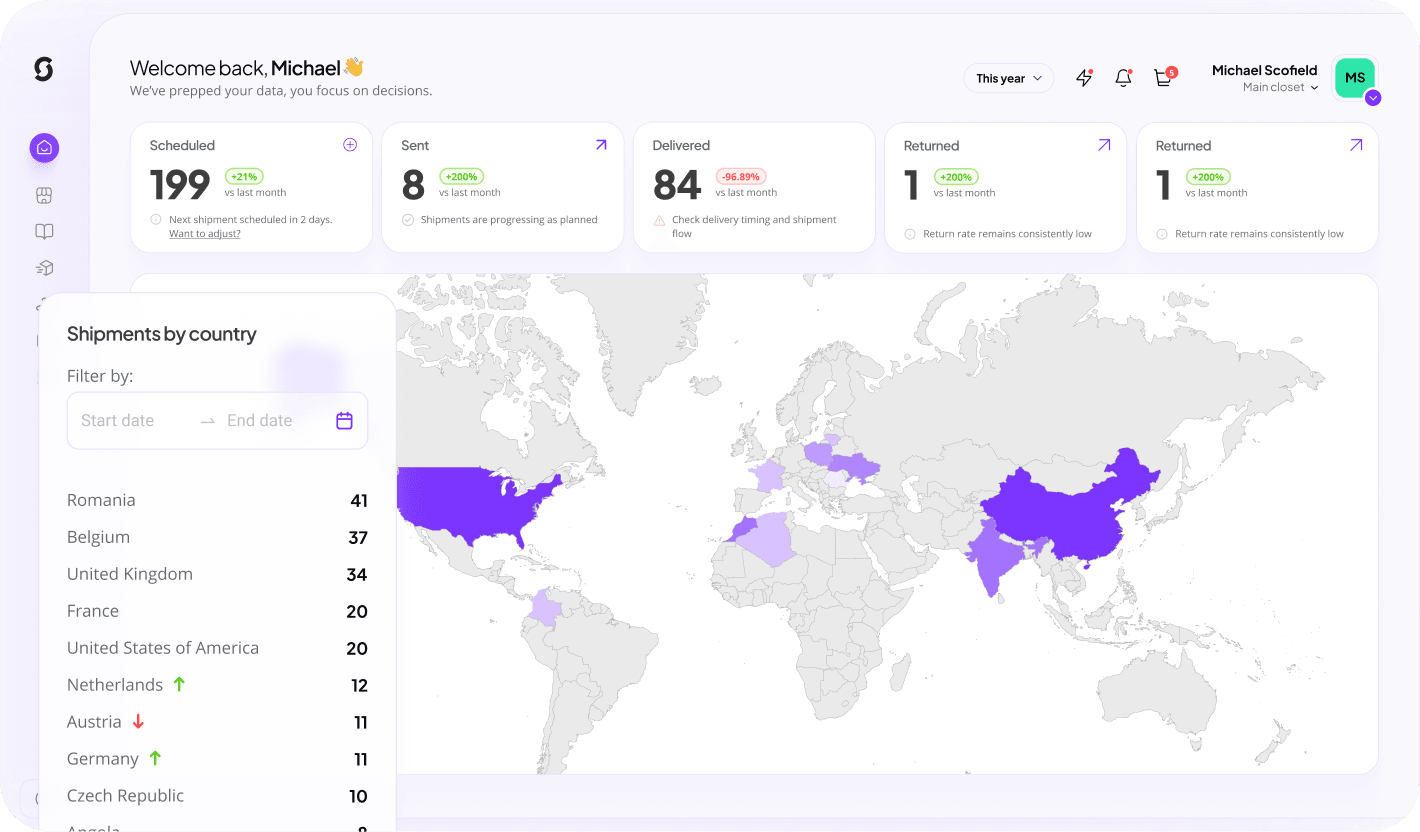
| Global shipping | Limited | You arrange | 200+ countries, split shipments |
| Reorder process | Manual resubmit | Manual resubmit | One-click from dashboard |
Questions to ask before ordering
- What is your minimum order quantity, and does it apply per design or per order?
- What needle count do your knitting machines use?
- Can you provide the exact yarn composition with source certifications?
- How many design revisions are included at no extra cost?
- Do you provide physical samples before production?
- What is your quality control process and acceptable defect rate?
- Can you ship to multiple addresses from a single production run?
- Do you offer warehousing and on-demand fulfillment?
- What compliance certifications do you hold (OEKO-TEX, GOTS, GRS)?
- What happens if the production run has quality issues?
- Can I reorder the same design without re-submitting specs?
- Do you handle customs and duties for international shipments?
Choosing the right partner for your needs
Match your situation to the right manufacturer model.
1. Assess your internal capacity
Do you have someone who can manage production specs, QC, logistics, and customs? If yes, factory direct might work. If not, a full-service partner saves you from building that capability internally.
2. Define your volume trajectory
One-time order for an event? A product supplier can handle it. Ongoing program with quarterly orders across multiple designs? You need a partner with warehousing and reorder infrastructure.
3. Test with a small order first
Never commit to a large production run with a new manufacturer without testing. Order 100 pairs, evaluate quality, turnaround, communication, and packaging. Then decide.
4. Evaluate the full cost, not just the unit price
A factory in China might quote €3/pair. But add shipping, customs, QC travel, design management time, and problem resolution, and the real cost is €6-8/pair plus weeks of your time. Full-service might quote €6/pair with everything included. The total cost is often lower.
Frequently asked questions
What's the difference between a sock manufacturer and a merch partner?
A manufacturer makes socks. A merch partner handles the entire process: design, production, quality control, warehousing, fulfillment, and campaign management. Most companies need the latter because manufacturing is just one step in a much larger process.
How do I know if a manufacturer's quality is good before ordering?
Request a physical sample. Wear it for a full day, wash it twice, and inspect the logo. Also ask for their needle count (144+ for good logo detail), yarn specifications, and QC documentation. If they can't provide these basics, look elsewhere.
What minimum order should I expect?
It ranges from 100 pairs (Sunday) to 500+ pairs (typical factory direct). If you're testing a design or running a small campaign, a low minimum matters. Don't commit to 500 pairs with an untested manufacturer.
How important are compliance certifications?
Very, if you're a brand with ESG commitments or distributing in the EU. OEKO-TEX certifies chemical safety. GOTS certifies organic. GRS certifies recycled content. Without certificates, sustainability claims are unverifiable marketing.
Should I work with a local or overseas manufacturer?
Depends on your priorities. Local manufacturers offer faster shipping and easier communication. Overseas factories (mainly China, Turkey, Portugal) offer lower production costs. Full-service partners like Sunday bridge this gap by managing overseas production with local-quality service.
What if my order arrives with quality issues?
Ask about the manufacturer's defect policy before ordering. Good manufacturers will replace defective pairs at no cost. At Sunday, we guarantee quality and replace any defective items. Get this commitment in writing before production starts.
Can I switch manufacturers mid-program?
Yes, but it's disruptive. Colors, materials, and knit quality will differ between manufacturers even with the same specs. If you're running an ongoing program, choose a partner you can stick with. The consistency matters.
Partner with Sunday for custom sock manufacturing
100-pair minimum. Free design support. Global delivery. 10+ years, 4,000+ brands, 4.9/5 reviews.