



Both Sunday and swag.com sell the same thing on the surface: a platform that handles branded merchandise for companies. But once you look at how each one is built, they're optimized for very different buyers. Picking the wrong one means months of friction, awkward shipping bills, and a procurement team that is going to remember you negatively.
This is the comparison we wish existed when our customers were evaluating us against swag.com. It's written by the founder of Sunday, so the bias is upfront. What it doesn't do is hide the dimensions where swag.com is the right answer. We'll call them out plainly. The goal is to help you pick correctly the first time.
Quick framing for what's coming: swag.com is a US-focused platform with a deep American catalog and free US warehousing. Sunday is a global merch infrastructure built for distributed teams in 200+ countries, with bulk production, free warehousing in our European hubs, accredited customs agent status, automated customs documentation, and 30-second activation. Both are good products. They're just not aimed at the same buyer.
If your team is mostly in the United States, you order in bulk, and you don't need full custom product development, swag.com works fine. If you have people in more than one country, want to launch in minutes instead of weeks, need real custom products (not just print-on-blank), or care about multi-team brand stores and self-serve redeem pages, Sunday is going to win on every dimension that matters to you.
What each platform actually is
Swag.com is a US-based merch e-commerce site headquartered in Tysons, Virginia. It started as a curated promotional product catalog and added a free swag-management layer with US-based fulfillment. It's an American company built for American buyers, and it does that one job well. The catalog is broad, the US shipping is fast, and the platform fee is zero. You pay only for products, fulfillment, and shipping per swag.com's published rate examples (a small US shipment typically lands under $10).
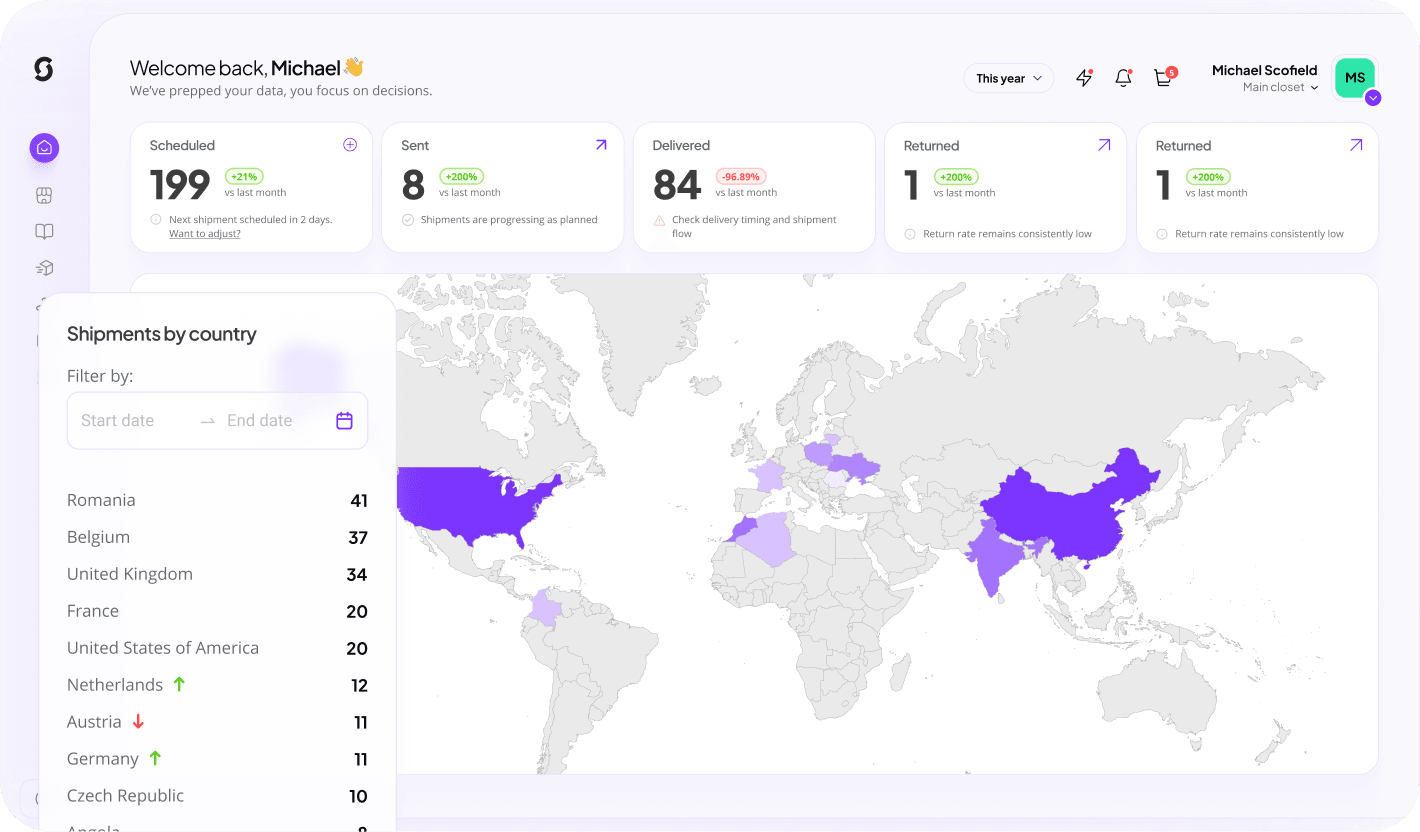
Sunday is global merch infrastructure. We started in Europe, scaled to 200+ countries, and run a different model: bulk production at the lowest unit cost, free warehousing in our European hubs, then on-demand global shipping powered by accredited customs agent status, fully automated customs documentation, and negotiated rates with major carriers. The result is shipping economics that beat most US-only operations even when the parcel is going to São Paulo. Activation takes 30 seconds, the minimum order is 10 pieces, and the platform handles HR-triggered onboarding kits, redeem pages, multi-team brand stores, and full custom product development beyond print-on-blank.
The two platforms aren't pretending to be each other. They're optimized for different realities. The rest of this post is about which reality you live in.
At-a-glance comparison
| Capability | Sunday | swag.com | Winner |
|---|---|---|---|
| Countries served | 200+ countries via automated customs and accredited agent | US-focused, international available with surcharges | Sunday |
| Activation time | 30 seconds, self-serve | Sales-led onboarding | Sunday |
| Minimum order quantity | 10 pieces | 25 to 50 typical, varies by SKU | Sunday |
| Free warehousing | Yes, in European hubs | Yes, in the US | Tie (different geography) |
| US catalog depth | Solid global core catalog | Very broad US-sourced catalog | swag.com |
| True custom products | Full custom from scratch | Print-on-blank focus | Sunday |
| Redeem pages | Built in, brandable | Limited "swag giveaway" feature | Sunday |
| Internal brand stores | Multi-team, multi-region, full control | Single store, US-centric | Sunday |
| Multi-team access | Native, role-based across departments | Single workspace | Sunday |
| HRIS & CRM integrations | Workday, BambooHR, HiBob, Salesforce, HubSpot, custom API | Limited native integrations | Sunday |
| Platform fee | None | None | Tie |
| Support model | Dedicated account manager from order one | Account managers on larger accounts | Sunday |
The 12-row scoreboard. Sunday wins on 9 of 12 capabilities, swag.com wins on 1, and 2 are a tie. The capabilities where swag.com leads (US catalog depth) are real, and they matter if you're a US-only team. Most growing brands are not US-only anymore, which is why this comparison usually ends with a migration.
Global reach & shipping to 200+ countries
★ Sunday wins. This is the single biggest dividing line between the two platforms. Sunday consolidates inventory in our European warehousing hubs, then ships to 200+ countries using accredited customs agent status, fully automated customs documentation, and negotiated carrier rates. The combination delivers prices that hold up against any US-only operation, even on cross-border parcels. Swag.com is fundamentally a US operation with international shipping bolted on, which means surcharges, manual customs friction, and lead times that scale poorly outside North America.
What Sunday delivers globally: European warehousing hubs as the consolidated base; accredited customs agent status (clearances handled in-house); fully automated customs documentation per shipment; negotiated rates with major carriers (DHL, UPS, FedEx); door-to-door delivery in 200+ countries; IOR (Importer of Record) handled at the platform level; lead times of 2 to 5 days to most destinations; pricing in EUR, USD, and local currencies.
"We had US, EU, and APAC teams. Swag.com handled the US fine, then everything else became a customs ticket." - VP People at a Series C, anonymous
US catalog depth & local sourcing
★ swag.com wins. Credit where it's due. Swag.com has spent years building a deep, curated US-sourced product catalog with strong relationships across American suppliers. If you're buying for US recipients only and want a one-stop shop with hundreds of US-made or US-stocked SKUs, swag.com's catalog is excellent.
Where swag.com's catalog leads: hundreds of US-sourced apparel and drinkware SKUs; strong relationships with American premium brands; fast US-to-US sample turnarounds; curated "trending" sections updated frequently; deep tech accessories selection; US-specific seasonal collections; Made-in-USA filter and tagging; integrated US-side proofing workflow.
"For pure US buying, swag.com's catalog is hard to beat. The question is whether your team stays US-only." - Procurement lead, US tech
Activation speed & onboarding
★ Sunday wins. Sunday's tagline is "Merch, in your brand. Live in 30 seconds." That's not marketing. The platform is genuinely self-serve: upload a logo, lock your brand colors, pick your starter catalog, and you're live. Swag.com's path involves contacting sales, getting onboarded, and waiting on a setup process before you can run a real program.
What 30-second activation actually looks like: sign up with your work email, no sales call; upload logo, lock Pantone colors; choose a starter catalog of 10 to 15 items; invite teammates and set roles; generate a redeem page in one click; connect HRIS or CRM via native integration; place your first order with a 10-piece minimum; track everything from one dashboard.
"I signed up at 2pm. We had our first kit shipping by Friday." - People Ops lead, fintech scale-up
US warehousing & fulfillment ops
★ swag.com wins (US-only). For pure US programs, swag.com's warehousing operation is mature. Free US storage, predictable US-side shipping rates, and a long track record of fast US-to-US fulfillment. If your program never leaves the US, this is a clean operation. The moment your audience stops being US-only, the picture changes (see global reach section above).
Where swag.com's US ops are strong: free US warehousing for stored inventory; published US shipping rate examples (small parcels under $10); fast US-to-US lead times (often 2 to 4 days); mature pick-and-pack workflows; integrated US returns handling; US-based customer support team; US tax handling automated; transparent US storage fees on overflow.
"For our US-only marketing team, swag.com is fine. Then we expanded to Europe and the math broke." - CMO, B2B SaaS
Custom product development
★ Sunday wins. There's a meaningful difference between "print your logo on this existing t-shirt" and "design a custom hoodie from scratch with your own fit, fabric, woven label, and packaging." The first is decoration. The second is product development. Sunday does both. Swag.com is heavily oriented toward the first.
What full custom looks like at Sunday: custom apparel design with your fit and fabric; bespoke packaging, not stock poly bags; woven labels, custom care tags, hidden brand details; custom drinkware (shape, finish, lid system); co-branded products with heritage makers; specialty decoration (embossing, screen, sublimation, embroidery); limited-run drops with serialized numbering; end-to-end product management, not just print procurement.
"Print-on-blank merch always looks like merch. Real custom looks like the brand." - Creative director, consumer brand
Redeem pages & sharable links
★ Sunday wins. A redeem page is a brandable URL where a recipient picks their item, size, and shipping address. It's how modern teams handle event giveaways, conference swag, and post-meeting gifts at scale. Sunday's redeem pages are first-class. Swag.com's "swag giveaway" feature exists but is more limited.
What Sunday's redeem pages do: custom URL, fully branded landing page; recipient picks item, size, color from a curated list; address collection in dozens of country formats; per-page budget caps and quantity limits; expiration dates and redemption windows; real-time tracking of who claimed what; multi-language support out of the box; embed via API or share via simple link.
"We sent 800 redeem links in a single day. Every recipient saw our brand, not the platform's." - Field marketing lead, B2B SaaS
Internal brand stores
★ Sunday wins. An internal brand store is a permanent, branded shop your employees, contractors, or customers can use to claim or buy merch on demand. Sunday lets you spin up multiple stores per region, team, or audience. Swag.com offers single-store setups that are tighter on customization and segmentation.
What Sunday's brand stores include: multiple stores per organization (by region, brand, team); full visual customization, your domain or a Sunday subdomain; SSO with your identity provider; audience-specific catalogs and pricing; built-in budget allocation per recipient; multi-currency support out of the box; reporting on usage, spend, and inventory; flexible payment models (employer-paid or employee-paid).
"We have a US store, an EU store, and a partner store. One platform, three completely different audiences." - People Ops, global tech
Multi-team access & permissions
★ Sunday wins. In real companies, merch isn't owned by one person. People Ops runs onboarding kits. Marketing runs events. Sales runs gifting. Customer Success runs renewals. Each team needs its own budget, catalog, and approval flow. Sunday is built for that. Swag.com's single-workspace model creates friction the moment more than one team gets involved.
What multi-team looks like on Sunday: role-based access for HR, Marketing, Sales, CS; per-team budgets and approval thresholds; team-specific catalogs and brand stores; centralized billing, decentralized operation; audit trail across teams and orders; procurement-friendly approval workflows; SSO with role mapping; team-level reporting on spend and impact.
"Three teams used to fight over one swag account. Now each one has their own and finance has one bill." - Finance director, late-stage startup
Integrations (HRIS, CRM, automation)
★ Sunday wins. Modern merch programs are triggered by other systems: an HRIS marks a new hire, a CRM closes an opportunity, a calendar event fires. Sunday integrates natively with the major HRIS, CRM, and identity tools, plus a public API for everything else. Swag.com's native integration footprint is thinner.
What Sunday connects to: HRIS, Workday, BambooHR, HiBob, Personio, Rippling. CRM, Salesforce, HubSpot, Pipedrive. Identity, Okta, Google Workspace, Microsoft Entra ID. Comms, Slack, Microsoft Teams notifications. Events, webhook triggers from any modern tool. Public REST API for custom workflows. Zapier and Make for low-code automation. SCIM for user provisioning.
The brands running merch as infrastructure aren't logging into a platform every time they want to ship a hoodie. They're triggering it from the system that already knows the recipient. Sunday's integration footprint is the actual difference between a tool and an operating system.
How to choose between Sunday and swag.com
If your program is US-only
Swag.com's deep US catalog, free US warehousing, and predictable US shipping rates make it a clean fit. The catalog depth is genuinely strong for American buyers, and the platform does that one job well.
If your team or audience is global, or trending global
Sunday is built for the multi-region, multi-team reality. Accredited customs agent status, automated customs documentation, 200+ countries served from European hubs, multi-team brand stores, redeem pages with global address handling, and HRIS/CRM integrations make Sunday the platform that scales with the program.
If you want to test before you commit
Sunday's 30-second activation and 10-piece minimum order make it cheap to pilot. Swag.com's sales-led onboarding adds days or weeks before the first ship. For modern operators who want to evaluate the platform itself, instant activation is the difference between launching this week and launching next quarter.
Final verdict
Sunday wins 9 of 12 capabilities, swag.com wins 1 (US catalog depth), and 2 are a tie. The category swag.com wins is real and matters if your program stays US-only. The categories Sunday wins are structural, global reach, custom product, redeem pages, multi-team brand stores, integrations, activation speed, and they compound as the program scales.
Sign up free, upload your logo, lock your brand colors, and see Sunday running in your account before this page finishes loading on mobile data. Try Sunday free.