
Executive Summary
When Bugatti Rimac needed merchandise worthy of a ten-unit limited edition hypercar, off-the-shelf vendors couldn't deliver. Matching prints across zippers, decorations on elastic ribs, custom woven drawstrings, the technical specifications were beyond what local suppliers could execute. Sunday produced 150 hyper-custom raincoats distributed to Bugatti Rimac's top-tier clients, and a 1,500-piece fan merchandise collection for the Rimac Nevera Time Attack launch. Every unit of the €2M+ cars sold out to that same group.
About the Client
Bugatti Rimac was formed from the merger of two automotive icons: Bugatti, the century-old French hypercar marque, and Rimac Automobili, the Croatian electric vehicle company that redefined what an EV powertrain could do. Together, they sit at the absolute top of the automotive world, producing cars in quantities measured in the dozens, sold to clients who expect perfection in every detail they touch.
That expectation doesn't stop at the car door.
For a brand where a door hinge gets the same obsessive attention as the powertrain, merchandise isn't a giveaway. It's an extension of the product philosophy. Get it wrong, and it undermines everything the brand stands for.
The Challenge: Local Vendors, Luxury Standards and a Hard Deadline
Before working with Sunday, Bugatti Rimac's merchandise process was largely manual, dependent on local suppliers, and constrained by what those suppliers could actually produce. For most brands, that's fine. For a company that sells a car with a hand-stitched interior to clients who own Picassos, it isn't.
The problem wasn't budget, Bugatti Rimac had a clear financial framework and needed everything to remain commercially viable. The problem was technical execution at speed.
The raincoat brief alone required three capabilities that most vendors simply don't have: matching prints that run continuously across a zipper seam (technically demanding, and easy to get wrong by millimeters), decorative treatments on elastic ribbing (a material that moves, stretches, and resists most standard print methods), and custom woven drawstrings, not printed, not screen-transferred, woven, delivered within a timeline that ruled out most production facilities in Europe.
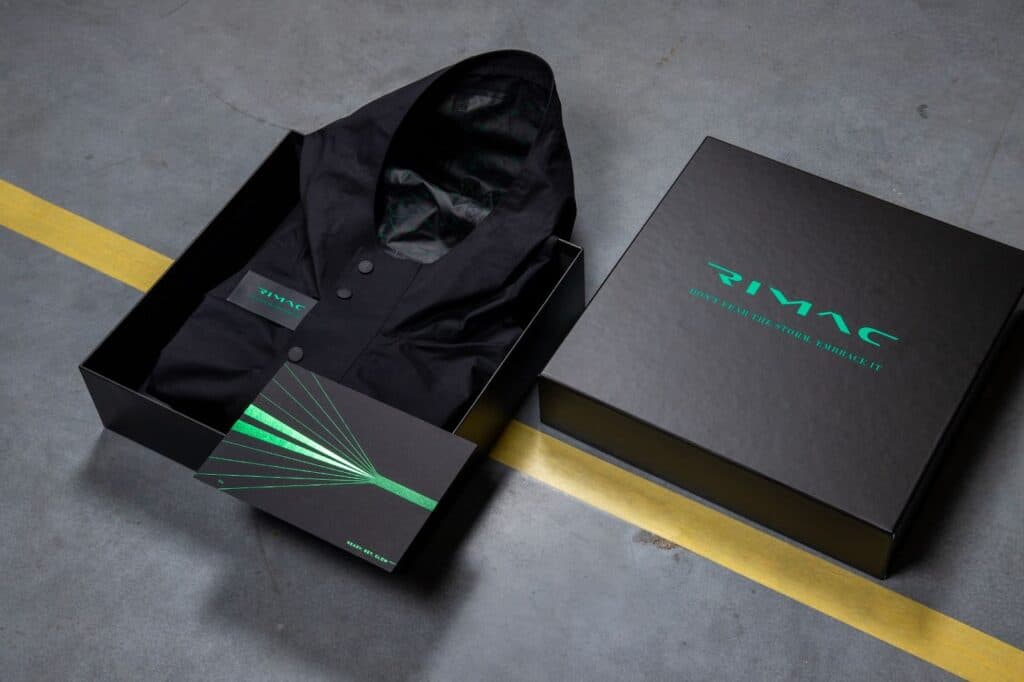
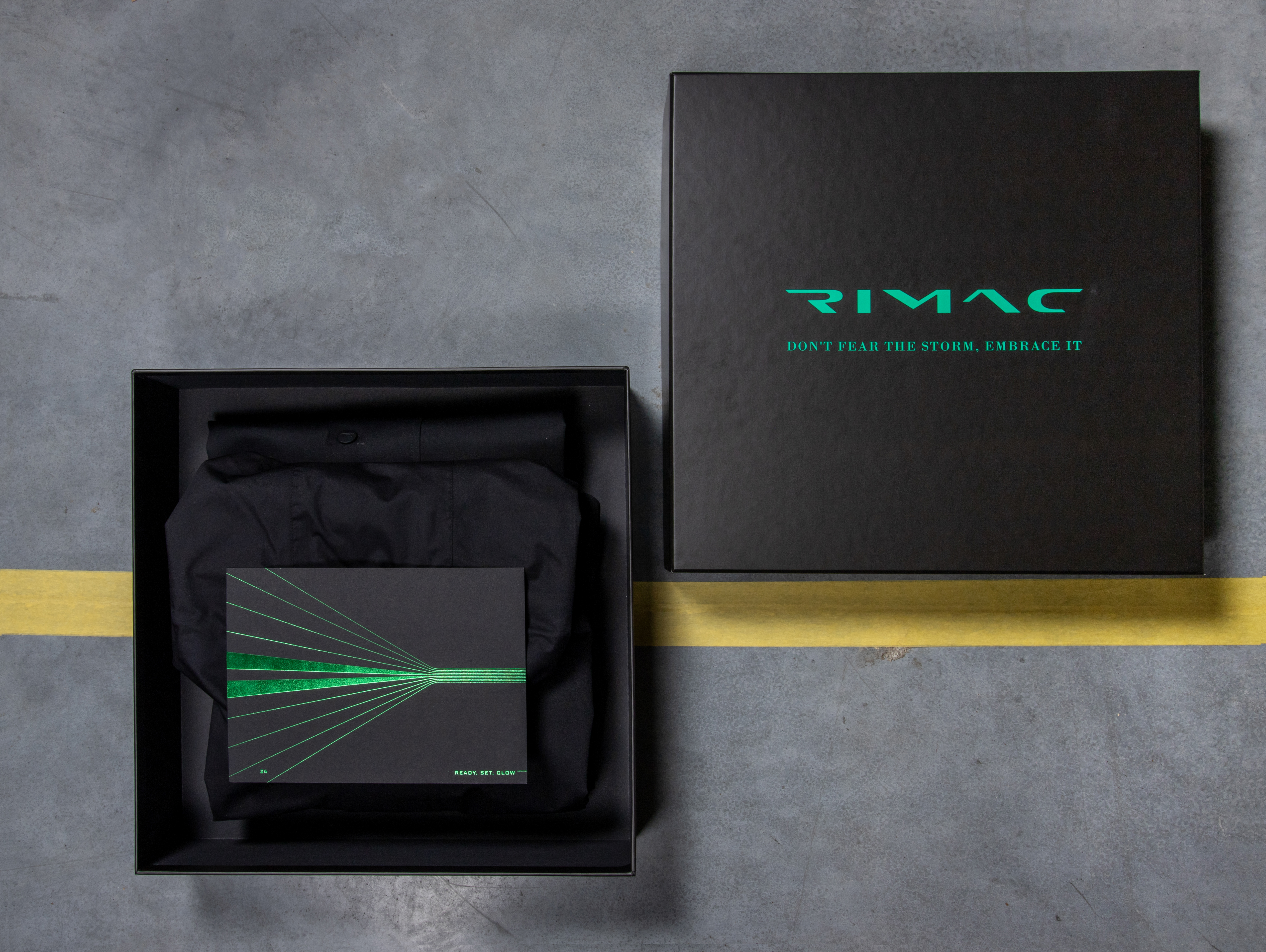
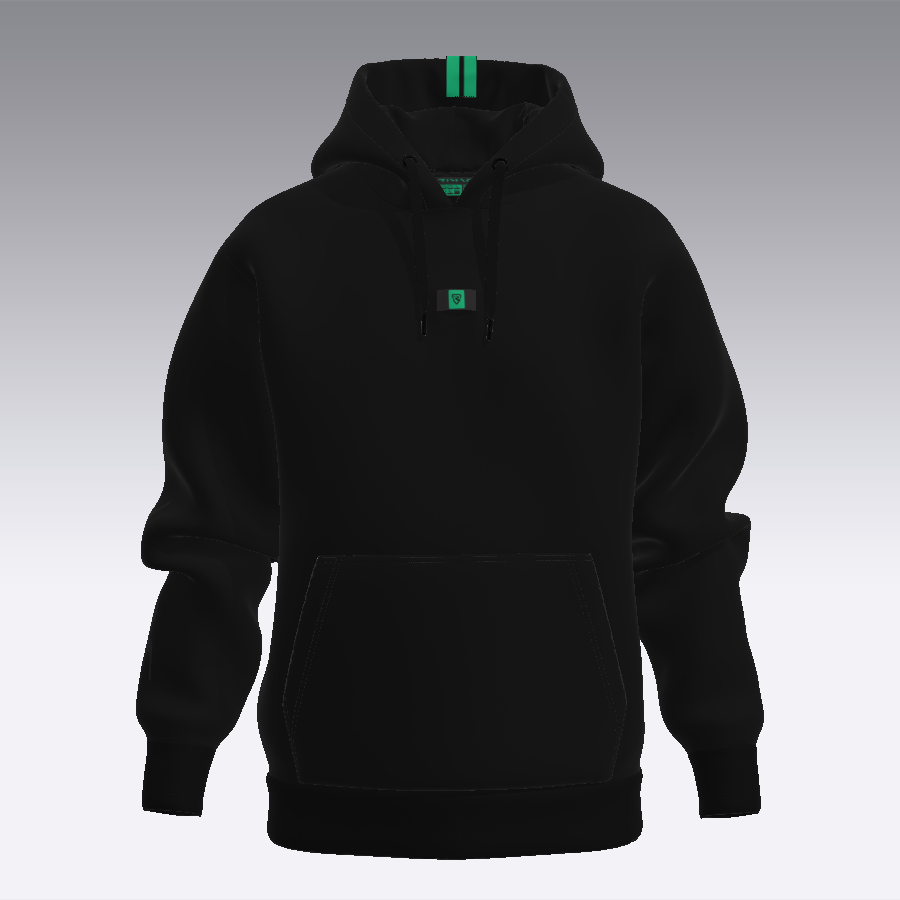
Then there was the brief itself: the coat had to look minimal. A black raincoat, almost austere at first glance. The luxury was in the details, a racing green zipper with an engraved logo, buttons carrying the Rimac icon, an interior lining built from a repeating brand pattern, woven labels that felt like something from a high fashion house. Restraint on the outside. Obsession underneath.
Finding a partner who could execute that, at commercial unit economics, within the required timeframe, ruled out most of the market.
The Solution: Three Iterations, One Standard
Sunday worked through three full design and production rounds with the Bugatti Rimac team before a single raincoat was approved for production. That's not unusual for a luxury brief, it's what luxury requires. What made the difference was having a production partner with the technical range to attempt it at all.
The cross-zipper print alignment was solved through precise placement engineering before production. The elastic rib decorations required a non-standard application method. The custom woven drawstrings were sourced and produced within the timeline constraints. Each detail was tested across samples before the full run was authorized.
The result: 150 raincoats that, when handed to a prospect at a major car fair, communicated exactly what Bugatti Rimac intended. Not "here's a branded giveaway." Something closer to: "this is what we think your time is worth."
The coats were never sold. They were given, personally, selectively, to the people Bugatti Rimac most wanted to impress. That distribution strategy was as deliberate as the product itself.
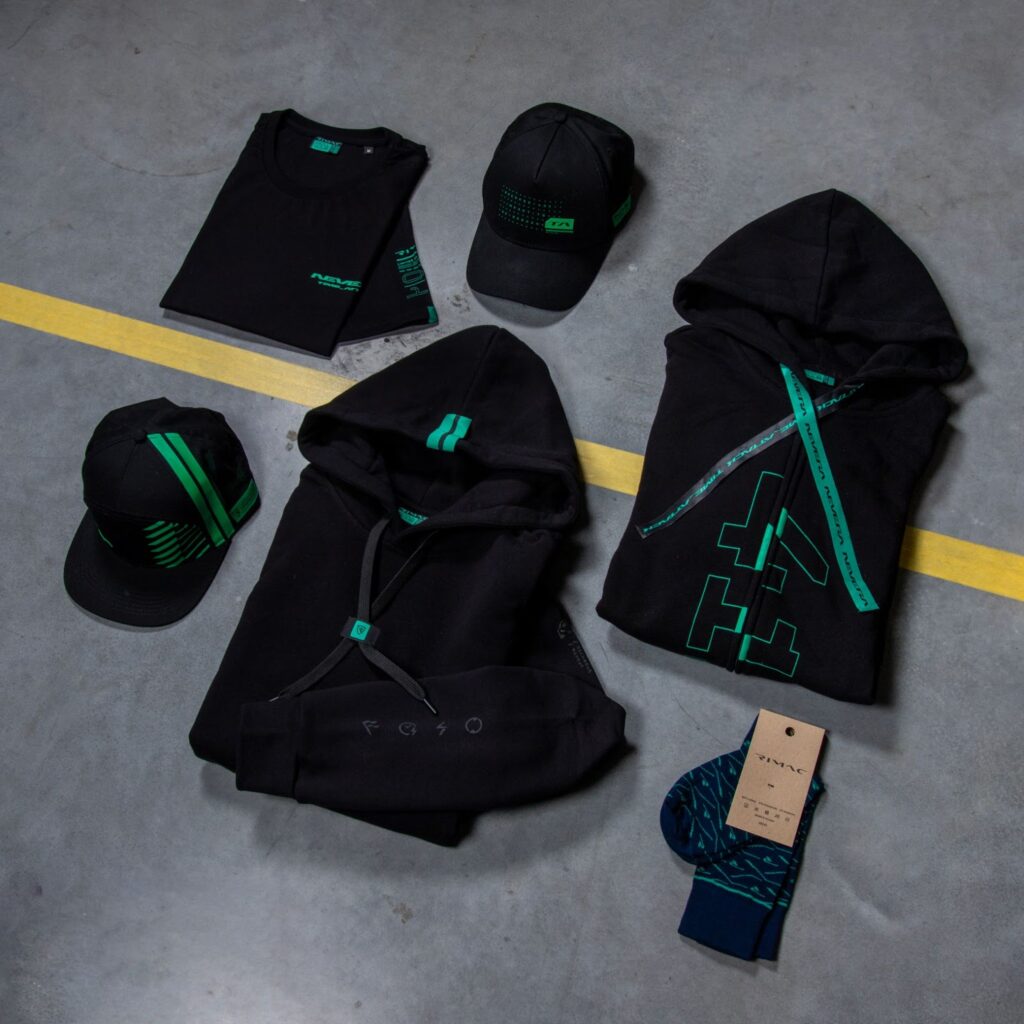
For the Rimac Nevera Time Attack launch, Sunday worked directly alongside Rimac's car designers to translate the vehicle's design language into a merchandise collection. The car had ten units. The merch had to feel like it belonged in the same conversation.
Hoodies, t-shirts, and caps were developed with design elements pulled from the car's visual identity, not applied branding, but integrated design. The collection launched through the Rimac online store and the physical shop at company headquarters, where visitors could buy them during factory tours. Around 1,500 units were produced across the collection, partially selling out.
Platform and Products Used
Products: Hyper-custom raincoats (limited run of 150), premium hoodies, t-shirts, and caps for the Nevera Time Attack fan collection.
Production capabilities applied:
- Cross-zipper matching print alignment
- Elastic rib decoration
- Custom woven drawstrings
- Engraved hardware (zipper pull with logo)
- Custom button tooling with Rimac icon
- Luxury interior lining with brand pattern
- Woven interior labels
Distribution: Direct gifting at major international car fairs (raincoats); Rimac online webshop and HQ physical store (fan collection).
Impact and Key Results
150 raincoats. 10 cars sold.
The Nevera Time Attack sold out entirely to the group of top-tier clients who received the raincoats. That's not a coincidence, it's what happens when a brand gift lands at the right standard. The raincoats didn't close the deals alone. But they reinforced, physically and tangibly, what Bugatti Rimac's relationship with their clients looks like.
1,500-unit fan collection, partially sold out
The Nevera Time Attack merchandise collection achieved partial sell-through through both the webshop and the HQ store. For a limited run tied to a ten-unit car, the merchandise created a point of access for fans who could never own the vehicle and a revenue line that didn't exist before.
Three iterations to get it right and they did
The production process required three full sample rounds. That's the honest cost of executing at this level. Sunday absorbed that iteration process within the project, delivering a final product that met Bugatti Rimac's standard, on technical specification, on timeline, and on unit economics that kept the collection commercially viable.
Benchmark for what's possible
The most significant outcome isn't a single metric. It's that Bugatti Rimac now has a production partner capable of executing at the technical level their brand demands. Local vendors with standard capabilities can't produce what Sunday produced here. That gap between what most suppliers can do and what this brief required is where the partnership was built.
Conclusion: Merchandise as Brand Proof
Most brands treat merchandise as a communications tool. Bugatti Rimac treats it as a proof point. The raincoat isn't evidence that they care about branding, it's evidence that they execute at a standard most companies can't reach, in every category they touch.
That's a different brief. It requires a different kind of partner.
Sunday's value here wasn't process efficiency or cost reduction. It was technical range, the ability to take a specification that ruled out most of the market and deliver it, on time, at a price that worked. For brands at the top of their category, that's the only thing that matters.