
Custom sportswear is technical sports apparel branded for a company, ordered for teams, events and wellness campaigns: custom team jerseys, custom cycling jerseys, custom tracksuits with logo, custom sports kit for teams and custom running gear with logo. It is the most expressive apparel category because full-colour sublimation makes the design part of the fabric, with unlimited colour, gradients and all-over patterns and no decoration layer to crack or peel. The rule that matters is production order: sublimate the fabric first, then cut the panels, then sew, so patterns run cleanly across seams. Sunday builds it in technical Dry Fit and Cooltech fabrics, with recycled versions at the same performance. Minimums start around 10, and a low-quantity order still gets full all-over sublimation at no per-colour charge. The biggest mistake is over-specifying: match the technical level to the activity, not to the catalogue.
One note before we start: this guide is for companies ordering branded sportswear in bulk, for company sports teams, running and cycling groups, sports days, wellness campaigns, sponsorship activations and events. It is not a consumer buying guide for the best running shirt of 2026. The rest of this guide is how to get the product, the fabric, the decoration and the technical level right so the kit does its job and the brand lands well.
Why custom sportswear is the most expressive branded category
Most branded apparel is a logo on a blank. Sportswear is different. It is the one category where full expression is normal: bright colour, gradients, brand patterns, numbers, names and full-surface designs all feel natural on a jersey. That freedom is the whole point. A well-designed kit turns a company sports activity into a visible brand moment while encouraging people to take part, building team spirit and supporting healthier habits.
It also sits in an unusually positive context. Health, movement, shared achievement, team building and personal pride are some of the best associations a brand can have. Put your logo on a race jersey and it lands very differently from putting it on a giveaway. The line to remember: custom sportswear should make people feel like a team, not like walking advertising.
Who buys custom sportswear, and when
The buyers are broad: HR and People teams, employer branding, event managers, internal comms, marketing, sponsorship managers, wellness-programme owners, company sports clubs and local offices. What they share is a moment that needs a kit rather than a t-shirt.
- Running teams and events. Marathons, ten-milers, club runs and wellness challenges, where a shared kit creates a real-team feeling on the day.
- Cycling groups. Company rides, route challenges and sponsorship activations, a genuine B2B niche in markets like Belgium.
- Sports days and team-building. A standard team jersey does the job and photographs brilliantly.
- Golf, padel and tennis. Technical polos and apparel for golf days, tournaments and networking events.
- Wellness campaigns. Walking challenges and movement programmes tied to a health message.
The through-line is context. Custom sportswear shines when it is tied to a genuine sports or wellness moment. It falls flat when it is handed out with no sports context at all, treated like standard corporate apparel.
Off-the-shelf vs fully custom
You have two real paths. Off-the-shelf works: pick a stock technical garment, add a logo, done. It is fast, accessible and a good fit for small campaigns. But it has two limits worth understanding before you commit.
- Co-branding. Your logo sits next to the sportswear maker's brand. Some companies like the association with a known sports label. Some do not want another brand on their kit at all.
- Limited brand expression. With stock you cannot control the colours, brand patterns, gradients, all-over artwork, panel design or construction. You get a blank in someone else's colours with your logo added.
When brand expression matters, go fully custom. That is the point at which sportswear becomes the most expressive category, and where sublimation earns its place.
| Decorated stock (off-the-shelf) | Fully custom sublimated | |
|---|---|---|
| Best when | Low quantity, tight timing, simple logo-only design, an existing sports brand is fine | Brand identity matters, exact colours, patterns, gradients, names and numbers |
| Brand control | Logo only, in the maker's colours and construction | Full control of colour, pattern, panels and the whole surface |
| Co-branding | Your logo sits beside the sportswear maker's brand | Your brand only, top to bottom |
| Complexity cost | Each extra print placement adds cost | A full-surface, multi-colour pattern costs no more than a simple one |
| Result | Fast and accessible, but generic | Distinctive, cohesive, unmistakably yours |
The range: jerseys, cycling, running, tracksuits and more
Custom sportswear is not one product. It spans cycling jerseys, running shirts, team jerseys, tracksuits, technical jackets, windbreakers, golf polos, tennis and padel apparel and complete kits. Each maps to a different activity, and picking the right one is most of the job.
- Cycling for company rides, route challenges and sponsorship, big in Belgium.
- Running shirts for marathons, clubs and wellness programmes.
- Team jerseys for general sports days and team-building.
- Golf polos plus accessories for golf days.
- Tennis and padel apparel for tournaments and networking events.
- Tracksuits for a coordinated, relaxed lifestyle look.
- Windbreakers and technical jackets for autumn, winter and cold outdoor activity.
Custom team jerseys and custom sports kit for teams
The custom team jersey is the workhorse of the category. For a company sports day, a team-building event or an internal tournament, a standard team jersey in your brand colours is exactly right. It is affordable, it creates instant team identity, and it photographs beautifully for social and employer-brand content.
A full custom sports kit for teams goes further: matching tops, shorts, and often a jacket or tracksuit, all in one coherent design. That is where the real-team feeling comes from. When everyone is in the same considered kit rather than mismatched shirts, participation feels like belonging. Preview a full kit in your colours in the free sportswear mockup generator before you order.
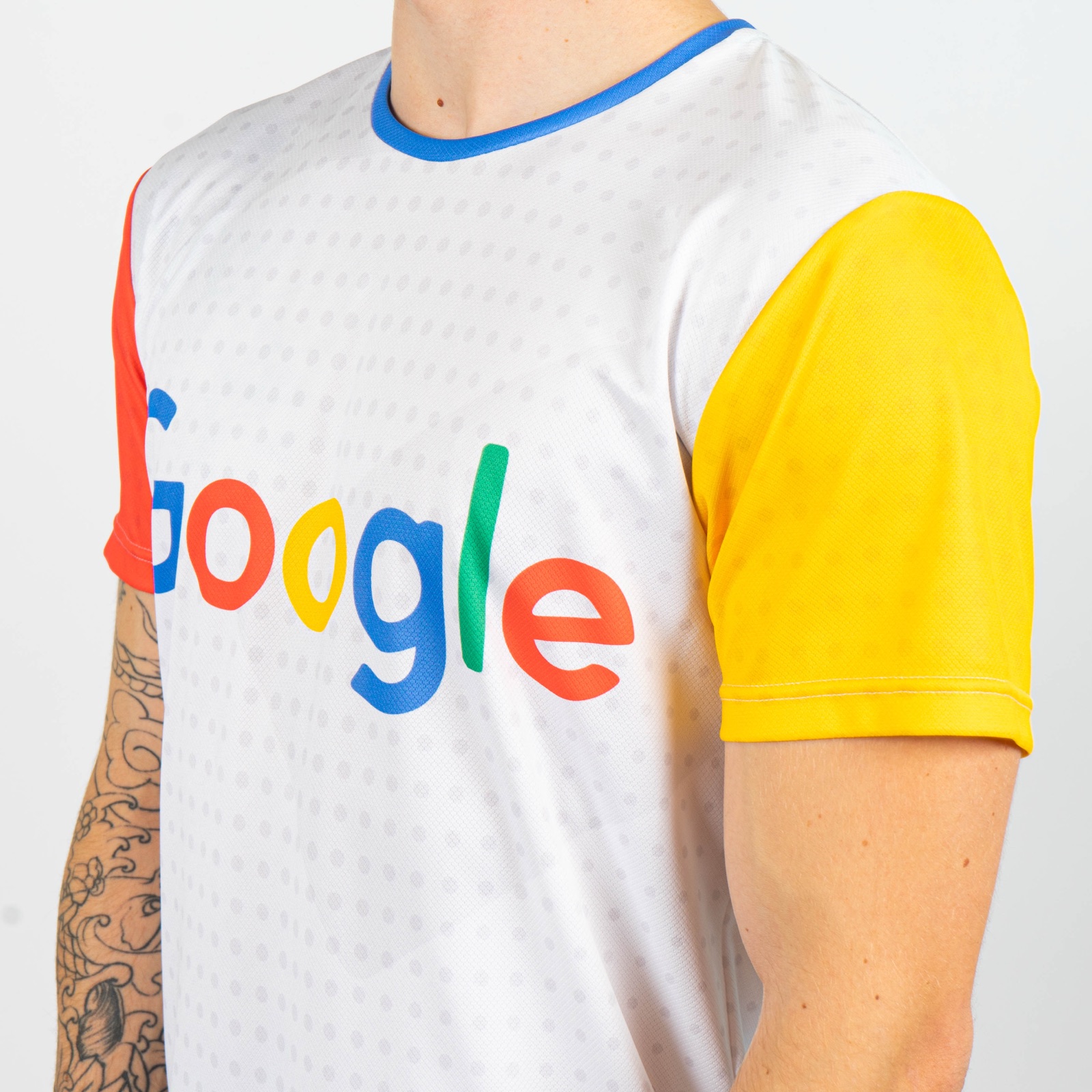
A Google-branded custom sports jersey, fully sublimated so the brand colours run edge to edge across the fabric.
Custom cycling jerseys
Cycling is a meaningful B2B niche, especially in Belgium, where company rides, event sponsorship and route challenges are common. It varies by market, but where it lands, it lands hard. A custom cycling jersey in full sublimation is one of the best-looking pieces of branded apparel a company can produce.
Fit is the decision that needs the most attention. Cyclists split into camps: some want a tight, aggressive pro fit, and casual riders want something more forgiving. Decide up front where the group sits.
- Entry-level leisure. A comfortable, forgiving fit for a casual company ride. Basic cycling wear is plenty.
- Comfortable club. A middle ground for regular riders who want performance without a race fit.
- Technical pro. A serious challenge, a Mont Ventoux climb say, justifies pro-level apparel and a race fit.
Match the level to the ride. A casual company outing does not need race clothing, and forcing a pro fit on a mixed group is a fast way to leave people uncomfortable.
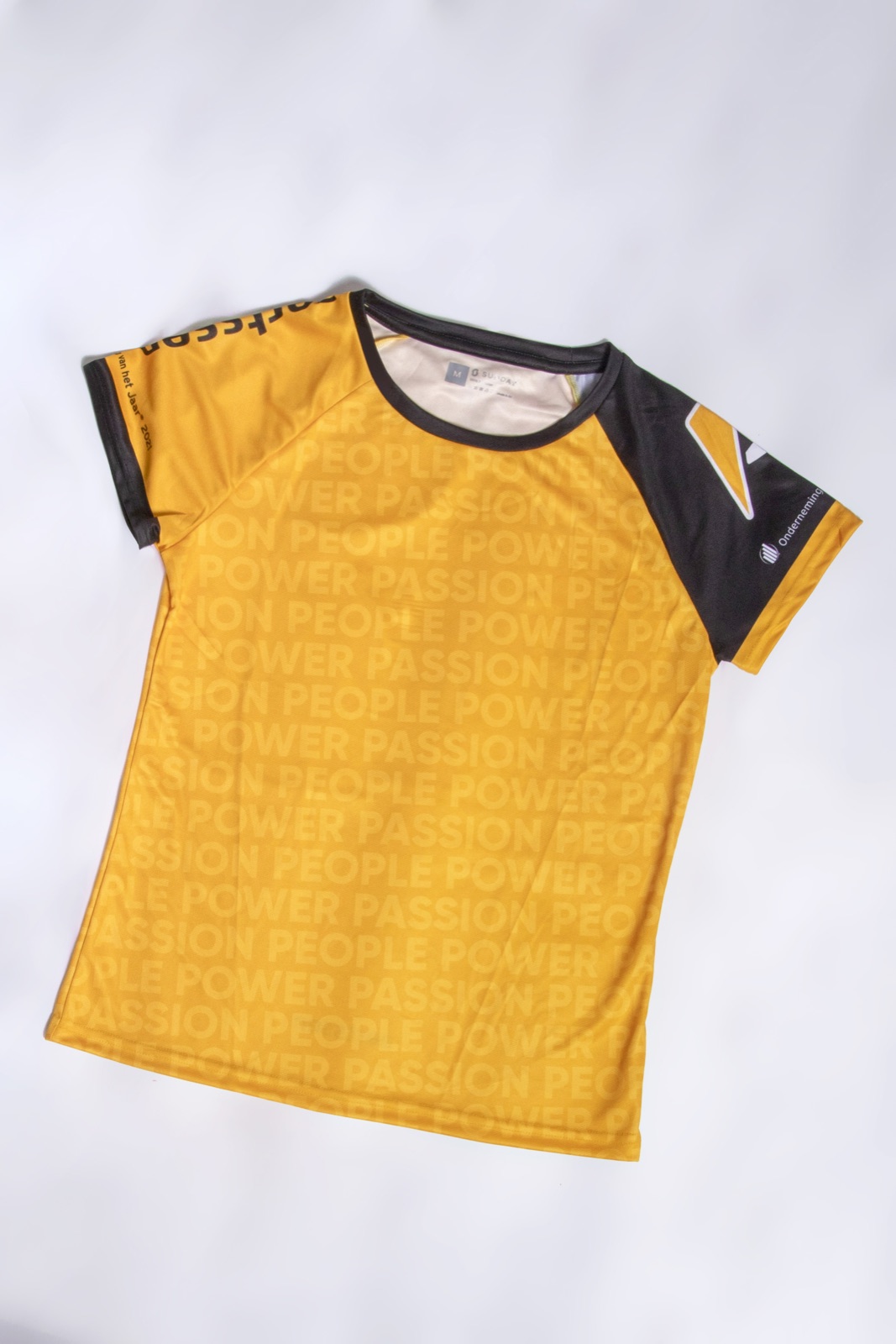
An Aertssen-branded custom sports jersey, with brand colours and pattern sublimated cleanly into the fabric.
Custom running gear with logo
Running gear covers marathons, running clubs and wellness campaigns. A branded running shirt is light, breathable and highly visible on the day, and it turns a company running team into a recognisable group at a public event.
One honest note for runners: the jersey matters less than most companies think. For running, shoes and support matter more than the shirt. So do not over-invest in a hyper-technical running top for a wellness 5k. A clean, breathable branded running shirt with reflective detail for low-light runs is the right spec for most company running programmes.
Custom tracksuits with logo
Custom tracksuits with a logo sit slightly outside pure performance. Their job is a coordinated, relaxed lifestyle look: warm-ups, travel to events, team photos and the downtime around a sports activity. A tracksuit reads as a considered team uniform rather than a race garment, which is exactly why it works for team-building and event branding.
Because a tracksuit is worn off the field as much as on it, fit should be comfortable rather than tight, and the branding can be a little more visible than on a race jersey. It is the piece people keep wearing after the event, which extends the brand impression well beyond the day.
What makes sportswear premium: fabric and fit
Fabric is the single most important thing. Good sportswear fabric is breathable, durable, lightweight, moisture-wicking, quick-drying and comfortable in movement. Sunday uses technical Dry Fit and Cooltech fabrics that move moisture away from the body and stay cool, versus a jersey that ends up heavy with sweat. That is the difference between a kit people love wearing and one they quietly retire.
Fit should support movement without being restrictive or tight. And construction is where quality shows on close inspection: strong seams, clean stitching, aligned panels, durable collars and cuffs, shape retention and a comfortable skin-side finish. A premium kit looks the part from a distance and confirms it the moment someone puts it on.
Sublimation: the key technique, and the production order that matters
Full-colour sublimation is the strongest technique for fully custom sportswear. Instead of sitting on top of the garment as a printed layer, the design becomes part of the fabric. The advantages are exactly what this category needs: unlimited colour, gradients and all-over patterns, no heavy decoration layer, no cracking, peeling or washing off, and preserved technical performance.
This production order is the difference between a cheap kit that shows white seam cracks after a few washes and a premium one where the pattern runs unbroken across every panel. It is also why a signature all-over design looks so clean on a properly made jersey. There is a second advantage that changes the budget conversation: with sublimation, design complexity does not add cost the way separate print placements do. A multi-colour, full-surface pattern does not mean paying per logo or per position. You get maximum expression without a complexity surcharge.
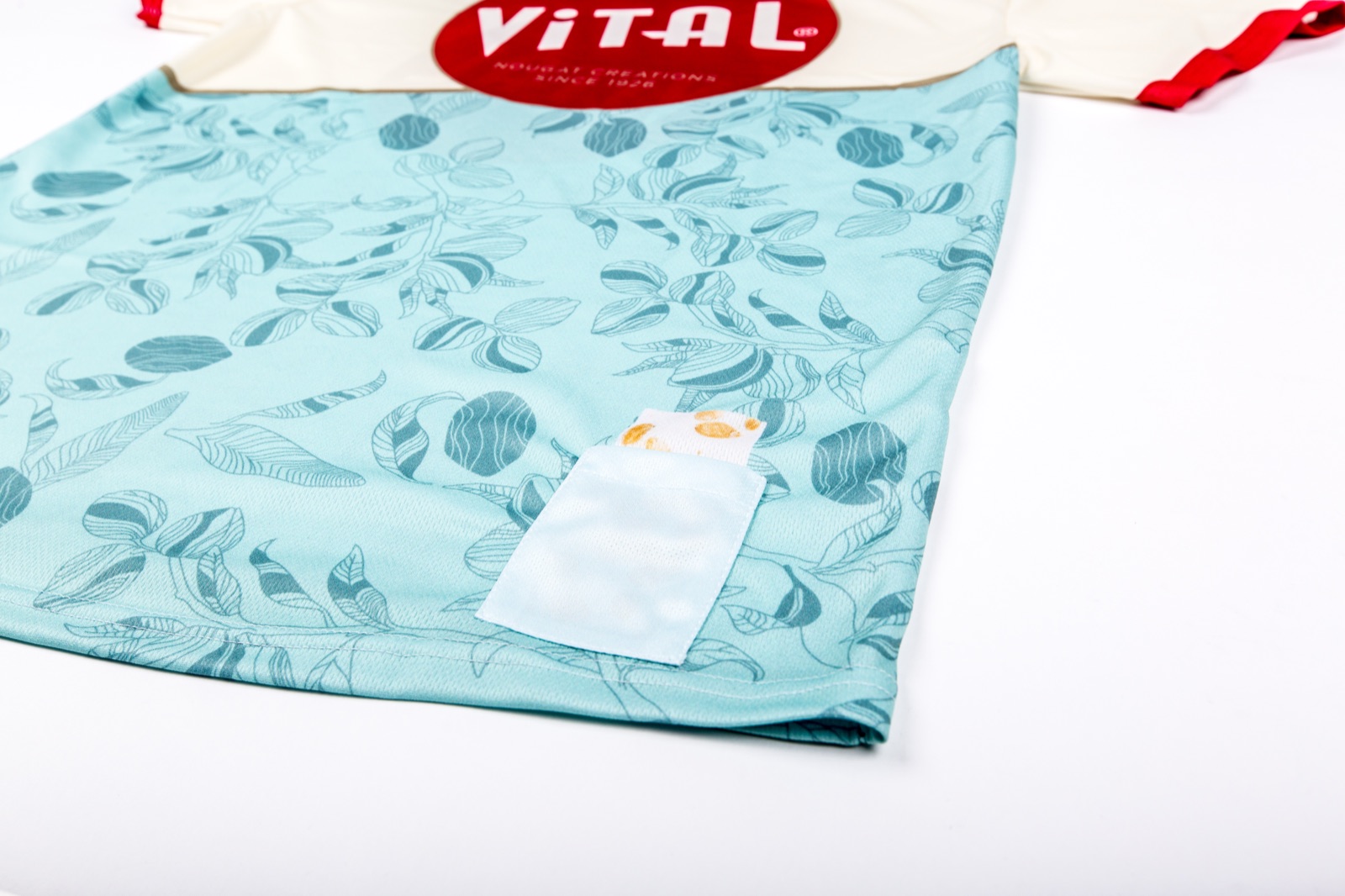
A Vital-branded custom sports jersey, sublimated first then cut and sewn so the pattern runs unbroken across the panels.
Decoration: why to skip embroidery on lightweight sportswear
Sublimation is the right call for fully custom kit, and print works well for ready-to-wear technical apparel. But one decoration choice deserves a clear warning.
Avoid embroidery on lightweight sportswear. Embroidery adds weight, reduces flexibility, can irritate the skin during movement and interferes with the technical performance of the fabric. On a heavy jacket it can be fine. On a race jersey or running shirt it is the wrong tool. If you need a raised or tactile mark, there are better options.
- Silicone patches and lightweight badges. A premium, low-weight way to add a mark or a sponsor.
- Reflective prints. Genuinely important for running and cycling in low light. Build it in for any outdoor or evening activity.
- Performance-compatible transfers. For logos and details that need to sit on top without embroidery's weight.
Names, numbers and personalisation
Personalisation is where a kit stops being uniform and starts being someone's. Names, numbers, departments, team names, event names, route references and country or office IDs all create a stronger connection and a genuine real-team feeling. It adds cost, but it significantly lifts perceived value. A jersey with your name on the back is a keepsake. A blank one is just kit.
For a marathon team, event names and dates turn the jersey into a memento of the day. For a company cycling group, a route reference or a rider number does the same. It is one of the highest-return additions you can make, and sublimation handles it cleanly as part of the design rather than as a separate decoration step.
Recycled custom sportswear
Sustainability is a real request in this category, and there is an honest answer. Sunday offers both standard and certified recycled technical fabrics, and both deliver Dry Fit and Cooltech performance, breathability and moisture management. Recycled is genuinely requested, and it works, provided it meets the same technical and durability standards. Do not compromise function for the label.
The practical approach is to offer both and let the customer choose on their priorities, certification requirements and budget. A recycled kit that performs and lasts is a strong sustainability story. A recycled kit that underperforms is not, so the material has to clear the same bar as the standard fabric.
MOQ, cost drivers and lead time
Minimums are low, typically starting around 10, with roughly 25 for many kits and higher for advanced builds. The standout advantage is this: a low-quantity order can still use full-colour, all-over sublimation, with no separate charge per colour, logo or design element. Small teams get the same expressive result as large ones.
| Factor | What to expect |
|---|---|
| Minimum order | From around 10, roughly 25 for many kits, higher for advanced multi-piece kits |
| Complexity | Full all-over sublimation at no per-colour charge, even at low quantity |
| Cost drivers | Garment type, fabric, fit, recycled vs standard, quantity, names and numbers, reflective details, zippers, pockets, technical construction, jacket or jersey complexity |
| Exact figures | Depend on the garment and spec. The platform shows live pricing as you choose from the catalog |
The #1 mistake: over-specifying
Here is the single most common and most expensive error. Companies pick apparel far more technical than the activity actually needs. The fix is simple: match the technical level to the challenge.
- A casual sports day needs standard sportswear, not race gear.
- A recreational company ride does not need pro race clothing. A Mont Ventoux challenge does.
- For running, shoes and support matter more than the jersey, so do not over-invest in the top.
- A walking event does not need an advanced running jacket.
The hot take: if they are willing to run or ride for you, kit them out
When a team is already willing to take part in a sports activity, the company should provide the sportswear. A jersey is affordable, it creates instant team identity, it generates excellent brand content, and it encourages others to join next time. The maths is generous and the association is unusually strong.
Think about what surrounds the moment: health, movement, shared achievement, team building and personal pride. It is one of the most positive contexts you can ever place a brand in. Skipping the kit to save a small amount per person misses the entire opportunity. If they are showing up, kit them out.
Native language: sportkleding and beyond
Demand for custom sportswear runs across the EU and the US, and buyers search in their own language and for their own sport. Dutch buyers search sportkleding, sportshirts, wielershirts, hardloopshirts and teamkleding. The right approach is to use the terms buyers actually search per market and per sport, not direct English translations, which is why Sunday builds native-language sportswear pages rather than translating one English page.
Custom sportswear vs the old swag-vendor approach
| Old swag-vendor approach | The Sunday approach | |
|---|---|---|
| Design | A logo on a stock blank in someone else's colours | Full-colour sublimation with your colours, gradients and all-over patterns |
| Production | Print a finished garment, white cracks appear at the seams | Sublimate first, then cut and sew, so the pattern runs cleanly across the kit |
| Fabric | Generic polyester that gets heavy with sweat | Technical Dry Fit and Cooltech, with recycled versions at the same performance |
| Complexity cost | Pay per logo and per print placement | Full-surface, multi-colour design at no per-colour charge, even at low quantity |
| Minimum | High MOQs before custom is possible | From around 10, with full sublimation still available |
| Process | Upload logo, write a brief, wait weeks for a mock-up | On-brand kit designs with live pricing in 30 seconds, EU-made on one platform |
Design your own custom sportswear in 30 seconds
Sunday is merch infrastructure, not a supplier. Open a sportswear product page and the platform uses your existing brand data to generate kit design directions with live pricing instantly. You see what a jersey, a cycling kit or a tracksuit could look like in your colours, which decoration options work, the approximate price range and how each choice changes the result. Then you pick a concept, request a variation, or use it as the starting point for a fully custom sublimated kit. No upload-logo, write-a-brief, wait-for-a-mock-up.
That speed works for a wellness team ordering 15 running shirts and for a company cycling club planning a signature route-challenge kit alike. Browse the custom sportswear range, drop your logo into the free sportswear mockup generator to see a full kit in your colours, or see how it works. Shipping kit to a distributed team, an event or across borders is exactly what our distribution service is built for.
See your kit in your brand
Custom team jerseys, cycling kit, tracksuits and running gear in technical fabrics, fully sublimated and EU-made, live in 30 seconds. Create a free account and preview your kit with live pricing.
Get free designsCustom sportswear: questions answered
What is custom sportswear?
Custom sportswear is technical sports apparel branded for a company and ordered in bulk for teams, events and wellness campaigns. It covers custom team jerseys, custom cycling jerseys, custom running gear, custom tracksuits with a logo, golf polos, tennis and padel apparel, technical jackets and complete kits. It is the most expressive branded-apparel category because full-colour sublimation lets you control colour, gradients, patterns, names and numbers across the whole garment, rather than just adding a logo to a blank.
Why is sublimation the best technique for custom sportswear?
Because the design becomes part of the fabric instead of a layer on top. Sublimation gives you unlimited colour, gradients and all-over patterns with no heavy decoration layer, and it will not crack, peel or wash off, so the technical performance is preserved. The critical detail is the production order: the fabric is sublimated first, then the panels are cut, then the garment is sewn. Printing a finished garment leaves white cracks at seams, folds and stretch points, which is why cheap kits fail there.
What is the minimum order for custom sportswear?
Minimums are low, typically starting around 10, with roughly 25 for many kits and higher for advanced multi-piece builds. The big advantage is that a low-quantity order can still use full-colour, all-over sublimation, with no separate charge per colour, logo or design element. Small teams get the same expressive result as large orders. Exact figures depend on the garment, fabric and spec, and the platform shows live pricing as you choose.
Should I use embroidery on sportswear?
Avoid embroidery on lightweight sportswear. It adds weight, reduces flexibility, can irritate the skin during movement and interferes with the technical performance of the fabric. For fully custom kit, use sublimation. For marks that need to sit on top, better options are silicone patches, lightweight badges, reflective prints and performance-compatible transfers. Reflective elements are genuinely important for running and cycling in low light, so build them in for outdoor or evening activity.
What fabrics does Sunday use for custom sportswear?
Sunday uses technical Dry Fit and Cooltech fabrics that are breathable, lightweight, moisture-wicking and quick-drying, so they move moisture away from the body and stay cool rather than getting heavy with sweat. Recycled versions are available at the same performance level, so you do not compromise function for sustainability. Fabric is the single most important factor in whether a kit feels premium, ahead of fit and construction.
How do I choose the right cycling jersey fit?
Decide where the group sits before you order. Casual riders on a company outing want a comfortable, forgiving fit and only need basic cycling wear. Regular club riders want performance without a full race fit. A serious challenge, such as a Mont Ventoux climb, justifies pro-level apparel and a tight race fit. The mistake is forcing a pro fit on a mixed group, which leaves casual participants uncomfortable. Match the level to the ride.
What is the most common mistake companies make with custom sportswear?
Over-specifying. Companies routinely pick apparel far more technical than the activity needs. A casual sports day needs standard sportswear, not race gear. A recreational ride does not need race clothing. For running, shoes and support matter more than the jersey. A walking event does not need an advanced running jacket. The rule is simple: match the technical level to the challenge and do not pay for performance features the participant will not use.
Are recycled custom sportswear fabrics as good as standard ones?
Yes, when specified properly. Sunday offers certified recycled technical fabrics that deliver the same Dry Fit and Cooltech performance, breathability and moisture management as standard fabrics. Recycled is genuinely requested and it works, provided it meets the same technical and durability standards. The practical approach is to offer both standard and recycled and let the customer choose based on their priorities, certification requirements and budget.
How fast can we design a custom kit?
On Sunday you see on-brand kit designs with live pricing in about 30 seconds. The platform uses your existing brand data to generate concepts, show which decoration options are possible and give an approximate price range, with no upload-and-wait. A wellness team ordering running shirts next month can go straight from concept to a clear design-to-production path, and a company cycling club can explore a fully custom sublimated route-challenge kit from the same place.