



The corporate gifting platform category is no longer one market. It is a bundle of adjacent markets: ABM gifting, employee recognition, choice-based gift marketplaces, branded merchandise operations, and premium relationship gifting. That distinction matters because a tool that is excellent for sending a $50 digital gift card after a demo is not necessarily the right system for building a global employee welcome kit, an event merchandise program, or an always-on branded merch store.
Competitor articles often rank platforms as if they all solve the same job. They do not. Reachdesk and Sendoso are strongest when gifting is part of revenue workflows. Snappy is strongest when HR teams want employee appreciation at scale. Goody and Loop & Tie are strongest when recipient choice and ease are the main product. PerkUp sits closer to the Sunday world because it combines gifting, swag, stores, milestone automation, and global logistics.
Sunday is not another generic rewards marketplace. The strongest use case is more specific and more valuable: branded merchandise gifting campaigns for customers and employees, with redeem pages, warehousing, global fulfillment, company brand stores, and measurable engagement built in. That connects directly to Sunday's platform, catalog, and end-to-end operating model.
Strategic takeaway: the most useful way to evaluate Sunday is as a branded merchandise gifting platform for customer, employee, event, and partner campaigns. That makes it specific enough for real operational needs while still fitting the broader corporate gifting platform category.
Methodology and disclosure
This guide is written by Sunday, so it should be read as a Sunday-owned buyer guide rather than a neutral analyst report. To make the article useful and verifiable, competitor claims are based on public platform pages, official product information, integration pages, pricing pages where available, and credible third-party comparison sources. Sunday-related claims are based on Sunday's own public product pages.
How platforms were selected
The list includes platforms that appear frequently in corporate gifting, sales gifting, employee gifting, swag management, choice-based gifting, premium relationship gifting, or direct-mail automation conversations. The goal is not to rank every vendor in the market. The goal is to compare the platforms a buyer is most likely to encounter when searching for a corporate gifting platform.
How rankings were judged
Rankings are editorial assessments based on buyer fit, category clarity, gifting workflow depth, branded merchandise capability, integration story, global fulfillment strength, analytics, and relevance to customer and employee gifting programs. A higher ranking does not mean the platform is best for every company.
How to use this guide
Use this article as a structured shortlist and category map. For procurement decisions, confirm current pricing, supported regions, integration depth, security requirements, data processing terms, fulfillment SLAs, and contract details directly with each vendor before buying.
What is a corporate gifting platform and why does it matter?
A corporate gifting platform helps companies select, personalize, send, track, and measure gifts for employees, customers, prospects, partners, and communities. The modern version adds recipient choice, address collection, automation, compliance controls, inventory, integrations, and reporting.
The shift is simple: gifting moved from a one-off procurement task to a workflow embedded in marketing, sales, HR, customer success, events, and partner programs. The old model relied on spreadsheets, local vendors, manual address collection, and messy shipping. The new model uses campaign workflows, branded pages, platform-triggered sends, and centralized reporting. That is why Sunday's brand store, redeem campaign, integrations, and MerchMetrics modules are relevant to this market.
| Old approach | New corporate gifting platform approach | Why it matters |
|---|---|---|
| Manual vendor selection for every campaign | Pre-approved catalog, brand store, or curated gift marketplace | Faster execution and fewer operational errors |
| Address collection via forms and email | Recipient enters details through a secure redeem or gift link | Better privacy, fewer mistakes, less admin work |
| One-size-fits-all gifts | Recipient choice, size selection, regional availability, or personalization | Higher acceptance and less waste |
| Local shipping handled case by case | Centralized fulfillment and shipment tracking | Better visibility for global teams |
| Campaign impact is anecdotal | Tracking, redemption analytics, ROI reporting, or feedback loops | Gifting becomes measurable instead of "nice to have" |
| Disconnected from CRM and HRIS | Integrated triggers from Salesforce, HubSpot, Marketo, Slack, HRIS, or workflow tools | Teams can automate gifting moments |
| Merchandise stored in closets or offices | Warehouse inventory, team closets, and brand stores | Stock, budgets, and brand control stay centralized |
Warning: not every gifting platform is a branded merchandise platform. A generic gifting marketplace can be excellent for a thank-you moment, but weak for repeatable brand programs, stocked inventory, event logistics, employee kits, and global branded campaigns.
Category map: where each platform really belongs
The cleanest way to understand the market is to map platforms by the primary job they solve, not by the generic label "corporate gifting platform."
1. ABM and sales gifting
Tools that help revenue teams use gifts and direct mail to drive replies, meetings, pipeline, loyalty, and expansion. Best examples: Sunday, Reachdesk, Sendoso, Postal, Alyce.
2. Employee gifting and recognition
Tools focused on birthdays, onboarding, anniversaries, appreciation, and employee engagement. Best examples: Sunday, Snappy, PerkUp, Goody.
3. Choice-based gift marketplaces
Tools where the recipient chooses the item, enters their address, or swaps the gift. Best examples: Goody, Loop & Tie, Giftpack.
4. Swag and branded merchandise platforms
Tools that handle custom swag, branded kits, stores, warehousing, shipping, and campaign logistics. Best examples: PerkUp, Reachdesk, Sendoso, Sunday.
5. Premium relationship gifting
Tools that prioritize taste, curation, sustainability, design, and emotional impact. Best examples: Sunday, &Open, Loop & Tie, Snappy.
The top corporate gifting platforms in 2026, including Sunday
This section compares Sunday with 10 external platforms across workflow depth, integrations, recipient experience, global operations, branded merchandise capability, and practical buyer fit.
Sunday, Best for branded customer and employee gifting campaigns
Pricing: free account; pay when you order.
Sunday belongs in this category when corporate gifting means branded physical brand moments, not generic gift cards. The strongest position is a platform for customer and employee gifting campaigns where teams can design branded merchandise, launch redeem pages, manage stock, ship globally, and measure engagement from one centralized system.
Key features: branded merchandise design and production, redeem pages for recipient choice and data capture, company brand stores, warehousing and virtual stock management, global fulfillment and campaign logistics, employee/customer/event/ABM gift flows, MerchMetrics and campaign feedback, centralized catalog/pricing/ordering.
Pros: much stronger for custom branded merchandise than generic gifting marketplaces; connects product creation, storage, delivery, and campaign execution; fits employee gifting, customer gifting, events, onboarding, ABM, and partner campaigns.
Cons: should not compete as a pure gift-card or rewards marketplace; needs clear CRM and HR trigger integrations to match Reachdesk and Sendoso on automation; must keep category language simple for buyers searching for "corporate gifting platform".
Why it wins: Sunday can own branded gifting campaigns, the moment where a company wants the gift to carry its brand, not just its budget.
Reachdesk, Best for revenue-led gifting and swag
Pricing: custom quote.
Reachdesk ranks first among the external set because it is one of the clearest examples of revenue-led gifting: it combines corporate gifting, branded swag, global sending, integrations, and measurable campaign workflows. Its official positioning emphasizes personalized gifts and branded swag globally, with ROI tracking and automation for sales, marketing, customer success, and people teams.
Key features: corporate gifting and branded swag, AI-assisted personalized gifting, Salesforce and HubSpot integrations, Marketo and marketing automation triggers, people-team workflows, campaign ROI measurement, global marketplace, compliance tracking.
Pros: strong B2B positioning; good fit for sales, marketing, CS, and HR use cases; integrations are a major part of the product story.
Cons: less Sunday-like if the buyer wants deep merch production and custom product development; pricing is not self-serve public; can feel revenue-tool-first rather than brand-platform-first.
Why it wins: Reachdesk is the clearest benchmark for turning gifting into measurable GTM workflows instead of one-off gifts.
Sendoso, Best for enterprise direct mail and ABM gifting
Pricing: custom quote.
Sendoso ranks second because it is deeply associated with B2B direct mail, sales gifting, and marketing automation. Its platform pages describe a direct marketing automation platform with sourcing, sending, marketplace access, warehousing, analytics, and campaign workflows.
Key features: direct mail automation, digital and physical gifting, swag management, campaign analytics, sales and marketing integrations, marketplace access, recipient experience tools, enterprise campaign workflows.
Pros: very strong enterprise category awareness; good for ABM, sales follow-up, and revenue campaigns; Alyce acquisition expands personalization story.
Cons: less focused on merchandise as a brand operating system; can be too heavy for simple HR and employee gifting programs; public pricing is limited.
Why it wins: Sendoso is the strongest reference for positioning gifting as a direct marketing channel connected to revenue outcomes.
Snappy, Best for employee appreciation
Pricing: custom quote.
Snappy ranks third because it has a clear employee gifting and appreciation story. It is especially useful as a benchmark for HR-led gifting moments: onboarding, birthdays, work anniversaries, recognition, and employee experience campaigns.
Key features: employee gifting, recognition moments, curated gift collections, recipient choice, bulk gifting, on-demand swag, campaign management, personal messages.
Pros: clear fit for HR and people teams; strong emotional positioning around appreciation; good recipient-choice experience.
Cons: less suited to full branded merchandise operations; not the strongest ABM or CRM-triggered sales gifting reference; public details on pricing and enterprise packaging are limited.
Why it wins: Snappy is one of the cleanest examples of gifting as an employee engagement layer.
Goody, Best for simple recipient-choice gifting
Pricing: no subscription for many use cases.
Goody ranks fourth because it makes corporate gifting feel lightweight and recipient-friendly. The sender can often send without knowing the recipient's address, and the recipient can choose or confirm details through the experience.
Key features: recipient address collection, curated gift marketplace, sender-controlled budgets, digital gift notes, business gifting workflows, HRIS integrations, Salesforce and Zapier integrations, no-subscription entry point.
Pros: very easy to understand; excellent recipient-choice pattern; good inspiration for Sunday redeem pages.
Cons: less defensible for custom branded merchandise; not built primarily for stocked inventory or merch logistics; less enterprise-GTM oriented than Reachdesk or Sendoso.
Why it wins: Goody wins on simplicity, speed, and recipient choice.
PerkUp, Best for employee gifting plus global swag
Pricing: available on pricing page.
PerkUp ranks fifth because it sits near Sunday's territory: branded swag, employee gifting, gift cards, global warehousing, swag kits, swag stores, and automations for new hires, work anniversaries, and birthdays.
Key features: branded swag, employee gifting, gift cards, global warehousing, swag stores, new hire kits, milestone automations, reporting and insights.
Pros: strong overlap with HR, marketing, and swag programs; clear language around global warehousing and stores; useful reference for employee gifting programs that include swag.
Cons: its own content is naturally biased toward ranking PerkUp first; Sunday differentiates with deeper branded merchandise production and campaign execution; less obvious positioning around European full-service merch operations.
Why it wins: PerkUp is one of the most relevant benchmarks for combining employee gifting and swag operations.
Postal, Best for integrated gifting workflows
Pricing: custom quote.
Postal ranks sixth because it positions itself as an intelligent gifting platform to increase pipeline, retain customers, and reward employees. Its integration story is particularly relevant for companies that want gifting connected to outreach, operations, and reporting.
Key features: gifting marketplace, direct mail, branded swag, reporting and ROI dashboard, CRM integrations, Chrome extension, budget controls, automation workflows.
Pros: strong automation and integration language; works across pipeline, customer retention, and employee reward use cases; good reference for workflow-triggered sends.
Cons: less distinctive on custom merch production; market perception overlaps heavily with Sendoso and Reachdesk; public pricing is limited.
Why it wins: Postal is strong when gifting is part of an operational workflow rather than a manual marketing request.
Giftpack, Best for AI-assisted personalization
Pricing: custom quote.
Giftpack ranks seventh because it brings a clear AI personalization angle to corporate gifting. Its own positioning describes a global incentive infrastructure for enterprises, combining gifting, recognition, incentive automation, and AI-powered decisioning.
Key features: AI gift recommendations, global incentives, recognition automation, customer loyalty campaigns, enterprise reporting, APIs, personalization workflows, budget logic.
Pros: clear AI story; good fit for personalization at scale; useful inspiration for data-driven recommendations.
Cons: less obviously tied to branded merchandise; AI positioning can feel abstract if not connected to operations; not the strongest fit for warehousing and merch logistics.
Why it wins: Giftpack's value is in intelligent matching, not in owning the entire merchandise supply chain.
Loop & Tie, Best for sustainable choice-based gifting
Pricing: free account plus gift cost.
Loop & Tie ranks eighth because it is a strong example of choice-based gifting with a sustainability and impact angle. Recipients select their preferred gift from a curated collection, and the platform emphasizes small businesses, local economies, charitable options, and planet-friendly delivery.
Key features: choice-based gifting, curated collections, address collection, small business gifts, charitable donation options, sustainability positioning, customer gifting, employee gifting.
Pros: strong recipient-first model; good sustainability narrative; useful reference for reducing waste and unwanted gifts.
Cons: less suited to deeply branded merchandise programs; not primarily an inventory and warehousing system; less of a revenue automation benchmark.
Why it wins: Loop & Tie is a sharp example of making gifting feel thoughtful without forcing the sender to guess.
&Open, Best for premium relationship gifting
Pricing: custom quote.
&Open ranks ninth because it is a premium, design-led gifting platform with a strong curation and brand-experience point of view. Its product positioning emphasizes a self-serve gift catalog, marketplace offers, team management, reporting, analytics, and global fulfillment.
Key features: premium curated gifts, gift catalog, marketplace offers, team management, reporting and analytics, global fulfillment, sustainability credibility, brand-led gifting.
Pros: excellent premium positioning; strong design and relationship language; B Corp status supports responsible gifting credibility.
Cons: less focused on branded merchandise depth; may feel more curated-gift than operational merch platform; not the most direct HRIS or CRM automation reference.
Why it wins: &Open shows how gifting can be elevated into a brand experience rather than a transactional perk.
Alyce by Sendoso, Best for hyper-personalized B2B gifting legacy
Pricing: part of Sendoso ecosystem.
Alyce ranks tenth because it still matters as a concept even though it now sits under Sendoso. The strategic idea is powerful: use recipient data, social signals, and personalization to make a gift feel specific, not generic.
Key features: AI-enhanced gifting automation, personalized smart sends, recipient choice, campaign triggers, revenue-team use cases, global campaign support, data-backed personalization, direct mail and swag heritage.
Pros: strong personalization thesis; useful for ABM and sales outreach strategy; good inspiration for AI-assisted gifting.
Cons: no longer a fully separate category leader after acquisition; less relevant as a standalone vendor decision; not a merch operations platform.
Why it wins: Alyce matters because personalization is one of the few ways gifting avoids becoming a forgettable expense.
How to use the stack
The smartest companies do not buy a gifting platform and hope people use it. They define the moments, connect the data, standardize the campaign types, and measure the outcome.
Separate gifting moments by job
New hire welcome, customer renewal, event follow-up, ABM activation, partner reward, service recovery, referral, birthday, work anniversary, or VIP relationship-building. Each moment has a different decision-maker, budget owner, and success metric.
Match the gift type to the goal
Use branded merchandise when the goal is long-term brand visibility. Use premium curated gifts when the goal is emotional surprise. Use gift cards when the goal is utility. Use redeem pages when you need address, size, preference, or item selection.
Connect to existing systems
Connect sends to tools like HubSpot, Salesforce, Zendesk, Deel, HiBob, Personio, Slack, or workflow automation. Sunday already has a natural integration story around HubSpot, Salesforce, Zendesk, and WooCommerce.
Solve the operational complexity
For branded merchandise, the real complexity is not the gift link. It is product quality, stock, sizing, approvals, customs, warehouses, shipping, and reporting. This is where Sunday is strongest.
Measure what really matters
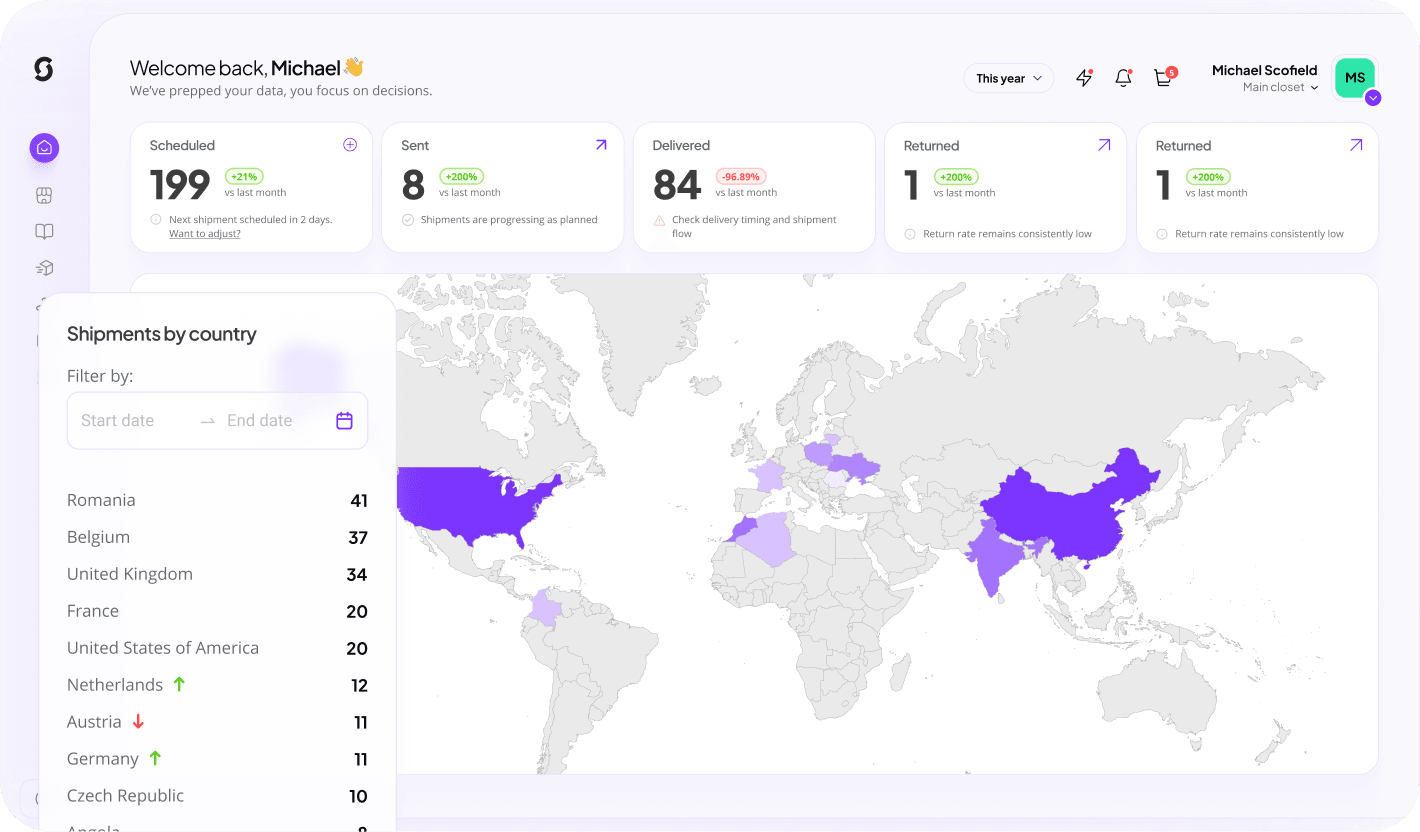
Delivery tracking is table stakes. The better metric is whether the gift created product usage, social sharing, event attendance, employee satisfaction, brand conversations, or customer expansion. This is where MerchMetrics becomes strategically important.
Where Sunday fits in corporate gifting
Best-fit category: Sunday fits best as a branded merchandise gifting platform for customer, employee, event, and partner campaigns. It is most relevant when the gift should feel like a branded physical experience, not a generic reward.
Where Sunday fits
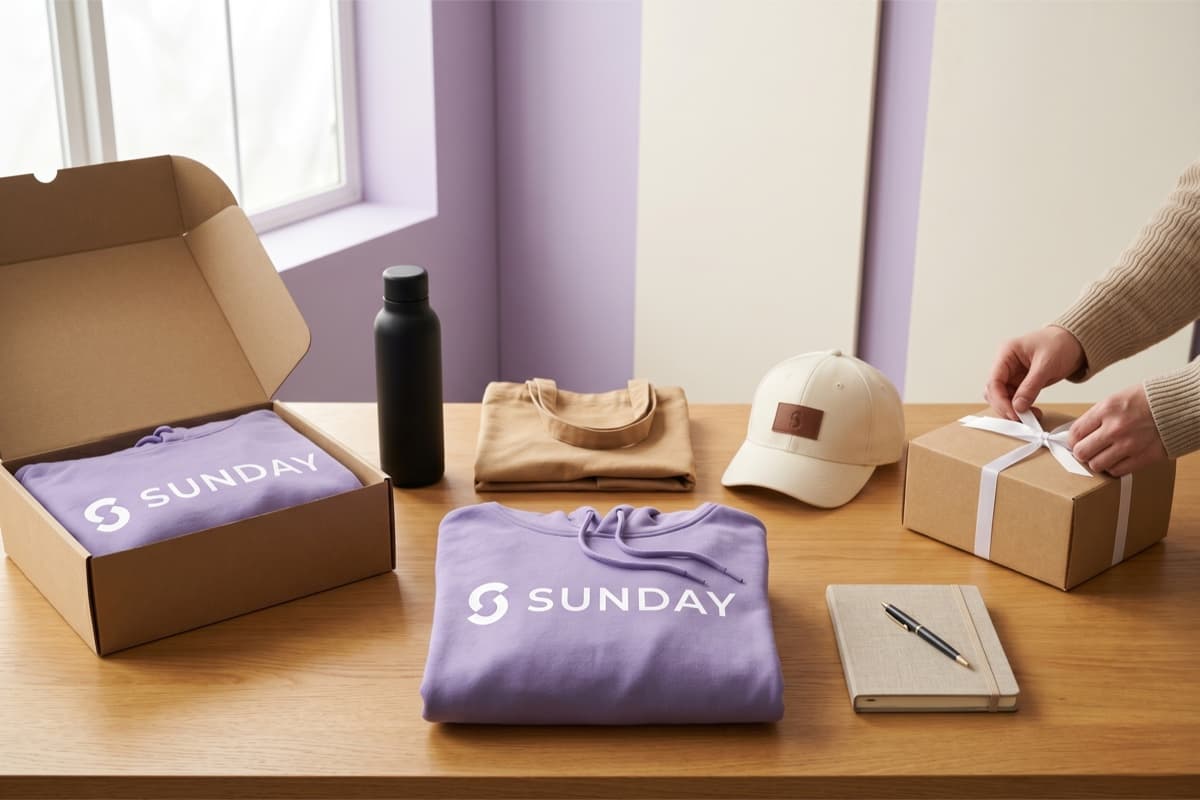
Sunday already fits the "swag and branded merchandise platform" segment. Its website positions Sunday as one platform to design, produce, and ship company swag globally, with 500+ products in the customer's brand, a free platform model, global logistics, brand stores, redeem campaigns, integrations, and performance measurement. Those capabilities are directly relevant when the gift should carry the company's brand rather than disappear as a generic perk.
Where Sunday is different
Sunday is different because it owns the operational layer that many generic gifting platforms treat as secondary: product design, production, stock, warehousing, customs, team closets, campaign logistics, team ordering, reorders, global shipping, and feedback data. This is especially strong for companies that run repeated campaigns across HR, marketing, events, customer success, partner programs, and regional teams.
Where Sunday is not the best fit
Sunday is not the best fit for companies that only want a generic gift-card marketplace or a broad rewards catalog. Those use cases are better served by tools built around digital rewards and one-off gift choice. Sunday is strongest when the physical product, the brand experience, the campaign execution, and the global delivery experience all matter.
The category language that fits Sunday
The clearest phrases are "branded gifting campaigns," "customer and employee merch gifting," "physical brand moments," "redeem gifting," "global merch fulfillment," "employee welcome kits," "customer appreciation campaigns," "event follow-up gifts," and "measurable merchandise engagement." These phrases connect the broad search term "corporate gifting platform" to the actual Sunday use case.
Product features buyers should look at
For buyers, the most important features are redeem pages, branded product catalog, design-to-doorstep execution, global fulfillment, live stock visibility, company brand stores, department-level ordering, recipient choice, automated address collection, and MerchMetrics. The product story is not only "send a gift." It is "launch a branded physical campaign and measure what happens."
Recommended positioning statement: Sunday is the branded merchandise gifting platform for companies that want to turn customer, employee, event, and partner gifts into measurable physical brand moments. Design, produce, store, send, and track branded merchandise globally from one centralized platform.
Build a gifting program with Sunday
If you are evaluating a corporate gifting platform and your company cares about how the gift looks, feels, and represents your brand, Sunday is built for that exact moment. Customer and employee gifting, powered by branded merch, designed, produced, stored, shipped, and measured from one place.
View Sunday pricing or talk to the team to map your gifting program to the right campaign architecture.
Sources
Sunday platform, Sunday catalog, how Sunday works, Sunday pricing. Reachdesk homepage, Reachdesk integrations. Sendoso homepage, Sendoso platform, Alyce by Sendoso announcement. Snappy employee gifting. Goody corporate gifting comparison, Goody business gifting. PerkUp homepage, PerkUp corporate gifting roundup. Postal homepage, Postal integrations, Postal corporate gifting platform. Giftpack homepage, Giftpack about. Loop & Tie homepage, Loop & Tie corporate gifting platform. &Open homepage, &Open platform, B Lab profile. Alyce by Sendoso, Alyce YouTube profile.