.png&w=256&q=75)
Executive summary
Zalando is one of Europe's strongest brands, and one of its most autonomous organisations: every department, country and campaign team buys what it needs. For merchandise, that autonomy came at a price. Every team ordered from its own suppliers, with its own budget and its own design, so there was no brand control, no quality control and no shared process.
In Q3 2025, Zalando's employer branding team and Sunday launched the House of Merch: one internal platform where every team can order on-brand merch through three collections — Ready to wear, Make it yours and Build something new. The principle is simple: centralise the system, decentralise the ordering.
Today the House of Merch serves 120+ teams, handles 200+ orders a year and has shipped 15,000+ items. An order that used to take around five hours of coordination now takes twenty minutes. That adds up to 933 hours saved and more than €30,000 in operating costs — before counting any savings on the products themselves.
Watch: how Zalando runs merch at scale
At DMEXCO 2026 in Cologne, Zili Wang (Employer Branding, Zalando) and Niels Vandecasteele (Co-founder, Sunday) took the stage together to walk through the House of Merch. Watch the full 13-minute masterclass below; this case study unpacks every part of it.
About Zalando
Zalando is Europe's leading online fashion and lifestyle platform. Two things define how it operates, and both shaped this project.
- A very strong brand. For a fashion company, the orange of the logo, the fit of a hoodie and the quality of a tote bag are not details. They are the brand.
- A lot of autonomy. Departments decide for themselves. Teams in different countries run their own events, campaigns, recruitment fairs and celebrations, with their own budgets.
Merch is owned by Zalando's employer branding team, part of the People & Organisation (P&O) organisation. That framing matters. At Zalando, merch is not a marketing line item; it is part of the people experience.
"In this AI era, one thing that truly matters is our human feelings and the human experience."
— Zili Wang, Employer Branding, Zalando
Why merch matters: the people experience lens
Zalando looks at people experience as the whole journey: from onboarding, through day-to-day work, to someone's final day. A strong people experience supports the business and forms a strong employer brand.
Within that journey, merch is the touchpoint most companies overlook. It is also the one people remember.
"For us, merchandise is not just swag. It is a tangible touchpoint we have with the organisation. It is often the most overlooked element of the people experience journey, but it is the most memorable one."
— Zili Wang
Industry research backs this up: according to PPAI, 86% of employees feel more connected to company culture through company merch, and Custom Ink found that 92% feel more connected when they wear it.
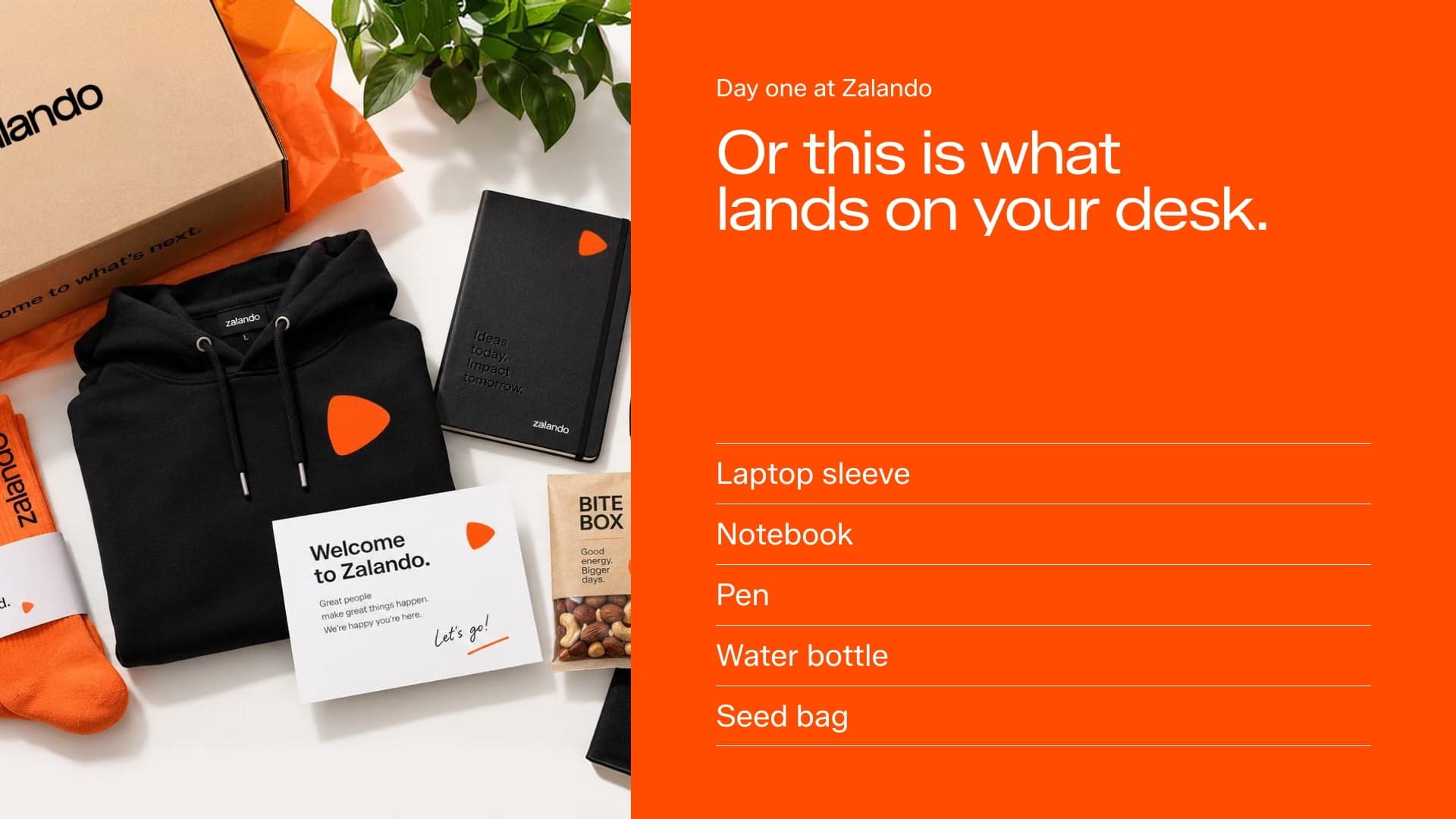
Take day one. Next to a laptop and a phone, every new Zalando colleague receives a welcome box: a laptop sleeve, a notebook, a pen, a water bottle and a seed bag with flower seeds — to plant and grow, as a symbol of their growth at Zalando. Every piece carries the Zalando brand identity.
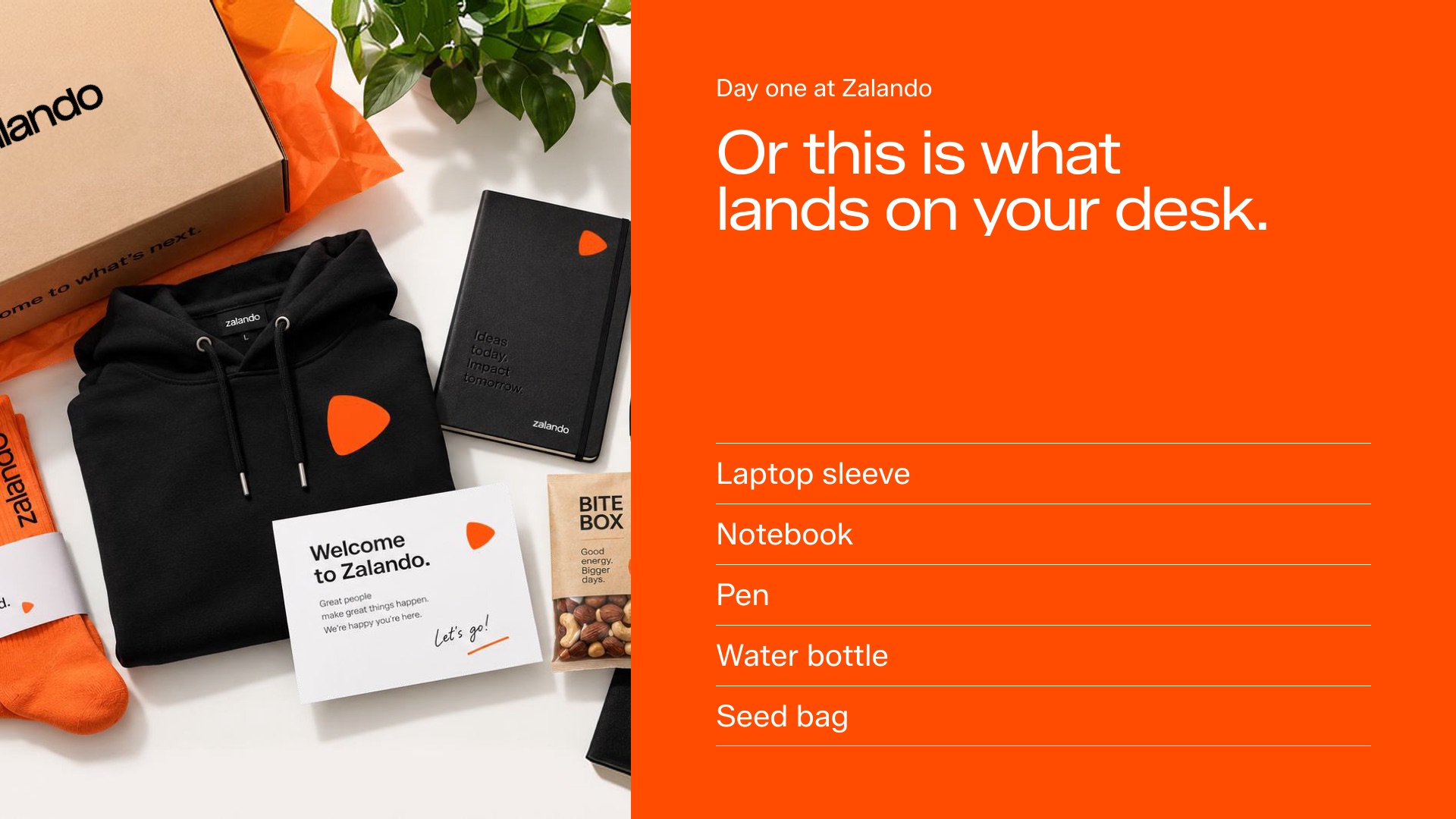
Day one at Zalando: the welcome box is the first thing the brand ever hands you.
The challenge: autonomy without a system
Before the House of Merch, that welcome-box experience was impossible to guarantee. Zalando had the same three problems in every team, in every office.
"Previously we had no centralised process at all. Imagine, we're such a massive organisation. Each team could order from their own suppliers, with their own budget and their own design. This naturally leads to a lack of brand consistency."
— Zili Wang
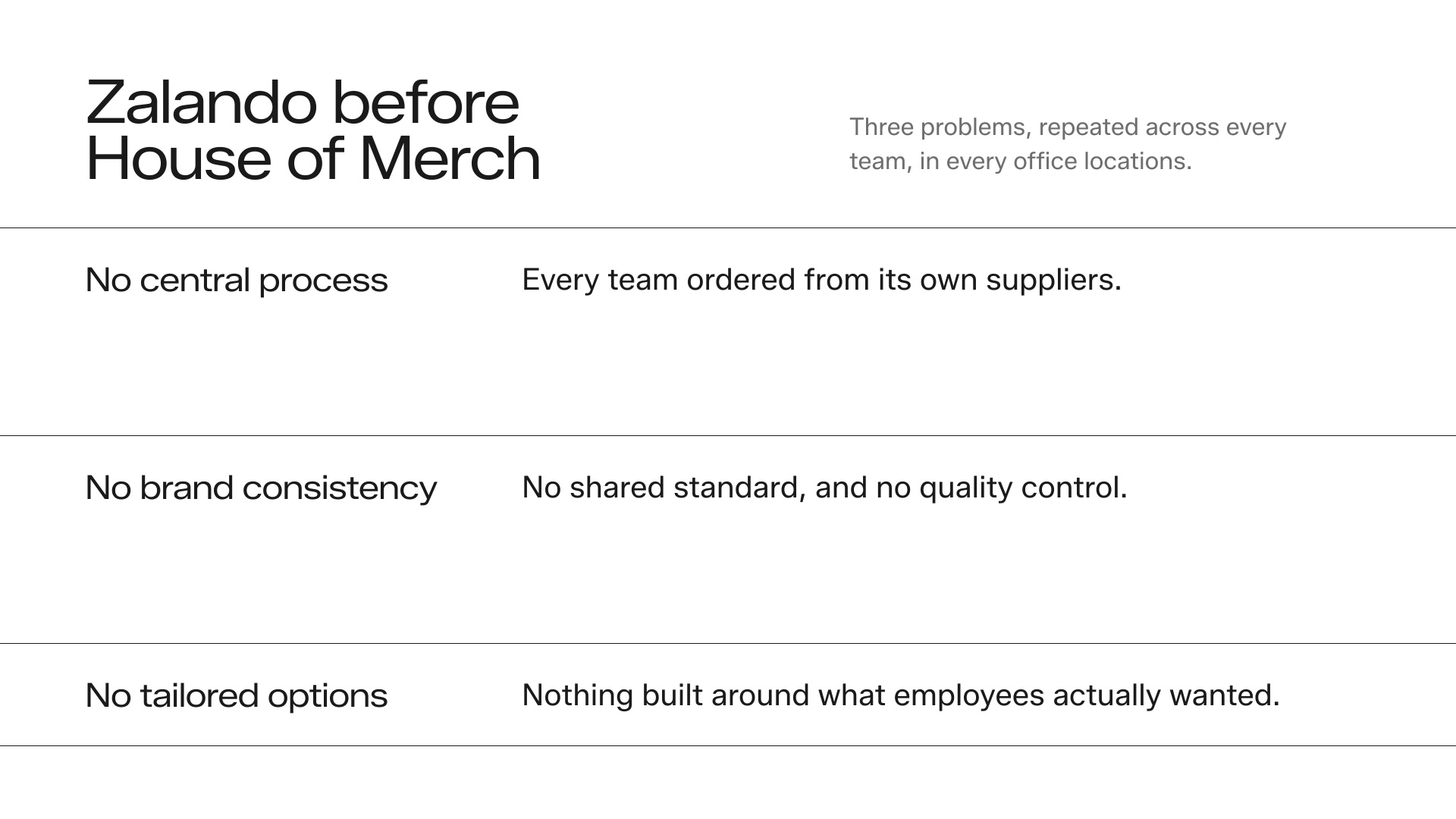
Three problems, repeated across every team and every office.
1. No central process
Every team ordered from its own suppliers. Requests went through long email chains, forwarded from one person to the next. A typical merch order, even with limited design requests, consumed around five hours across everyone involved: the requesting team, the design team that had to approve the artwork, and often procurement or purchasing.
And it was nobody's core job. The person organising tote bags for a recruitment fair was a recruiter, not a buyer. The classic version: "Can you quickly organise some merch? We need it by Friday." It is already Wednesday.
2. No brand consistency, no quality control
With no shared standard, every team made its own choices — a slightly different orange, the logo on the wrong product, a supplier nobody had vetted. For a fashion brand, that is a real risk. A t-shirt that shrinks after one wash says something about Zalando, whichever team ordered it.
3. No tailored options
Because there were no merch guidelines, colleagues could not safely customise anything. There was nothing built around what employees actually wanted: a team name on a hoodie, an event date on a tote bag.
The hidden cost: fragmented purchasing
On top of the time, fragmentation was expensive. Each team bought locally, in small quantities. Add tight deadlines and the bill grows: faster turnaround costs money, express shipping costs money. The "cheap" local order was rarely cheap once you counted rush fees and five hours of people's time.
The brief to Sunday was therefore a balancing act. Zalando needed 100% brand control — no random oranges, no logos on the wrong items, one quality bar. But it did not want to centralise ordering into a bottleneck that would kill the autonomy its teams rely on.
The design principle: centralise the system, decentralise the ordering
The answer was to split the problem in two.
- Centralise the system. One brand standard, one supplier base, one approved product range, one place where everything lives — owned and approved by the brand team.
- Decentralise the ordering. Every team logs in, chooses what it needs and orders on its own budget, without asking anyone for permission.
Teams do not all need the same thing, so the House of Merch offers three collections, each matched to a different kind of need.
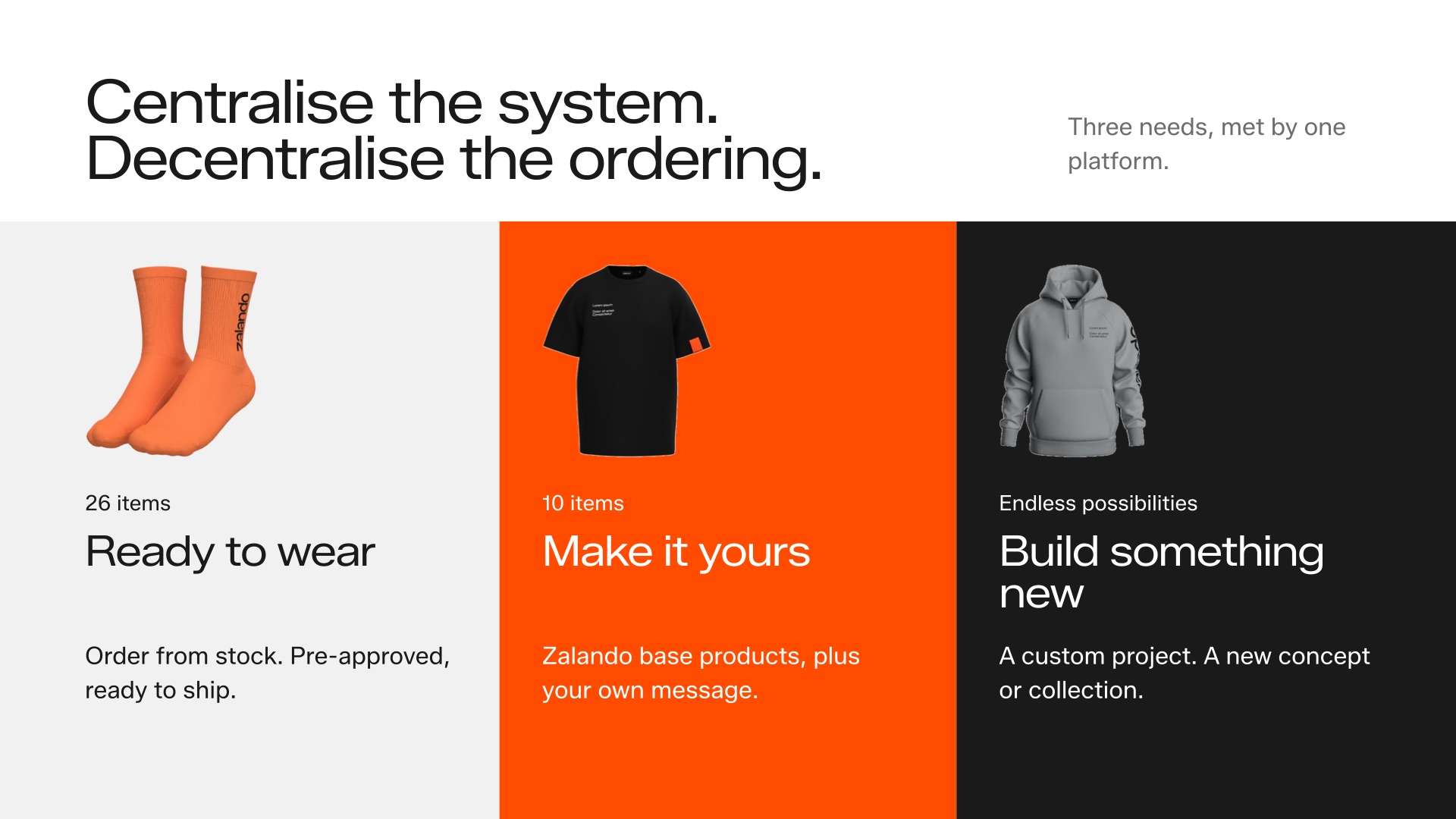
Three needs, met by one platform.
The three collections, explained
1. Ready to wear — order from stock, delivered in 2–3 days
What it is: 26 pre-approved, pre-produced Zalando products. They are produced in volume, held in stock by Zalando, and available through the internal web shop.
What it solves: the "we need tote bags by Friday" problem. Zalando has a lot of people, a lot of events and a lot of last-minute needs. Ready to wear makes sure any team can solve its merch question at the moment it comes up.
How fast: merch reaches the team that needs it, anywhere in Europe, in two to three days.
Typical uses: welcome boxes, recruitment fairs, conferences, office visits, quick thank-yous.
2. Make it yours — Zalando base products plus your own message
What it is: around 10 products kept 90% finished: already made, already Zalando-branded, ready for one last print.
What it solves: a team that needs merch for a specific event and wants that event — or a team name, a date, a partner — printed on it. The brand-critical work is already done and locked. The team only adds the final layer.
Typical uses: team hoodies with the team name, event-specific t-shirts, co-branded items for partner events, internal kick-offs and offsites.
3. Build something new — a custom project or collection
What it is: a fully custom route for new concepts and collections, developed together with Sunday.
What it solves: Zalando is a fashion brand, and sometimes it wants to do something special. This route takes longer, but it still runs through the same system, the same brand standard and the same quality bar.
Example: a full collection to support the marathons Zalando sponsors across Europe.
At a glance
| Ready to wear | Make it yours | Build something new | |
|---|---|---|---|
| Range | 26 items | ~10 items | Endless possibilities |
| Product state | Finished, in stock | 90% finished, final print added | Designed from scratch |
| Customisation | None — pure Zalando brand | Your event, team or message | Fully custom |
| Speed | 2–3 days across Europe | Short production run | Project timeline |
| Best for | Last-minute needs, onboarding, fairs | Events, teams, partners | Flagship campaigns, sponsorships |
The point is not the products. The point is that every team can decide for itself which route fits its campaign — and every route ends in something that is 100% on brand.
How an order works, end to end
The House of Merch is the official destination for all Zalando merchandise. Here is what ordering looks like for any team in the company:
- Log in. Every Zalando employee who needs merch gets their own account.
- Choose a collection. Ready to wear, Make it yours, or a request to build something new.
- Configure. Pick quantities and sizes and, where relevant, add custom text. Volume pricing is shown in the same flow.
- Order on the team's own PO number. The budget stays with the team. No approval loop, no budget transfers.
- Receive. Stock items arrive anywhere in Europe within two to three days.
No more email chains. No more forwarding and forwarding. No designer checking logo placement, because the logo placement is already locked.
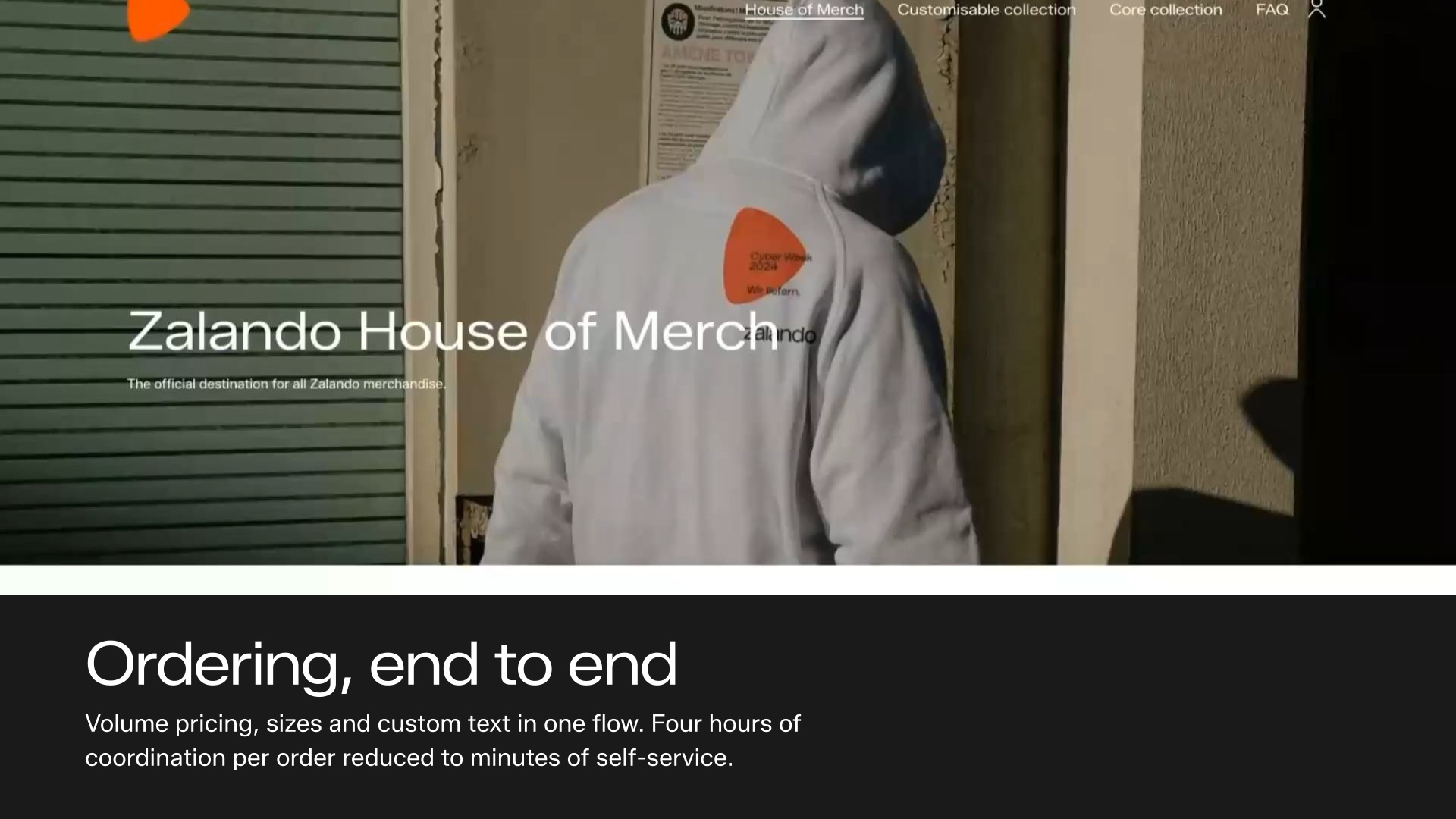
The Zalando House of Merch: volume pricing, sizes and custom text in one flow.
Governance: approve once, then lock it in
Brand control in the House of Merch does not come from approving every order. It comes from approving the range.
Once or twice a year, Sunday and Zalando build the collection together. It is reviewed and approved by the branding team and everyone involved in the Zalando brand. Once it goes live, it is locked. From that moment, the brand team knows that everything ordered through the platform is 100% on brand — whichever team, country or campaign it is for.
This is what makes autonomy safe at international scale. The brand team moves from gatekeeper to architect: it sets the system once, and the system does the policing.
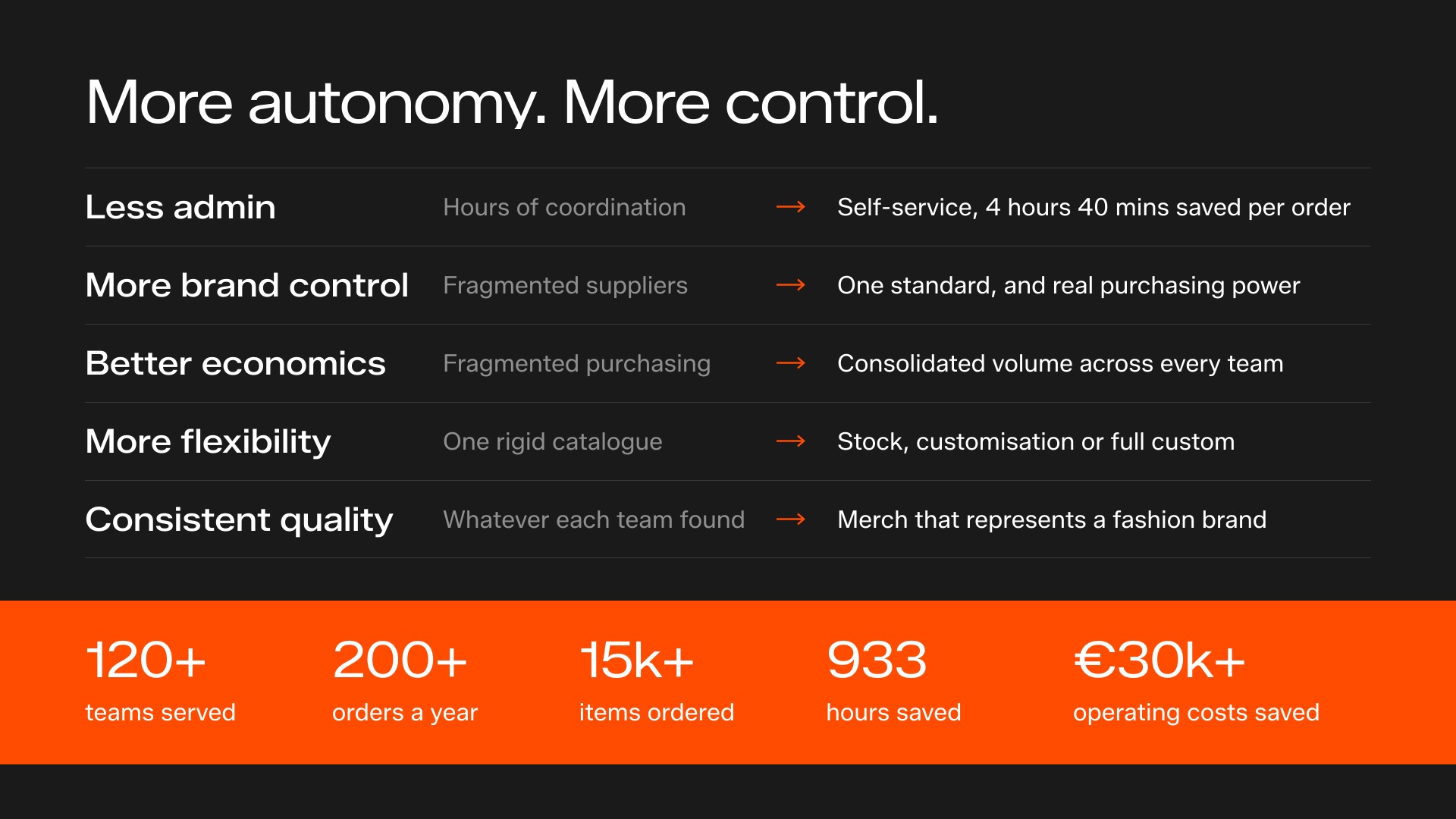
Five shifts: more autonomy and more control
Autonomy and control usually pull against each other. The House of Merch was built to increase both.
| Shift | Before | After |
|---|---|---|
| Less admin | Hours of coordination per order | Self-service: 4 hours 40 minutes saved per order |
| More brand control | Fragmented suppliers | One standard, and real purchasing power |
| Better economics | Fragmented, small-quantity purchasing | Consolidated volume across every team |
| More flexibility | One rigid catalogue — or none | Stock, customisation or full custom |
| Consistent quality | Whatever each team found | Merch that represents a fashion brand |
Less admin
An average order used to take around five hours of combined effort from design, procurement and the requesting team. Through the House of Merch, it takes a maximum of twenty minutes.
More brand control
The collection is approved and locked, so nothing off-brand can be ordered. That matters more as you scale internationally: there is no country or team that drifts.
Better economics
Instead of dozens of small local orders — each with its own setup cost, rush fee and express shipment — volume is consolidated across every team. Having stock ready also removes most of the deadline premium.
More flexibility
Sometimes a team needs plain Zalando branding. Sometimes it wants to customise because the event is with a partner. Sometimes it wants to go big. All three are available, and the team chooses.
Consistent quality
A welcome kit for the team in Finland is exactly the same as one for the team in Germany, and holds the same standard as a tote bag handed out at a recruitment fair. Every physical piece of Zalando merch meets one quality bar.
More autonomy. More control.
Merch across the whole employee journey
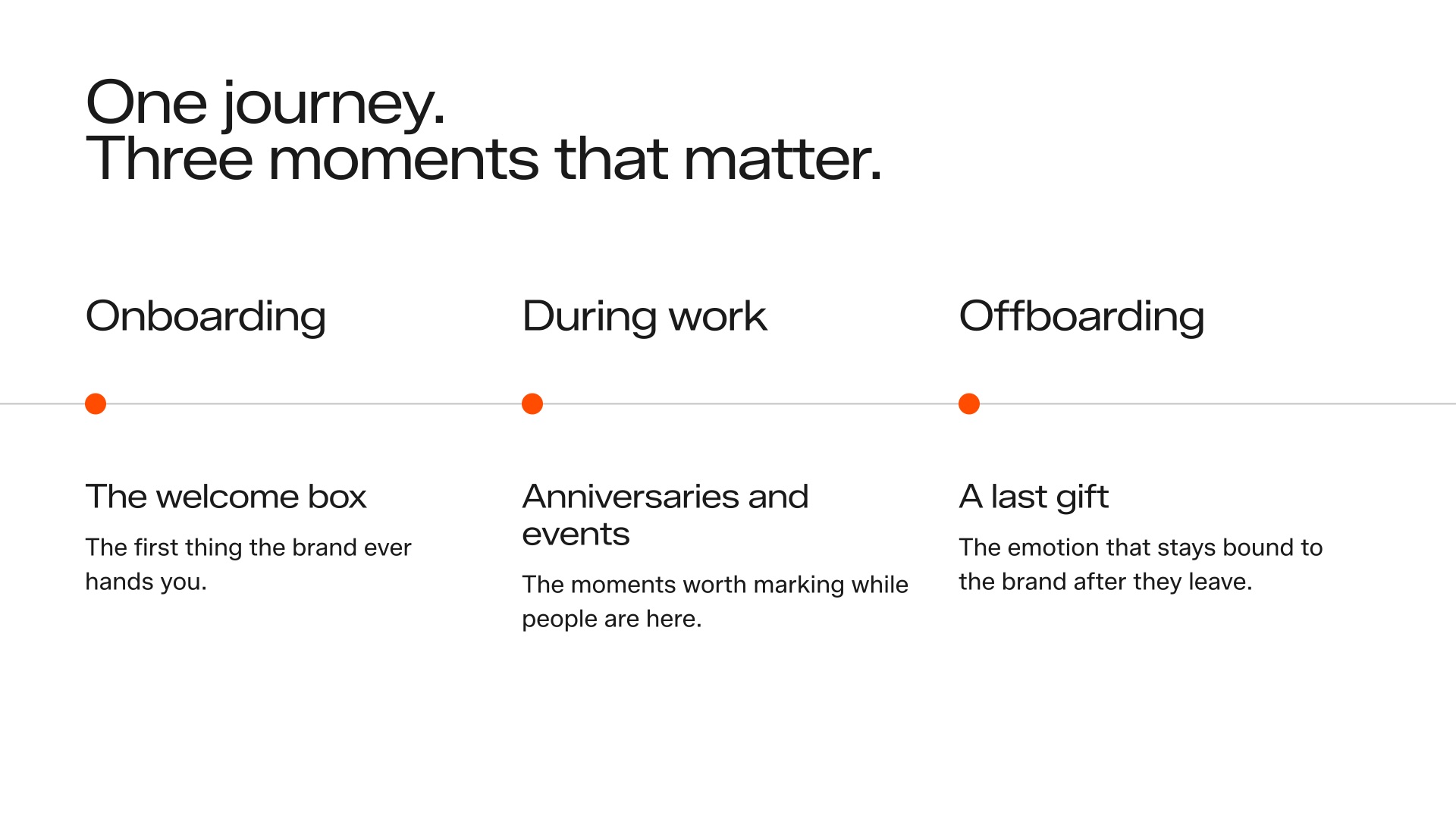
Solving the operational pain was step one. Step two was using the House of Merch to raise the people experience across Zalando, at three moments that matter.
Onboarding: the welcome box
A manager logs in and orders a welcome box for a new joiner. If the team has specific needs, it can tailor items — for example, the team name on a hoodie or t-shirt. It is the first thing the brand ever hands a new colleague, and it is identical in every country.
During work: anniversaries, rewards and events
Team leads use the House of Merch to reward a hard-working colleague, to celebrate a five- or ten-year anniversary, or to equip a team for an event — such as Zalando's appearance at DMEXCO itself.
Offboarding: a last gift
On someone's final day, a colleague can order a farewell gift to give a remarkable journey a memorable end. The emotion stays tied to the brand after the person leaves — and alumni are some of an employer brand's most credible voices.
One journey. Three moments that matter.
Impact and key results
One year after launch, the numbers Zalando and Sunday presented on stage at DMEXCO 2026:
- 120+ teams serve themselves through the House of Merch.
- 200+ orders a year run through one system instead of hundreds of email threads.
- 15,000+ items ordered through the platform.
- 4 hours 40 minutes saved per order: from around five hours of coordination to a maximum of twenty minutes.
- 933 hours saved — hours from people whose core job is not ordering merch.
- €30,000+ in operating costs saved — only the cost of placing and managing orders, not counting product savings from consolidated volume.
- 2–3 days delivery across Europe for stock items.
The real result is harder to put in a table. Teams get better merch, faster. The brand team gets total control without approving a single t-shirt. And every new colleague, in every country, gets the same welcome.
How to structure your own merch operation: the Zalando blueprint
You don't need to be Zalando's size to use its model. Any organisation where multiple teams order merch — from around 250 employees upward — can apply the same structure.
- Map what you have. Who orders merch today, from which suppliers, on which budgets? Most companies cannot answer this, and few know their total annual merch spend.
- Find your "Friday" products. Identify the items teams need again and again at short notice. These become your Ready-to-wear stock range.
- Define what teams may customise. Pick a small set of base products that teams can personalise with an event, team or partner name — inside fixed brand rules.
- Keep a door open for special projects. A Build-something-new route stops strong ideas from leaking out to random suppliers.
- Approve once, then lock. Have the brand team approve the range once or twice a year, instead of approving individual orders.
- Give every team access and its own budget. Accounts plus PO-based ordering keep autonomy with the teams and remove admin from the centre.
- Connect merch to the employee journey. Onboarding, milestones, events and offboarding are where merch has the most impact.
Three things to take with you
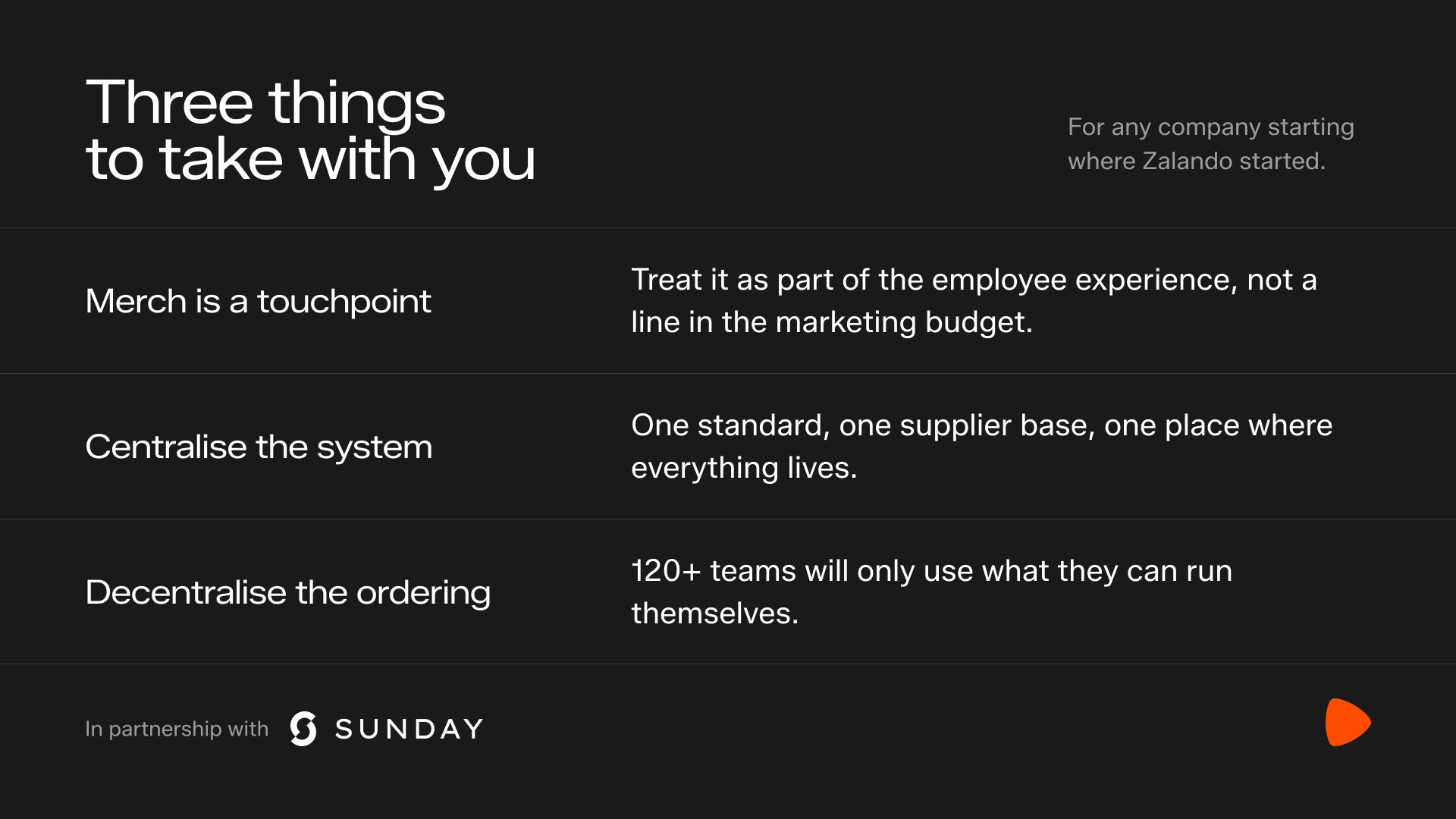
Zili closed the DMEXCO masterclass with three takeaways for any company starting where Zalando started.
- Merch is a touchpoint. Treat it as part of the employee experience, not a line in the marketing budget.
- Centralise the system. One standard, one supplier base, one place where everything lives. Centralisation ensures consistent branding, consistent process and consistent quality.
- Decentralise the ordering. 120+ teams will only use what they can run themselves. Give them the autonomy to plan their own needs, budget and purpose.
For any company starting where Zalando started.
"The House of Merch is a good example of Zalando's continuous commitment to deliver a strong and meaningful people experience for our employees — the experience they deserve."
— Zili Wang, Employer Branding, Zalando
Find the cost hiding behind your merch
Good merch is easy to find if you look hard enough. The hard part is organising it so every team can order for itself while internal workload and frustration go down. Sunday offers a free 30-minute Merch Efficiency Audit: we map your current operation, quantify the hidden costs and leave you with a one-page action plan.