



Definition
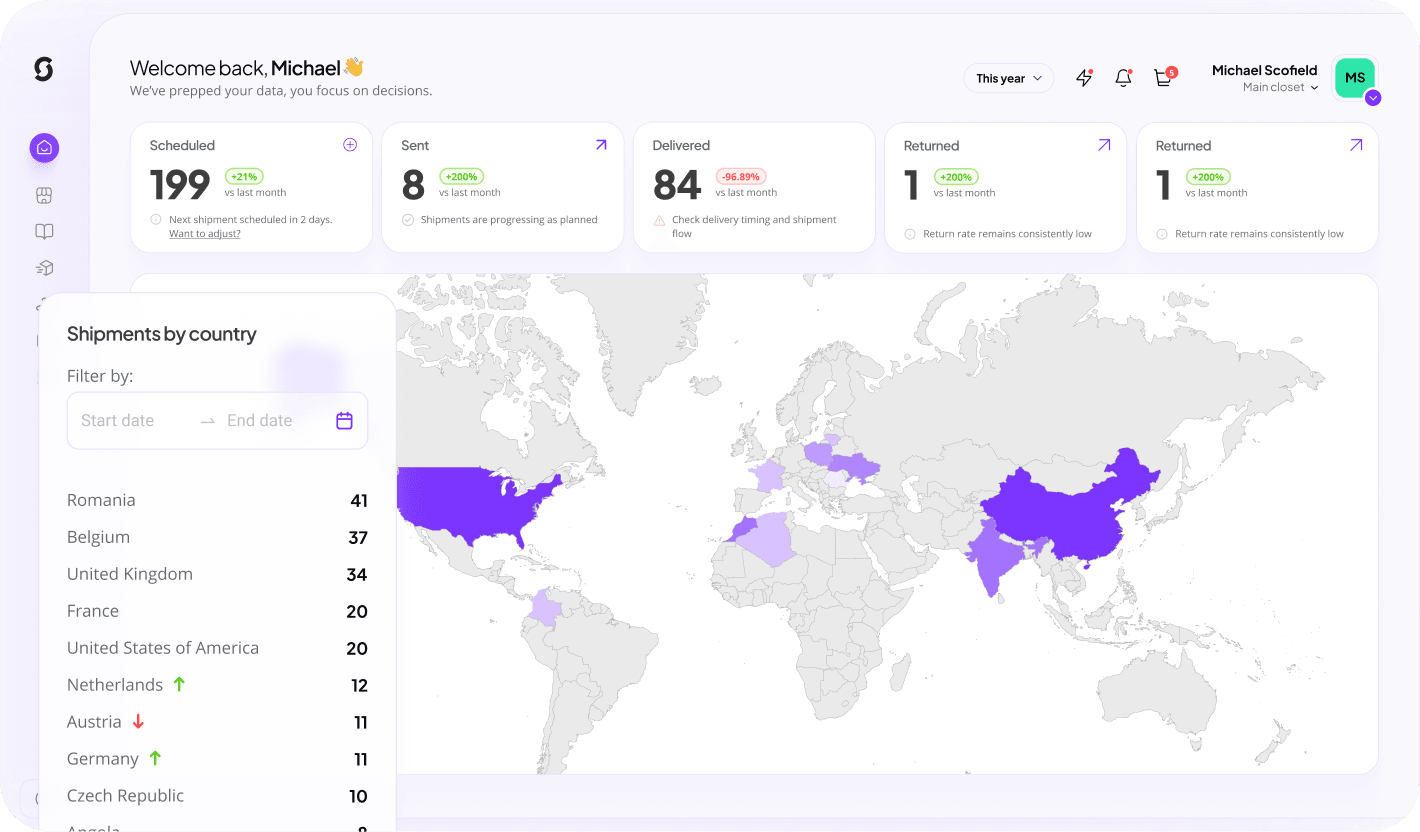
Global distribution is how one merch program reaches people in twenty countries without creating twenty separate problems. It decides where items are produced, which warehouse a parcel leaves from, who pays the import duty, and how many days the recipient waits. The moment your team stops sitting in one building, this stops being optional.
Definition
Global distribution moves branded merchandise from production to recipients in multiple countries, using regional production and regional stock instead of one central warehouse mailing the world. It covers hub strategy, customs handling, carrier choice, duties and taxes, and the product decisions that make cross-border shipping work at all.
A concrete example. A company headquartered in Amsterdam sent 400 onboarding kits a year to staff in the US, Brazil and Singapore, all from a Dutch warehouse. Transit ran twelve to eighteen days. Duties were billed to the employee on arrival, so new hires got a customs invoice in their first week. Splitting the same program across three hubs, one in the Netherlands, one in New Jersey and one in Singapore, with duties prepaid, cut delivery to three to five days and removed the surprise bills entirely. Same kit, same brand, different starting point.
How global distribution works
It starts with hubs. A hub is a warehouse or production site close to a cluster of recipients. Ship from Rotterdam to a colleague in Texas and you pay international freight, clear customs, and wait. Ship from a New Jersey hub instead and it is a domestic parcel: two days, no paperwork, a fraction of the cost. Most programs need three nodes to cover the majority of employees and customers, usually EU, North America and Asia Pacific. Add a fourth for Latin America or the Middle East once volume justifies it. Bulk stock moves between hubs by sea freight, which is slow and cheap, and last-mile parcels move locally, which is fast and cheap. The expensive combination is international express parcels, and that is exactly what an unplanned program ends up buying.
Then comes customs. Every item crossing a border needs an HS code, a declared value and a commercial invoice. The two terms that matter are DDP and DAP. Under DDP, delivered duty paid, the sender covers duty and import VAT, so the recipient signs for the box and nothing else. Under DAP the recipient pays on delivery, which is fine for a business address and terrible for a new hire or a client. Ship gifts DDP, always. Watch de minimis thresholds too, since a country's duty-free limit determines whether a 40 dollar mug arrives clean or triggers a 25 dollar handling fee. Marking a shipment as a gift does not make duty disappear, and undervaluing an invoice is fraud, not a shortcut.
Product choice is the last piece, and it quietly decides everything. Power banks and anything with a lithium battery face air freight restrictions and are refused outright by some carriers and countries. Aerosols, alcohol and certain food items are similar. Sizing conventions differ, so a US large is not a European large, and a range built for one region will fit badly in another. The practical answer is a core range that ships anywhere, produced regionally where volume allows, with local substitutions where the item cannot legally or sensibly cross a border. A pick and pack operation in each hub then assembles kits from local stock rather than shipping finished boxes around the planet.
Global distribution in branded merch
- Onboarding kits for a distributed team. A new hire in Sao Paulo gets the same welcome kit as one in Berlin, packed and shipped from the nearest hub, arriving before day one rather than three weeks after it.
- Multi-city event and conference drops. Merch for a roadshow in five cities is produced and held regionally, so each venue receives stock from within its own market. No pallets crossing oceans on a deadline, no customs holding your booth kit.
- Client gifting across regions. Sales sends a redemption link. The recipient chooses their item and enters their own address, and the gift ships locally with duties prepaid, so the gesture never arrives with an invoice attached.
Global distribution is the system for producing, storing and shipping branded merchandise across borders, so every recipient gets the same item at a sensible cost and lead time.
5 tips to elevate your Global distribution strategy
| Tip | Steps |
|---|---|
| Ship DDP for anything that is a gift | Prepay duty and import VAT. A customs bill lands on a person who did nothing but accept a present. |
| Hold stock where your people are | Map headcount by country, then place hubs where the top three clusters sit. Coverage beats warehouse count. |
| Check restrictions before you pick the product | Lithium batteries, aerosols and liquids fail at borders. Confirm shipability before design, not after. |
| Move bulk by sea, parcels by local carrier | Sea freight between hubs, domestic last mile out of each hub. Avoid international express as a default. |
| Validate addresses at checkout | Bad addresses are the main cause of failed cross-border delivery. Capture and verify the address from the recipient. |
Key Terminologies
Frequently Asked Questions
How many warehouses do you need for global distribution?
Three usually covers the bulk of a distributed company: one in the EU, one in North America, one in Asia Pacific. Add a fourth only when a region generates enough volume to pay for the stock sitting there.
What is the difference between DDP and DAP shipping?
Under DDP the sender pays duty and import VAT before delivery, so the recipient owes nothing. Under DAP the recipient is billed on arrival. Use DDP for employee kits and client gifts, since nobody should pay to receive a gift.
Which merch items are hardest to ship internationally?
Anything with a lithium battery, such as power banks, wireless chargers and speakers, plus aerosols, liquids and alcohol. These face air freight rules and country-level bans, so produce or source them locally instead of shipping them across borders.
Does global distribution cost more than shipping from one warehouse?
Per parcel it costs less. Regional stock turns expensive international express shipments into cheap domestic ones, and prepaid duty avoids failed deliveries. The trade-off is inventory spread across more locations, which is why a fixed core range matters.
How long should a cross-border merch delivery take?
From a regional hub, two to five days is normal. Shipping the same item internationally from a single central warehouse typically takes ten to twenty days once customs clearance is counted, and the range is unpredictable.