





Part of our complete guide to turning your dealer network into a local brand activation network.
Cooperative advertising is an arrangement where a manufacturer pays part of a retailer's or dealer's local advertising cost in order to stimulate sales of its products. The manufacturer gets local reach it could not buy efficiently on its own. The retailer gets a bigger advertising budget than it could justify alone. Both sides sell more of the same product.
What's in this guide
What cooperative advertising is
Cooperative advertising, usually shortened to co-op advertising, is a cost-sharing arrangement between a manufacturer and the party that sells its products locally. The manufacturer contributes a defined share of the local advertising spend. The retailer, dealer or distributor runs the advertising in their own market, under their own name, featuring the manufacturer's product.
The classic form is an accrual. A dealer earns co-op funds as a percentage of what they purchase, typically somewhere between one and five percent, and can then claim reimbursement against qualifying local advertising. Some programmes work on a fixed annual allocation instead. Others match spend up to a cap, most commonly fifty-fifty.
The vocabulary varies by industry. In technology channels it is usually market development funds, or MDF, which tends to be discretionary and campaign-based rather than accrued on purchases. In automotive and durable goods it stays co-op. The economics underneath are the same.
| Model | How the money is earned | Best suited to |
|---|---|---|
| Accrual co-op | A percentage of the dealer's purchases builds a fund | Stable, high-volume dealer networks |
| Fixed allocation | A set budget per dealer, region or tier | Networks with many small partners |
| Matched spend | The manufacturer matches the dealer up to a cap | Encouraging partners who already invest |
| Market development funds | Discretionary, awarded per campaign or plan | Technology and reseller channels |
Why cooperative advertising exists at all
Strip away the administration and there is one structural problem underneath. In a channel, the party best placed to advertise locally is not the party that captures most of the benefit.
A dealer advertising your product in their town pays the full cost of that advertising. They capture only their own margin on the resulting sales. You capture the manufacturing margin, plus the brand effect, plus the sales that the advertising sends to other dealers in the region. From the dealer's point of view, a lot of the return leaks away. So, rationally, they advertise less than would be best for the channel as a whole.
That is not a motivation problem. It is arithmetic. And it is exactly the kind of misalignment a subsidy corrects. When the manufacturer carries part of the cost, the dealer's private calculation moves closer to the channel's collective one, and local advertising rises toward the level that is actually optimal.
What the research actually found
This is not just theory in a textbook. Cooperative advertising has been modelled formally, and the direction of the finding is consistent.
In the European Journal of Operational Research, Xie and Wei studied cooperative advertising and pricing in a two-member supply chain, comparing what happens when the manufacturer and retailer act independently against what happens when they cooperate. Their analysis found that cooperation generated greater advertising effort and higher total channel profits than the non-cooperative model.
Two parts of that are worth separating. Greater advertising effort means more local advertising actually gets done. Higher total channel profits means the pie grows rather than simply being divided differently. The second point is what makes co-op a strategy rather than a discount.
Related work in the Journal of Business Research points the same way, finding that manufacturer support for local advertising can improve channel performance, including under conditions of uncertain demand. That last qualifier matters in practice, because uncertain demand is the normal state of a dealer network rather than an edge case.

Co-op has always been about a local name appearing next to a national one. The surface has changed. The economics have not.
What co-op advertising looks like in 2026
The mechanism is unchanged. The definition of "advertising" is not. A co-op programme that still only reimburses print, radio and local press is subsidising the channel of 1995, which is a large part of why so many co-op funds go unclaimed.
The qualifying categories in a current programme usually look more like this:
- Local digital. Paid search, paid social, local landing pages and retargeting in the dealer's own catchment.
- Co-branded campaign assets. Manufacturer creative with dealer identity applied, generated rather than manually adapted.
- Events and exhibitions. Regional trade fairs, open days, demo days, showroom events.
- Showroom and point of sale. Displays, signage, product staging.
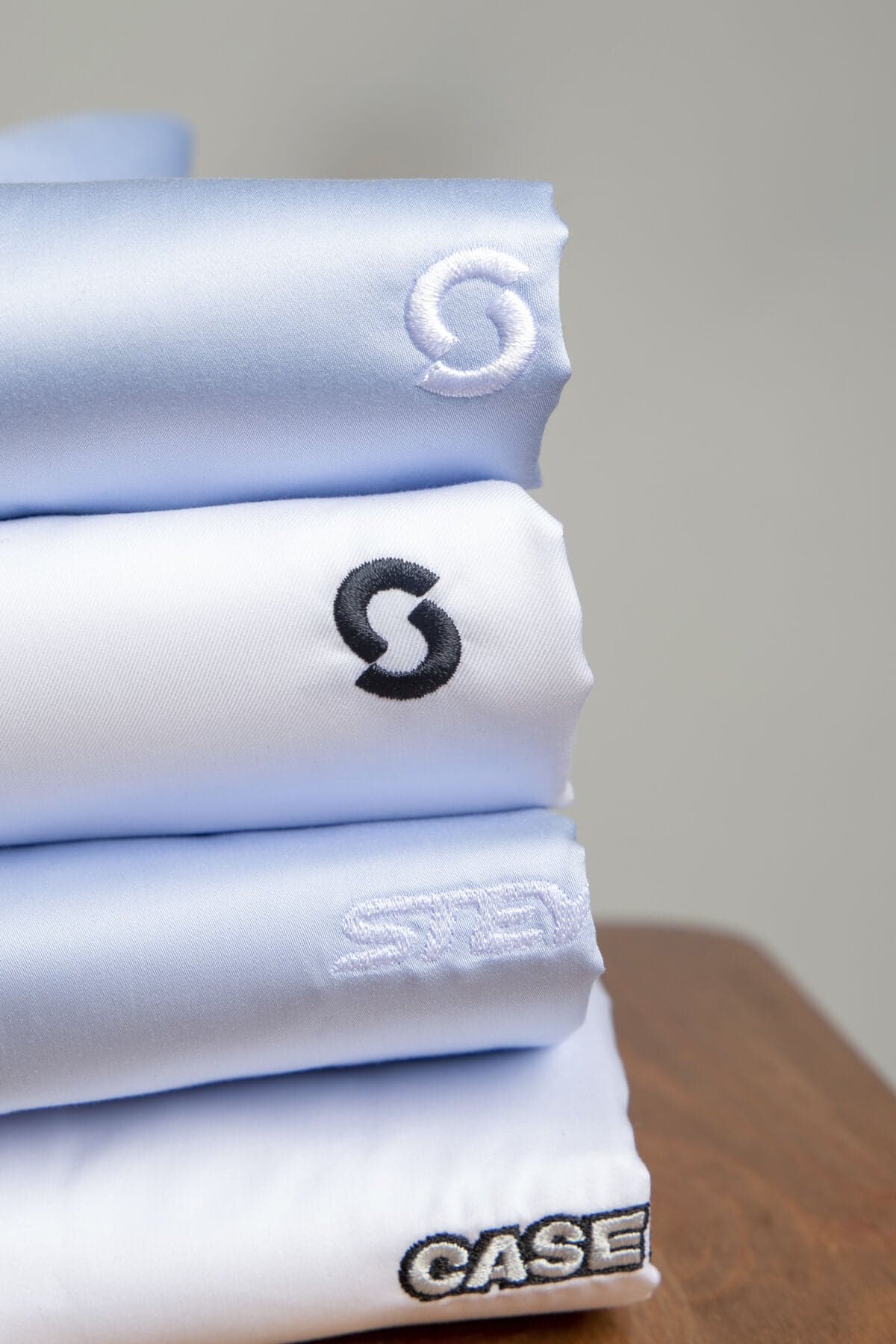
- Physical merchandise. Branded apparel for customer-facing staff, event giveaways, local customer gifting.
The last two are where most programmes are still weakest, and they are also where the local partner most often needs help. A dealer can figure out a boosted post. A dealer cannot easily produce forty on-brand polos and a co-branded pull-up banner for a regional fair in the two weeks before it happens. The automation side of making this fast is covered in through channel marketing automation.
Merchandise as a modern co-op category
Physical merchandise deserves its own line in a co-op programme for a reason that has nothing to do with gifting and everything to do with duration.
A co-op-funded search campaign delivers impressions while the budget runs and then stops. A co-op-funded set of branded jackets for a dealer's installation team delivers impressions in customers' homes for two or three years, at the exact moment the product is being fitted and discussed. Same subsidy, very different decay curve.
There is supporting evidence for the effect, and it is worth citing precisely rather than loosely. Research on promotional products in the Journal of Marketing Communications has found significant improvements in advertising credibility, attitude toward the ad, attitude toward the product, purchase intention and referral intention, and found that merchandise increased the effectiveness of television and print advertising when used alongside them. That combination effect is directly relevant to a manufacturer who is already buying national media and wants the channel to amplify it. The full evidence review, including the limits, is in do promotional products work.
Practically, adding merchandise to co-op works best when the dealer does not have to become a buyer. Approved products, fixed artwork, dealer co-branding inside a written rule, ordered against the co-op balance without a separate procurement process. That is the model described in co-branded merchandise for dealers, and it is the same infrastructure covered in dealer marketing programs.

A co-op category that keeps working after the budget stops. Apparel on customer-facing staff is local advertising with a multi-season decay curve.
How to structure the funds
Four decisions determine whether a co-op programme is used or ignored.
Accrual or allocation
Accrual rewards volume and suits stable, high-purchasing dealers. Allocation suits networks with a long tail of small partners, because a small dealer accrues almost nothing and therefore never participates. If your adoption problem is concentrated among smaller partners, accrual is part of the cause.
Reimbursement or pre-allocated credit
This is the single biggest lever on usage. Reimbursement asks the partner to front the money, complete a claim and wait. Pre-allocated credit removes the purchase decision and the cash-flow question entirely. Same budget, very different behaviour, and the difference falls hardest on exactly the partners you most want to activate.
Match rate and caps
Fifty-fifty up to a cap is the common default and it works, because a partner with skin in the game selects better activities. Full funding is appropriate for things you want standardised across the whole network, such as staff apparel or showroom signage, where partner choice is not the point.
Expiry
Funds with no expiry accumulate quietly and never convert. Quarterly or half-yearly expiry with a clear reminder cycle produces far more activity than an open-ended balance nobody feels urgency about.

Full funding suits the items you want consistent everywhere. Matched funding suits the activities where local judgement adds something.
Approval and proof of use
Every co-op programme needs controls. The failure mode is making the controls heavier than the activity they govern.
The workable split is to move approval from after to before. Rather than reviewing each claim, define a pre-approved menu. Anything on the menu, ordered inside the rules, needs no approval at all. Anything off the menu goes through a proper review. Most activity ends up on the menu, and the review queue shrinks to the genuinely unusual.
| Activity | Approval | Proof required |
|---|---|---|
| Approved merchandise from the standard collection | None | Order record, automatic |
| Co-branded assets generated from templates | None | Generated file, logged automatically |
| Local digital in the dealer's catchment | None, within spend cap | Platform report or screenshot plus invoice |
| Regional event or exhibition | Light, one form | Photos plus invoice |
| Anything using custom creative | Full review | Artwork approval before spend |
Where the ordering runs on a platform, proof of use largely takes care of itself, because the order record already shows who ordered what, when, against which budget and in which market. That removes the most tedious part of co-op administration for both sides.
Where co-op programmes go wrong
- Unclaimed funds treated as a saving. A fund nobody claims is a programme that is not working, not a budget win.
- Categories frozen in the past. If the qualifying list has not changed in five years, it no longer matches how partners reach customers.
- Claim processes longer than campaign cycles. If reimbursement lands two quarters later, the partner has already stopped.
- Accrual-only in a long-tail network. The smallest partners accrue nothing and stay dark forever.
- No definition of a good activation. Partners will not invent your category's playbook for you.
- Measuring claims instead of activations. Claims processed is an administrative metric. Count partners doing things.
Co-op advertising is one of the oldest tools in channel marketing and one of the least modernised. The economics still hold. The delivery mechanism is what needs rebuilding, and merchandise is the category with the most obvious gap between what partners need and what most programmes currently fund. For how this fits a wider partner relationship, see partner appreciation gifts and partner onboarding kits.
If you want to see what a co-op-funded apparel line looks like before writing it into a programme, the custom polos page shows the range and the free polo mockup generator lets you preview a co-branded dealer version in your own colours.
About this article
Make merchandise a co-op category that works
Approved collections, budgets by partner or region, ordering without a claim form, and proof of use recorded automatically. Create a free account to see it.
Set up partner budgets