

Business books have a structural problem. They are written by people with something to sell, they make claims that sound testable, and almost none of them are ever tested. The author moves on, the claims stay in print, and nobody checks.
In 2021 I co-wrote one of those books. Making Everyone a Superfan, with Stefan Doutreluingne, published by LannooCampus. Its argument was that ambassadors, meaning customers and employees who recommend you without being asked, are the most underrated growth channel available to a company, and that branded merchandise is one of the most effective accelerators for creating them.
Two years later I paid an independent research agency to find out whether that was true. This article is the comparison: what the data supported, what it did not, and what I would write differently now.
What the book actually claimed
Three claims from the book are specific enough to be tested, which is the only reason this exercise is possible at all.
- Ambassadors are the best yardstick for growth. The book argues that willingness to recommend is a better forward indicator than most of what companies put on a dashboard, and it builds a framework, DEAL (Develop, Engage, Attract, Love), around deliberately growing that group rather than waiting for it to appear.
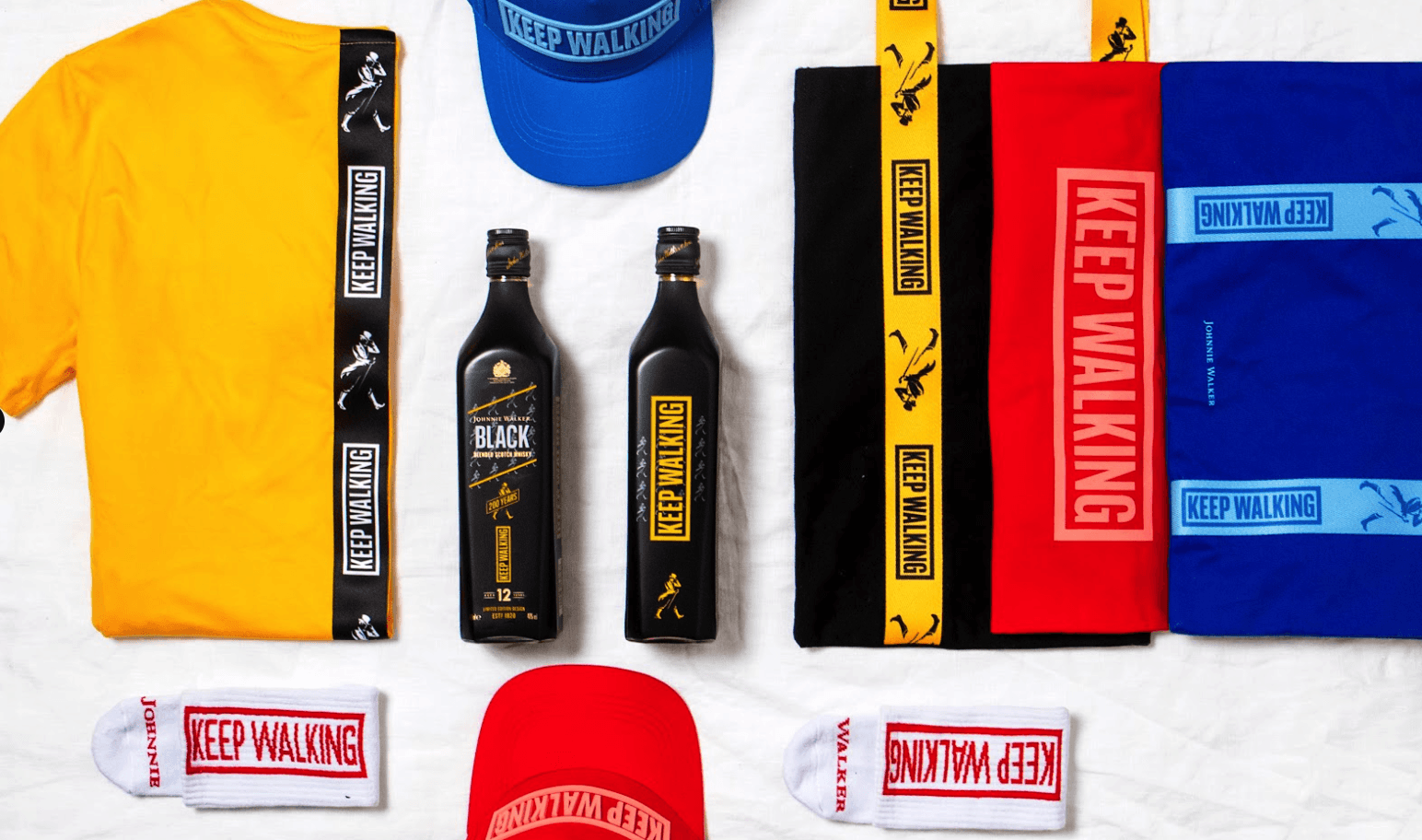
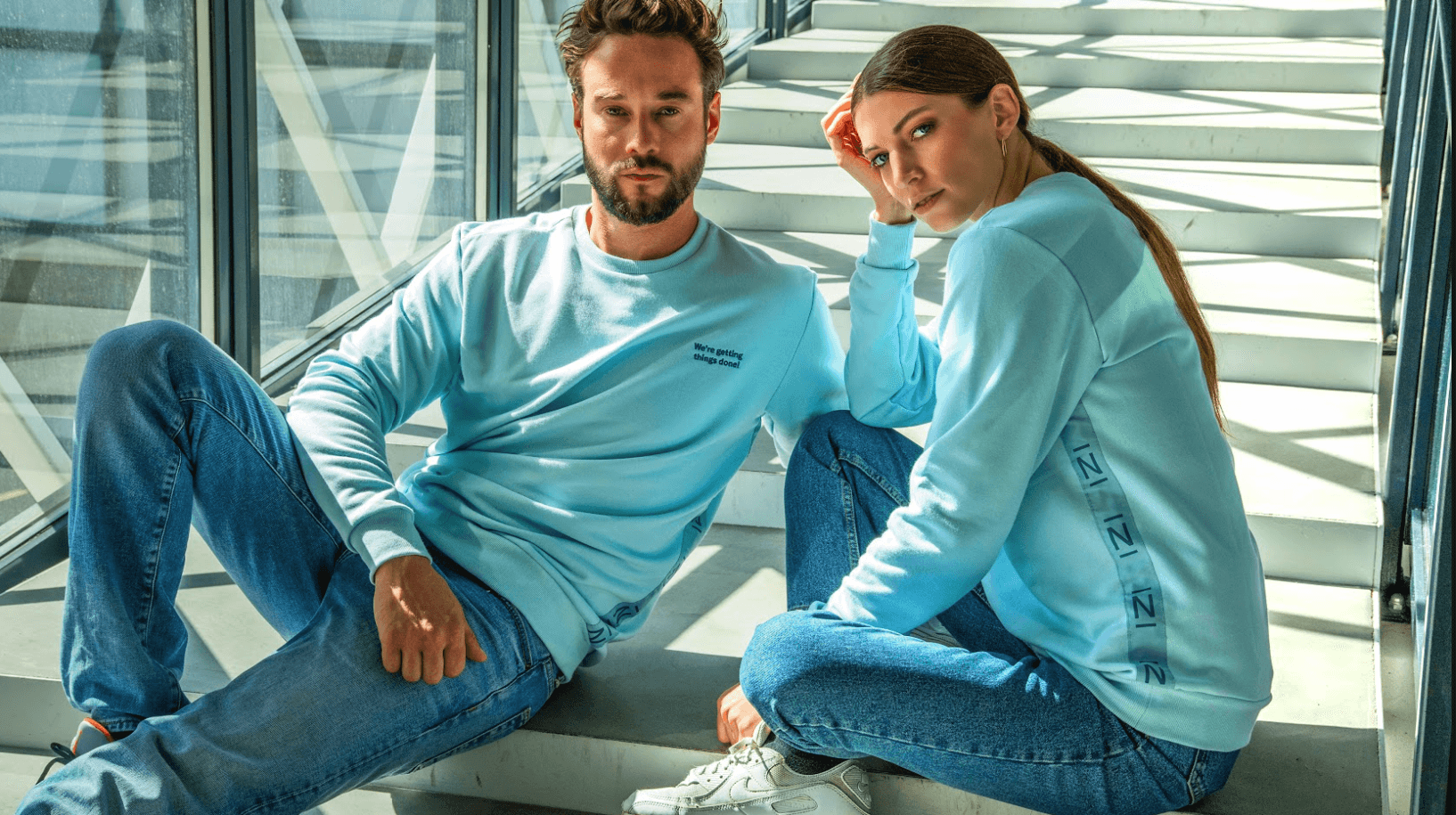
- Merchandise is an accelerator, not a giveaway. Chapter 6 argues that branded clothing is a form of non-verbal communication, and that a logo someone chooses to wear in public is doing work that an advertisement cannot do.
- Quality, design and story decide whether it works. The book is blunt about this: branded clothing only returns anything if your ambassadors are willing to be seen wearing it. Buy on unit price alone and the shirts end up in the bin.
Those are falsifiable statements. So we tried to falsify them.
The study
Sunday commissioned research agency Sapience, working with the Vrije Universiteit Brussel, to study the branded merchandise programme at Belgian rail operator NMBS/SNCB. Fieldwork ran in January 2023 with 258 respondents, 72 employees and 168 external buyers, benchmarked against the organisation's own existing internal engagement survey and brand tracker.
Two features of the design matter. First, the questions reused the wording of NMBS's existing internal survey, which is the only reason a benchmark comparison was possible at all. Had we commissioned a better questionnaire, we would have had nothing to compare against. Second, and more uncomfortably, the collection was sold, not given away. People paid for these items. That is a harder test than a free giveaway, and it is also a self-selection problem I will come back to.
The full methodology, sample sizes and limitations are published in the study itself.
What held up
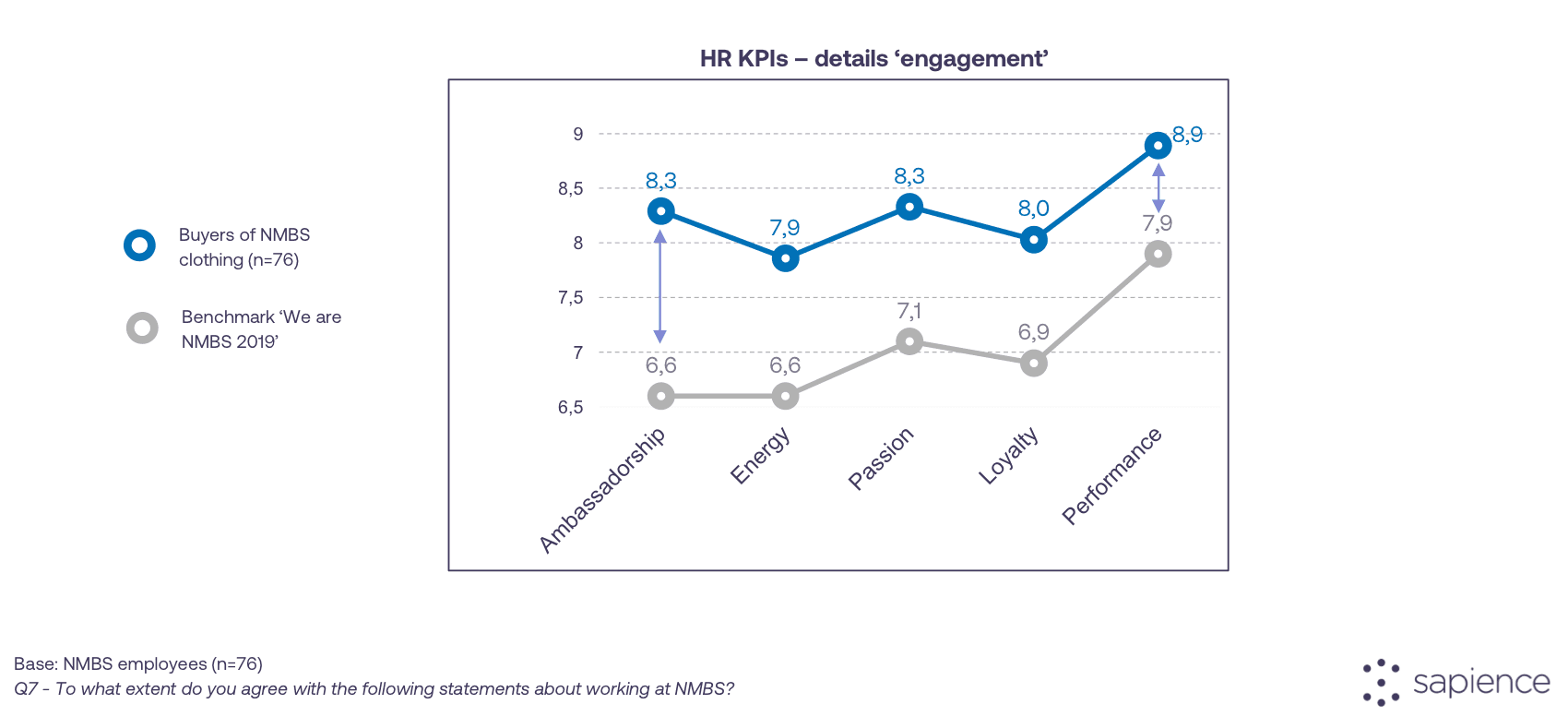
Ambassadorship was the largest single effect in the study
Of the five engagement sub-factors measured, the one closest to the book's central claim moved furthest.
| Sub-factor | Benchmark | Merchandise group |
|---|---|---|
| Ambassadorship | 6.6 | 8.3 |
| Passion | 7.1 | 8.3 |
| Energy | 6.6 | 7.9 |
| Loyalty | 6.9 | 8.0 |
| Performance | 7.9 | 8.9 |
Performance was already high and had the least room to move. Ambassadorship started lowest and travelled furthest. If the book had been wrong about which variable merchandise touches, this table is where it would have shown.
People really do talk, unprompted
84% of wearers reported that other people spoke to them about the item. 46% of those reactions were exclusively positive and a further 48% mainly positive, so 94% positive overall. Each wearer generated an estimated 1.6 to 3.2 brand conversations per wearing occasion. The book's claim that a worn logo starts conversations an advertisement cannot buy is the part the data supports most directly.
"Willing to be seen wearing it" turned out to be the whole game
This is the finding I did not expect to be so clean. People who received items with visible branding reported higher engagement (8.6 versus 8.1) and higher satisfaction (8.4 versus 7.7) than people whose item carried a discreet logo. The gap is not between branded and unbranded. It is between visible and hidden.
The bin problem is real and measurable
The book warned that badly chosen merchandise ends up unworn. It turns out you can put a number on it, per item.
| Item | Worn more than twice | Never worn |
|---|---|---|
| Bag | 69% | 15% |
| Sweater | 67% | 10% |
| Christmas sweater | 55% | 5% |
| Plain socks | 50% | 31% |
Plain socks were the worst performer in the entire study at 31% never worn. Seasonal socks reached 66% worn. Same product category, different design, completely different outcome. That is the book's quality-and-design argument, quantified.
What did not hold up
Merchandise moves warmth, not competence. The book implied it moves both.
The book treats merchandise as a general-purpose brand accelerator. The data disagrees, and the disagreement is specific. Of nine brand image attributes measured, the ones that moved significantly were the warmth attributes: sympathetic and friendly rose from 3.2 to 3.6, trustworthy from 3.2 to 3.4. The competence attributes did not move. And one went backwards: "efficient and well-organised" fell from 2.8 to 2.7.
That is worth sitting with. If your brand problem is that customers think you are cold or distant, this channel addresses it. If your brand problem is that customers think you are disorganised or unreliable, a sweater will not fix it, and there is at least a hint in the data that it can make things marginally worse. A company with an operational problem that spends its budget on merchandise is decorating the wrong thing.
This is the one substantive thing the book got wrong, and I would rewrite that chapter around it.
What the book left out: the price of the channel
The book argues merchandise works. It never says what it costs next to the alternatives. That is an omission rather than an error, but it is a consequential one, because it invites the reader to run the obvious comparison themselves and reach the wrong answer. So let me run it, and then explain why it is the wrong answer.
500 people at €40 per item is a €20,000 programme. At an 86% wear rate that is roughly 430 wearers, and at twelve wearing occasions a year, about 5,160 occasions. At 1.6 to 3.2 conversations each, that is 8,256 to 16,512 conversations, of which 94% positive gives 7,761 to 15,521 positive brand conversations. That works out at €1.21 to €2.42 per positive conversation.
Paid social at a €40 CPM costs roughly €0.04 per impression. On that arithmetic, merchandise looks 30 to 60 times more expensive.
That comparison is a category error, and it is worth being precise about why. An impression is an advertisement that entered a viewport. It may have been visible for under a second, it may not have been looked at at all, it comes from a brand the viewer has no relationship with, and it arrives in a context where people are actively trying to avoid it. A conversation is a person voluntarily raising your brand with another person, face to face, while acting as its endorser. The two differ on attention, on source credibility, on recall, and on one thing no impression can do at any price: a conversation runs in both directions, so it can answer an objection on the spot.
Dividing spend by "contacts" and comparing across those two units is like comparing cost per billboard view with cost per sales meeting. The arithmetic is valid. The conclusion is not.
The defensible comparison is against the other channels that produce conversations rather than impressions: events, sponsorship and field marketing, which typically run €50 to €200 per meaningful conversation. Against those, €1.21 to €2.42 is not expensive. It is roughly two orders of magnitude cheaper, and that is the comparison the book should have made explicitly instead of leaving the reader to guess.
One honest caveat on our own number: the €1.21 to €2.42 comes from a model, not from a measurement. The wear rate and the conversation rate are measured; the twelve wearing occasions a year is an assumption. Change that assumption and the figure moves proportionally.
Two more limits worth stating
The NPS result is the weakest number we published, and it is the one people quote
Net Promoter Score moved from −27 in the general benchmark to +1 among merchandise buyers. A 28-point swing. It is the most quotable figure in the study and the one I trust least, because the comparison group selected itself by choosing to buy branded merchandise from a rail operator. People who do that were probably already better disposed. I would rather say that plainly than let a good headline stand unchallenged.
It did not measure what a CFO would ask about
The study measured engagement, satisfaction, advocacy and brand image. It did not measure staff turnover, retention, revenue or customer lifetime value. The book gestures at growth; the study cannot support a growth claim. Anyone citing this research as proof that merchandise reduces attrition is overreaching, including me if I ever do it.
What I would write differently now
- Name the mechanism precisely. Not "merchandise builds your brand" but "merchandise moves perceived warmth among people who wear it visibly, and does nothing for perceived competence."
- Lead with visibility, not quality. The book puts quality first. The data says visibility is the variable that separates outcomes, and quality matters mainly because it determines whether the thing gets worn at all. Quality is upstream of visibility, not parallel to it.
- Price the channel, and name the right comparison. Every chapter recommending a channel should say what it costs per unit of attention, against comparable channels rather than incomparable ones. Merchandise competes with events and field marketing, not with display advertising.
- Say what would falsify it. The most useful thing a business book could do, and almost none of them do it.
The part that transfers to anyone running a survey
If you take one operational thing from this, take the methodology rather than the findings. The study only worked because it reused the wording of the client's existing internal survey. Change the wording of your engagement questions to something better and you permanently lose the ability to compare against last year. Add the improved question alongside the old one for a cycle, then switch. More on that in employee engagement survey questions.
Frequently asked questions
What is ambassador marketing?
Ambassador marketing is the deliberate practice of growing the group of customers and employees who recommend a company without being asked, rather than treating those recommendations as a lucky by-product of doing good work. It differs from influencer marketing in that ambassadors are usually unpaid and already have a real relationship with the brand.
Does branded merchandise actually create brand ambassadors?
In one study of 258 people, the group with branded merchandise scored 8.3 on ambassadorship against an internal benchmark of 6.6, the largest single effect measured, and 84% of wearers were spoken to about the item with 94% of those reactions positive. The study is correlational, not causal, and covers one organisation in one country.
What does branded merchandise not do?
It does not appear to shift perceived competence. In the same study the attributes that moved were warmth attributes such as sympathetic and trustworthy, while "efficient and well-organised" moved slightly backwards, from 2.8 to 2.7. The study also did not measure turnover, retention or revenue.
How much does a brand conversation cost through merchandise?
Modelled from the study's figures, a €20,000 programme for 500 people works out at roughly €1.21 to €2.42 per positive brand conversation. Compare that against events, sponsorship or field marketing at €50 to €200 per meaningful conversation, where it is very cheap. Do not compare it against a cost per advertising impression: an impression and a conversation are different units, and the comparison is a category error.
Is merchandise more expensive than paid social advertising?
Per contact the arithmetic says yes, but the arithmetic is misleading. An impression may last under a second, may go unseen, and comes from a brand the viewer has no relationship with. A conversation is voluntary, face to face, carries a peer's endorsement, and can answer an objection in real time. Comparing the two on cost per contact is like comparing cost per billboard view with cost per sales meeting.
What is the DEAL framework?
DEAL stands for Develop, Engage, Attract and Love. It is the four-pillar structure from Making Everyone a Superfan for building an ambassador programme deliberately: developing ambassadors' knowledge, engaging them, attracting new ones, and rewarding the relationship.
Why publish research that could contradict your own book?
Because a claim nobody has tried to falsify is not evidence, it is marketing. The study was commissioned with no guarantee of the result, the limitations are published alongside the findings, and the parts that went against the original argument are in this article rather than left out of it.
Read next
- The full study with NMBS, Sapience and the VUB, including methodology and every limitation
- Employee advocacy programmes, the internal half of the same idea
- Brand awareness strategy, including the cost-per-conversation model in full
- 25 company swag ideas, ranked with the measured wear rates
- Sustainable corporate gifts, where the never-worn rate is the sustainability metric nobody counts
- Brand ambassador kit and company swag in the glossary