Almost every brand awareness strategy is built on impressions, because impressions are easy to buy and easy to report. They are also the weakest unit of attention that exists.
An impression means a piece of creative was technically rendered somewhere near a person's eyes. A conversation means a named human being brought your brand up with someone who trusts them.
Those are not the same thing, and one of them is measurable in a way most marketers never attempt.
Step 1: Decide what awareness is actually for
Awareness on its own does very little. People are aware of plenty of brands they would never buy from.
The useful question is not "do they know us" but "do they know us and think something specific." That distinction determines everything downstream, because a strategy aimed at recall looks nothing like one aimed at warmth.
Step 2: Pick a unit of attention you can defend
Rank the units by how much they actually mean:
| Unit | What it means | Typical cost |
|---|---|---|
| Impression | Creative rendered near a person | ~€0.04 |
| Click | Momentary interest | €0.50 to €5 |
| Conversation | A trusted person raised your brand unprompted | see below |
| Meaningful event conversation | Same, but you paid for the room | €50 to €200 |
Most awareness strategies optimise the top row because it is cheapest per unit. That is only rational if you believe the units are interchangeable, and they are not.
Step 3: Put a number on the conversation channel
This is where we have measurement.
In a 2023 study run by Sapience with the Vrije Universiteit Brussel, 258 people were surveyed after receiving branded clothing from NMBS/SNCB. Among those who wore it:
- 84% were spoken to about it by someone else
- 94% of those reactions were positive
- Each wearer generated 1.6 to 3.2 conversations per wearing occasion
The derivation is published so you can check it: 79% were addressed by multiple people, conservatively 2 to 4, and 5% by exactly one person. That gives (0.79 × 2) + (0.05 × 1) = 1.63 at the low end and 3.21 at the high end.
That makes merchandise one of the few awareness channels with a calculable reach figure that is not an impression.
Step 4: Cost it honestly
Modelled for a 500-person programme at €40 per unit, with a deliberately conservative twelve wearing occasions per year:
| Low | High | |
|---|---|---|
| Conversations per year | 8,256 | 16,512 |
| Of which positive | 7,761 | 15,521 |
| Cost per conversation | €2.42 | €1.21 |
Now the comparison everyone reaches for, and why it does not work. At a €40 CPM you buy an impression for about four cents, so on cost per contact merchandise looks roughly thirty to sixty times more expensive. The arithmetic is fine. The conclusion is not, because an impression and a conversation are not the same unit.
An impression is creative that entered a viewport. It may have been visible for under a second, it may not have been looked at at all, it comes from a brand the viewer has no relationship with, and it arrives in a context where people are actively trying to avoid it. A conversation is a person raising your brand with someone who trusts them, face to face, while vouching for it. It also runs in both directions, so it can answer a doubt on the spot, which no impression can do at any price. Comparing the two on cost per contact is like comparing cost per billboard view with cost per sales meeting.
This cuts both ways, which is why it is worth stating plainly. Anyone in this industry telling you merchandise beats paid media on CPM is comparing two different units and hoping you do not notice. So is anyone using the same arithmetic in reverse to argue merchandise is poor value.
The comparison that works is the bottom row of the table in step 2. Events, sponsorship, field marketing and referral programmes all produce genuine two-way exchanges, and they typically cost €50 to €200 per meaningful conversation once staff time is counted. Against those, €1.21 to €2.42 is very hard to beat, and unlike an event the programme keeps producing conversations for as long as the item survives the wash.
Those figures are a model built on stated assumptions, not a measured finding. The wear rate and the conversation rate are measured; the twelve wearing occasions per year is an assumption, and the cost moves proportionally if you change it. The full working and its limitations are published.
Step 5: Measure perception, not just reach
Reach is the input. Perception is the output, and it is the half most awareness strategies never check.
In the same study, brand image was measured across nine attributes against the company's existing brand tracker. Four moved significantly:
| Attribute | Benchmark | Exposed group |
|---|---|---|
| Sympathetic & friendly | 3.2 | 3.6 |
| Trustworthy | 3.2 | 3.4 |
| Knowledge & expertise | 3.6 | 3.8 |
| Open to all | 3.8 | 4.0 |
| Efficient & well-organised | 2.8 | 2.7 |
The pattern is the finding. Everything that moved was a warmth attribute. The competence attribute did not move at all and sat marginally lower.
That tells you precisely what this channel is for. If your problem is that people find your brand cold, distant or corporate, this targets it directly. If your problem is that people doubt you can deliver, it will not help and you should spend elsewhere.
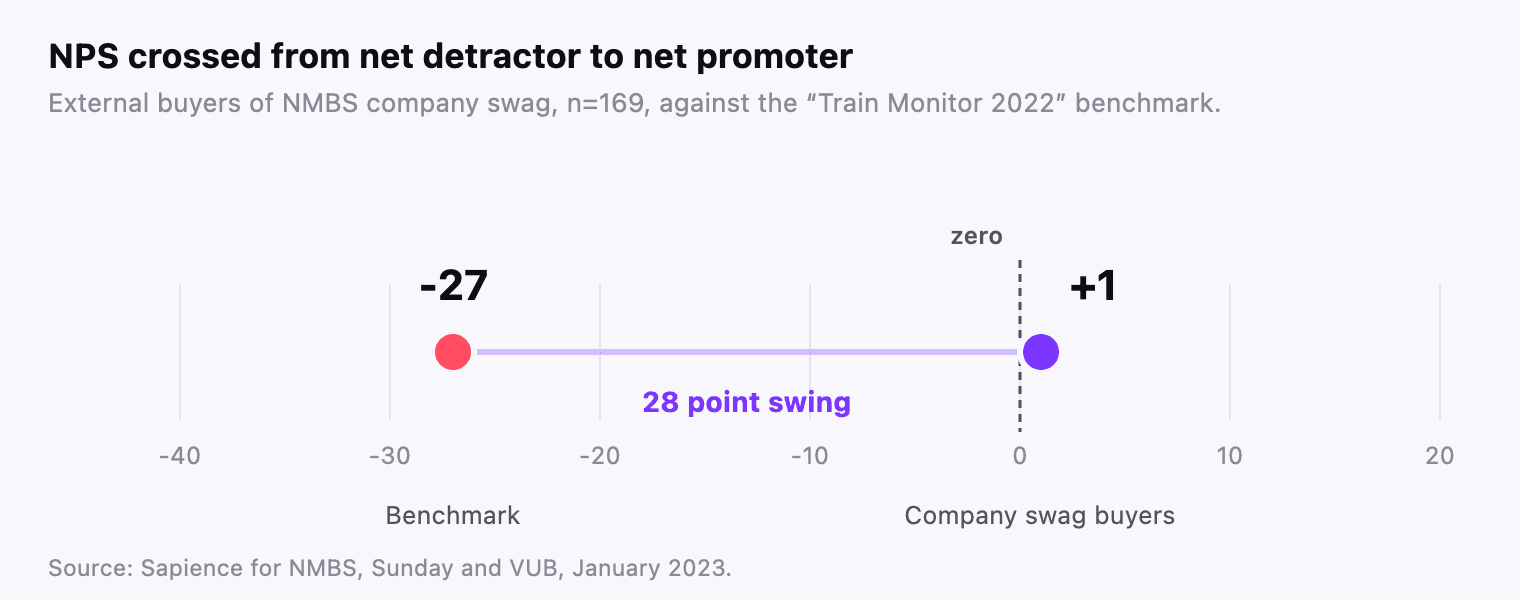
Net Promoter Score in the same group moved from -27 to +1, crossing from a net-detractor to a net-promoter population. Treat that one with caution: the group selected itself by choosing to buy the clothing, so some of the gap is self-selection rather than effect.
Step 6: Put it in the media plan, not the swag budget
The structural point. Merchandise usually sits in procurement or an office budget, where nobody reports on reach because nobody expects any.
Once you have a cost per conversation, it belongs in the media plan next to the other conversation channels, evaluated on the same terms. Whether it wins depends entirely on whether you value conversations above impressions, which is a strategy question rather than a budget one.
Practically that means choosing items by measured usage rate rather than unit price, because an unworn item produces zero conversations and therefore has infinite cost per conversation. In the study, plain socks were never used by 31% of recipients while bags and sweaters were used repeatedly by roughly two thirds.
Frequently asked questions
What is a brand awareness strategy?
A plan for who should know about your brand, what they should believe, and how you will measure whether that changed. The measurement half is what separates a strategy from a spend.
How do you measure brand awareness?
Recall and recognition surveys are standard. More useful is a brand tracker measuring specific attributes over time, because awareness without a favourable association does very little.
Is branded merchandise good for brand awareness?
It produces conversations rather than impressions. In a benchmarked study, 84% of wearers were spoken to about their item and 94% of reactions were positive, at a modelled €1.21 to €2.42 per conversation.
Is merchandise cheaper than advertising for awareness?
That question cannot be settled per contact, because an impression and a conversation are not the same unit. Paid social buys an impression for around four cents; merchandise produces conversations at a modelled €1.21 to €2.42. The comparison that works is against events, sponsorship and field marketing at €50 to €200 per meaningful conversation, where merchandise is very hard to beat.
What brand attributes does merchandise improve?
The warmth ones. Sympathetic and friendly rose 12.5%, with trustworthiness, expertise and openness also significant. Efficient and well-organised did not move.
Further reading
The full research study · We tested our own book against this data · Why passive advocacy outlasts sharing tools · Items ranked by measured usage · Swag bag ideas for events · Corporate gift ideas · Brand awareness merch explained