Most articles about employee engagement survey questions give you fifty of them. That is the wrong problem. The hard part is not finding questions, it is asking questions whose answers you can still compare in twelve months.
So this is a short list rather than a long one: the six questions we actually used in a benchmarked study, the one design rule that made the results usable, and the two extra questions that let you measure whether the money you spend on engagement does anything.
The rule that matters more than the questions
If you take one thing from this page, take this.
Do not change the wording of a question you intend to trend.
The most common way engagement measurement fails is not bad questions. It is good questions, reworded between cycles by someone trying to improve them. The moment the wording changes, this year and last year measure different things, and you have lost the only baseline worth having: yourself, previously.
This applies with double force when you are testing a change. In the study below, every headline number is a comparison against the company's own prior survey, using the same wording. That is the whole reason the numbers mean anything.
The six questions we used
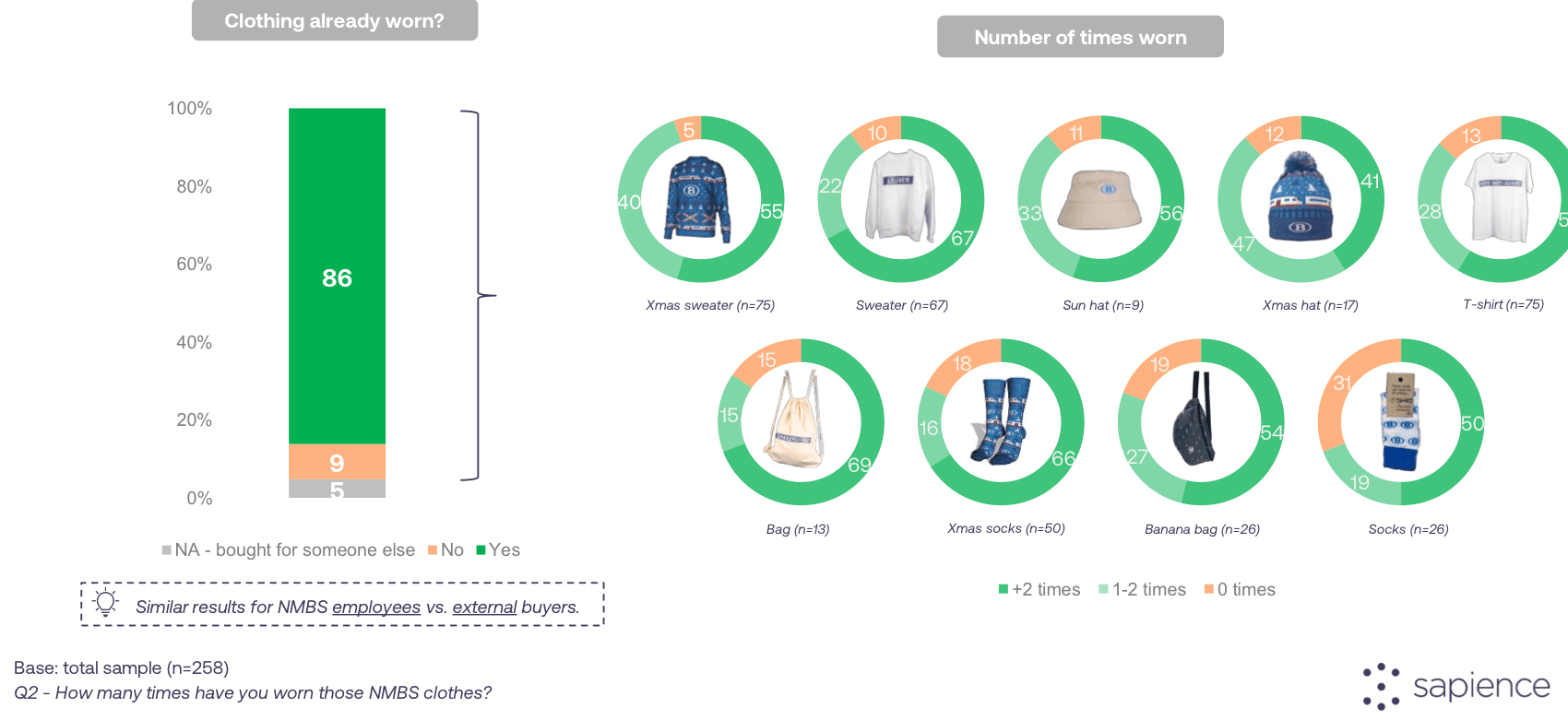
These are from a 2023 study run by research agency Sapience with the Vrije Universiteit Brussel, surveying 258 people for NMBS/SNCB and Sunday. We are publishing them so the work can be replicated.
| Ref | Question | What it measures |
|---|---|---|
| Q2 | How many times have you worn those company clothes? | Exposure, per item |
| Q3 | Did others address you about your company clothing when you wore it? | Word of mouth reach |
| Q4 | Were the reactions you got to the clothing...? | Word of mouth sentiment |
| Q7 | To what extent do you agree with the following statements about working at [company]? | Engagement, satisfaction and five sub-factors |
| Q9 | To what extent do you agree with the following statements about [company]? | Brand image across nine attributes |
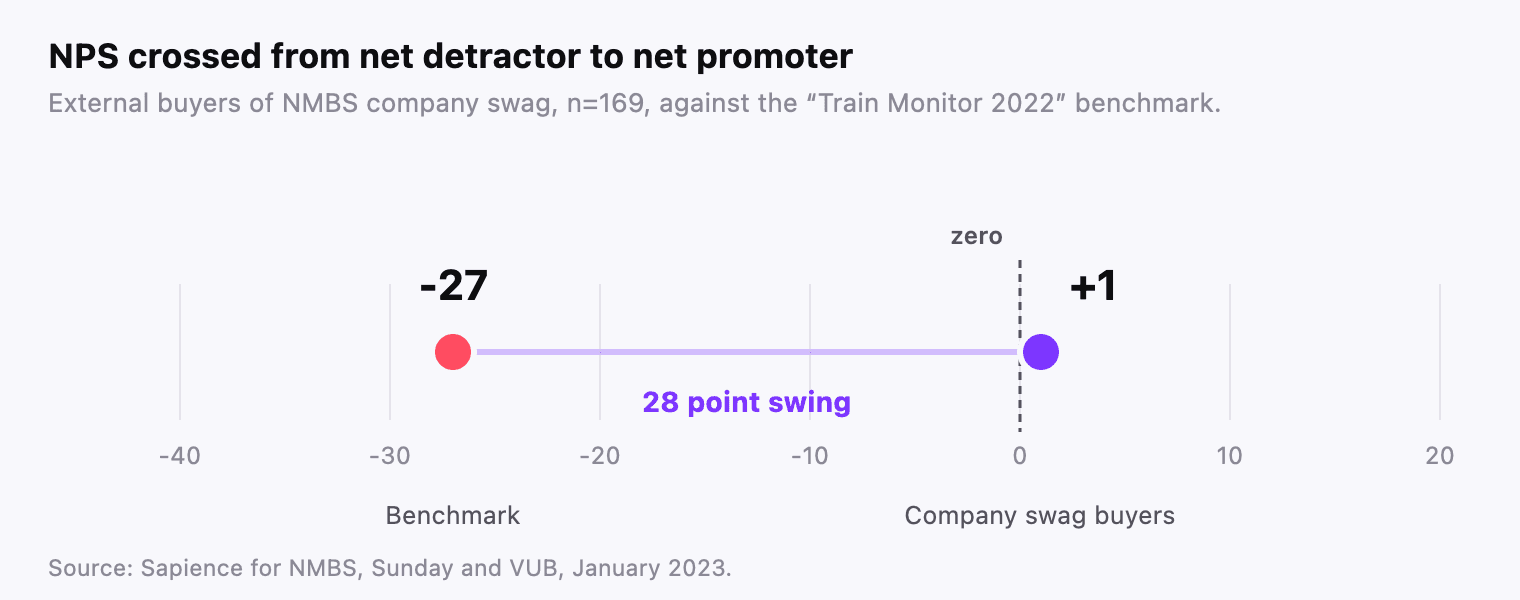
| Q10 | How likely would you be to recommend [company] to others? | Net Promoter Score |
Q7 and Q9 are the important ones, and neither was written by us. They reuse the exact wording of the client's existing employee survey and brand tracker. That is the point. Write your own clever version and you get a number with nothing to compare it to.
The five engagement sub-factors worth splitting out
Q7 is not one question but a block, and the block matters because engagement is not a single thing. The study measured five sub-factors, and they did not move equally.
| Sub-factor | Benchmark | Exposed group | Gap |
|---|---|---|---|
| Ambassadorship | 6.6 | 8.3 | +1.7 |
| Energy | 6.6 | 7.9 | +1.3 |
| Passion | 7.1 | 8.3 | +1.2 |
| Loyalty | 6.9 | 8.0 | +1.1 |
| Performance | 7.9 | 8.9 | +1.0 |
If you only report a single composite engagement score, you cannot see this. Ambassadorship, whether people speak positively about you externally, moved most, and it is the sub-factor closest to an employer branding outcome. A composite would have hidden that.
The two questions most companies are missing
Everything above measures whether engagement is high. Neither tells you whether anything you did caused it.
Add these two, keep the rest of your instrument untouched, and you can attribute:
- Did you receive [the thing] and do you use or wear it? Exposure, and crucially whether the exposure was real rather than nominal.
- A single item about the thing itself, worded consistently so you can trend it.
Then split every existing result by the answer to question 1. That is the entire method. It costs two survey lines and it converts an engagement survey into an experiment.
In the study, that split is what produced the most actionable finding of the whole exercise. People who received visibly branded items scored 8.6 on engagement; people who received non-branded or non-visible items scored 8.1. Same programme, same year, same employer. Without the exposure split, both groups would have been averaged into one meaningless number.
How often to run it
Annually for the full instrument, because that is what your benchmark is built on. Anything more frequent should be a short pulse using a subset of the same items, with the same wording.
Resist the temptation to add questions each cycle. Survey length is the main driver of response-rate decay, and a shorter survey people actually finish beats a comprehensive one they abandon.
The most damaging mistake
Running the survey and doing nothing visible with it.
Response rates fall, the people with genuine criticism stop bothering, and within two cycles your data quietly becomes a measure of who still believes the exercise is real. Publish what you heard and what you are doing, including where the answer is "not this year."
Frequently asked questions
What are good employee engagement survey questions?
The ones you asked last time, worded identically. Comparability matters more than elegance. If you are starting fresh, cover engagement, satisfaction and the sub-factors separately, ambassadorship above all, and add an exposure question for anything you are testing.
How many questions should an employee engagement survey have?
Short enough that people finish it. The study above used six question blocks. Adding items each cycle is the most common cause of falling response rates.
How do you measure whether an engagement initiative worked?
Add one question asking whether the respondent was exposed to it, then split every other result by that answer. Compare against your own prior cycle rather than an industry benchmark.
What is the most important employee engagement question?
The ambassadorship item, usually worded as whether someone would recommend the company as a place to work. In the study above it moved 26%, more than any other sub-factor, and it is the closest thing to a direct employer branding measure.
Should we use an industry benchmark or our own?
Your own, wherever possible. An industry average tells you how you compare to companies with different jobs, pay and geography. Your own prior cycle tells you whether what you did worked.
Further reading
The full study, methodology and limitations · 11 engagement levers ranked by evidence · Building a measurable employer branding strategy · Employer branding examples with real outcomes · Swag ranked by measured wear rate · Measuring welcome kit ROI