

To improve NPS, do four things: ask at a consistent moment in the customer journey, always pair the score with a free-text reason, close the loop with detractors inside 48 hours, and fix the recurring drivers rather than the score itself. Everything else is secondary. The single biggest cause of a misleading NPS trend is not a bad experience, it is a change in when or whom you asked.
This guide covers how the score is built, what good looks like, seven practices that actually move it, how to work detractors specifically, and what employee NPS adds. It closes with a finding from our own commissioned research and a frank account of why it is the weakest number in that study.
How NPS is calculated
One question: how likely are you to recommend us to a friend or colleague, on a scale of 0 to 10. Respondents split into three groups, and the score is the percentage of promoters minus the percentage of detractors. Passives count for nothing, which surprises people the first time.
| Group | Score | Counts as |
|---|---|---|
| Promoters | 9 to 10 | +1 each |
| Passives | 7 to 8 | Nothing |
| Detractors | 0 to 6 | −1 each |
The range runs from −100 to +100. A score of 0 means promoters and detractors cancel out exactly, which is a more common position than most companies admit.
On what counts as good: treat published industry averages with suspicion. They vary by survey method, by country, and by whether the sample was transactional or relational. The only benchmark that reliably means anything is your own previous score, measured the same way. That is why the methodology practices below matter more than any target number.
Seven practices that improve NPS
1. Ask at a consistent moment
Asking after a successful delivery produces a different score than asking after a support ticket. Neither is wrong, but mixing them makes the trend meaningless. Pick the moment, write it down, and keep it.
2. Always pair the score with the reason
A number without a free-text field tells you that something is wrong and nothing about what. The verbatim answers are the actual product of the survey; the score is just the index that gets it onto a dashboard.
3. Close the loop with detractors within 48 hours
The window matters. A detractor contacted quickly, by a human, about their specific complaint often ends up more loyal than a customer who never had a problem. A detractor contacted three weeks later has already told other people.
4. Fix drivers, not scores
Tag the verbatims, count the themes, and work the top three. Teams that target the number instead of the causes end up optimising the survey rather than the business, which shows up as a rising score and flat retention.
5. Never change the wording or the scale
This is the unrecoverable mistake. Change the question and every historical comparison is gone permanently. Improve the instrument once, before you start, then freeze it. The same rule applies to employee engagement survey questions, and for the same reason.
6. Segment before averaging
A blended score hides the situation where your enterprise customers are delighted and your small accounts are leaving. Segment by tier, by tenure and by channel before you report a single number.
7. Never incentivise the score
The moment a team's bonus depends on NPS, you start measuring the team's ability to manage the survey. Staff will ask for tens, time the send, and quietly exclude unhappy accounts. Incentivise the loop-closing rate instead, which is a behaviour rather than an outcome.
Working detractors: the highest-return activity
Detractors are the 0-to-6 group, and they are worth more attention than promoters for a simple arithmetic reason: each one is subtracting a full point from the score, and unlike passives they are actively telling other people.
A workable recovery sequence looks like this.
- Route automatically. A detractor response should create a task within minutes, not appear in a monthly report.
- Have a human call. Not an email, not a survey follow-up. The medium is part of the message.
- Ask, do not defend. The first call is for understanding the specific incident. Explaining your policy at this point converts a detractor into a former customer.
- Fix the individual case, then log the theme. One is service recovery, the other is product improvement. Do both, and do not let the first substitute for the second.
- Go back. Tell the person what changed. This is the step almost everyone skips, and it is the one that converts.
Track the share of detractors contacted within 48 hours as a standing operational metric. It is more actionable than the score and it is fully within your control.
Employee NPS, and why it moves first
Employee net promoter score, or eNPS, asks the same question about the workplace: how likely are you to recommend working here. It is calculated identically and it tends to be lower, because employees have more information than customers.
It is worth running alongside customer NPS for one reason: in most organisations, employee sentiment leads customer sentiment. The staff who serve customers know a problem is coming before the customers do. eNPS also maps almost exactly onto ambassadorship, the engagement sub-factor covering whether someone would recommend the company, which is covered in more depth in how to improve employee engagement and employee advocacy programmes.
What we measured, and why we would defend it least
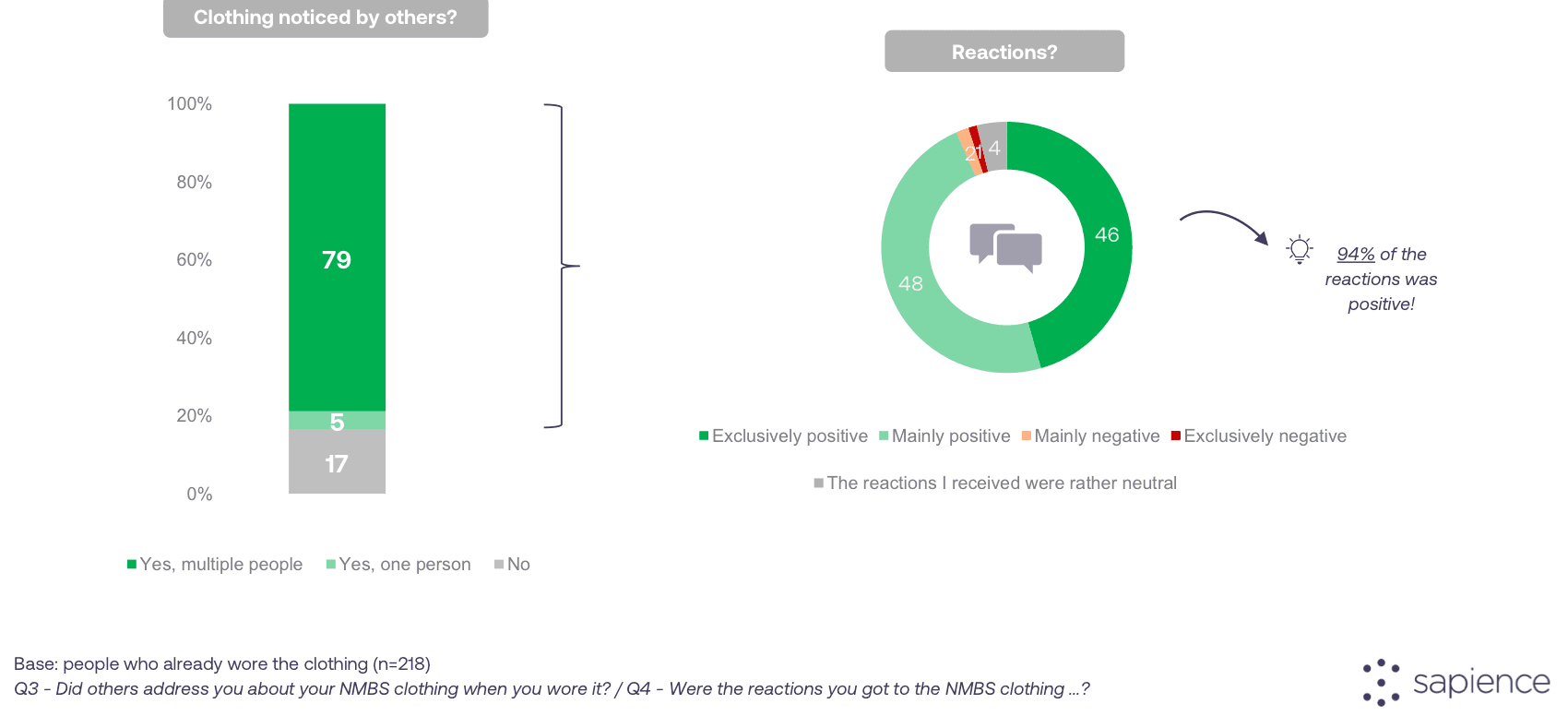
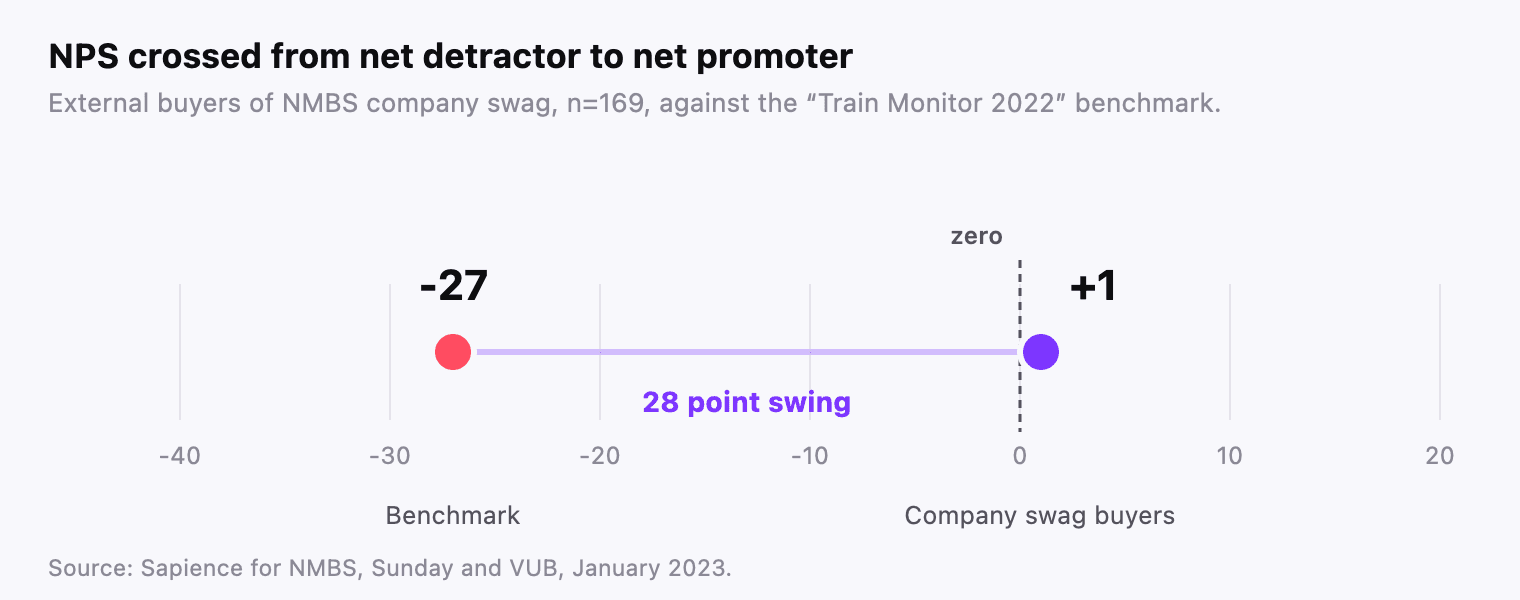
Sunday commissioned research agency Sapience and the Vrije Universiteit Brussel to study the branded merchandise programme at Belgian railway operator NMBS/SNCB. 258 people were surveyed and results compared against the organisation's own existing brand tracker. On NPS the gap was large: the benchmark stood at −27, and the group who had bought or received branded merchandise scored +1, a 28-point difference, with no change to the underlying service in between.
That number is the least trustworthy finding in the entire study, and it should be read with real caution. The comparison group is people who chose to buy merchandise from a company. Choosing to spend your own money on a brand's clothing is close to a definition of being a promoter. Selection alone could plausibly explain most or all of the 28 points. Anyone quoting this figure as evidence that merchandise raises NPS is overstating it, including us if we did.
What survives scrutiny better is the brand-image data measured on the same group, where individual attributes were tested for statistical significance.
| Attribute | Benchmark | Merch group | Significant |
|---|---|---|---|
| Sympathetic and friendly | 3.2 | 3.6 | Yes |
| Trustworthy | 3.2 | 3.4 | Yes |
| Knowledge and expertise | 3.6 | 3.8 | Yes |
| Open to all | 3.8 | 4.0 | Yes |
| Dynamic and modern | 3.0 | 3.0 | No change |
| Efficient and well-organised | 2.8 | 2.7 | Went the wrong way |
The pattern in that table is the genuinely useful finding. Warmth attributes moved. Competence attributes did not, and the operational one moved backwards. People who wore the brand liked the organisation more without believing it ran any better.
The practical conclusion for anyone with an NPS problem: diagnose the cause before choosing the tool. If your detractors are leaving because trains are late, deliveries are missed or tickets go unanswered, no amount of merchandise will help, and this study is mild evidence that it may even sharpen the contrast. If your problem is that customers find you competent but cold, that is the gap where affection-building activity has something to offer.
The study is correlational rather than causal, covers one organisation in one country, and the employee benchmark predates the pandemic. Full method, sample and limitations are in the scientific study on company swag and employee engagement.
Five mistakes that flatter or wreck an NPS programme
- Changing the question. The benchmark dies with it, permanently.
- Surveying only happy moments. Sending after successful transactions only produces a number that means nothing.
- Reporting a blended average. It hides the segment that is actually leaving.
- Treating loop-closing as optional. An uncontacted detractor is a churn event with a timestamp.
- Attaching a bonus to the score. You will get the score. You will not get the loyalty.
How to improve NPS: questions answered
How do you improve your NPS score?
Ask at a consistent moment in the journey, pair every score with a free-text reason, close the loop with detractors within 48 hours by phone, tag the verbatims and fix the top three recurring drivers, segment before averaging, and never change the question wording or the scale once you have started.
What is a good NPS score?
There is no universal answer, and published industry averages vary by survey method, country and whether the survey is transactional or relational. Above 0 means you have more promoters than detractors. The only benchmark that reliably means anything is your own previous score, measured the same way at the same moment.
How do you handle NPS detractors?
Route detractor responses automatically to a person within minutes, have a human call rather than email within 48 hours, ask about the specific incident rather than defending policy, fix the individual case and separately log the theme for product work, then go back and tell the person what changed. Track the percentage contacted within 48 hours as a standing metric.
What is employee NPS, and how is it different?
Employee NPS, or eNPS, asks how likely someone is to recommend the organisation as a place to work, on the same 0 to 10 scale with the same calculation. It usually runs lower than customer NPS because employees have more information, and it tends to move before customer sentiment does. It maps closely onto ambassadorship in an engagement survey.
Does branded merchandise improve NPS?
Our study found a 28-point gap between an organisation benchmark of −27 and a merchandise group at +1, but that group self-selected by choosing to buy the merchandise, so selection could explain most of the gap. The better-supported finding is that warmth attributes such as sympathetic, friendly and trustworthy improved significantly, while competence attributes did not and efficiency scored slightly worse. Merchandise appears to build affection, not credibility.
Should NPS be tied to bonuses?
No. Once compensation depends on the score, teams manage the survey rather than the experience: asking for tens, timing the send, and excluding unhappy accounts. Incentivise the loop-closing rate instead, which is a behaviour people can control directly and which improves the outcome anyway.
Keep reading
- The full scientific study, including the NPS and brand-image data
- Employee engagement survey questions, including the benchmark-preservation rule
- Brand awareness strategy, for the conversation-volume side of brand perception
- Corporate gift ideas for clients and employees and company swag ideas ranked by wear rate, if the warmth gap is the one you are trying to close
- Sustainable corporate gifts
- Client gifts and branded merchandise in the glossary