



Almost every article on how to improve employee engagement has the same problem. It lists things that sound true, and not one of them comes with a number.
So this list is sorted differently. Not by how good the idea sounds, but by whether anyone has actually measured whether it works.
Three tiers: levers with published measurement, levers you can measure yourself starting this quarter, and levers that matter but resist measurement. Being honest about which is which is more useful than pretending all eleven are equally proven.
First: what engagement actually is, and why most measurement is broken
Engagement is not happiness. A comfortable employee who has quietly checked out scores well on satisfaction and badly on engagement. The distinction matters because the two respond to different things.
Most engagement surveys break for a mundane reason: the wording changes between cycles, so the comparison is meaningless. If you take one methodological point from this article, take that one. Never change the question wording of an instrument you intend to trend. The moment you do, you lose the benchmark, and without a benchmark you have opinions.
Tier 1: levers with published measurement
1. Give people something visible with the company on it
This is the one we can quantify, because we commissioned the research.
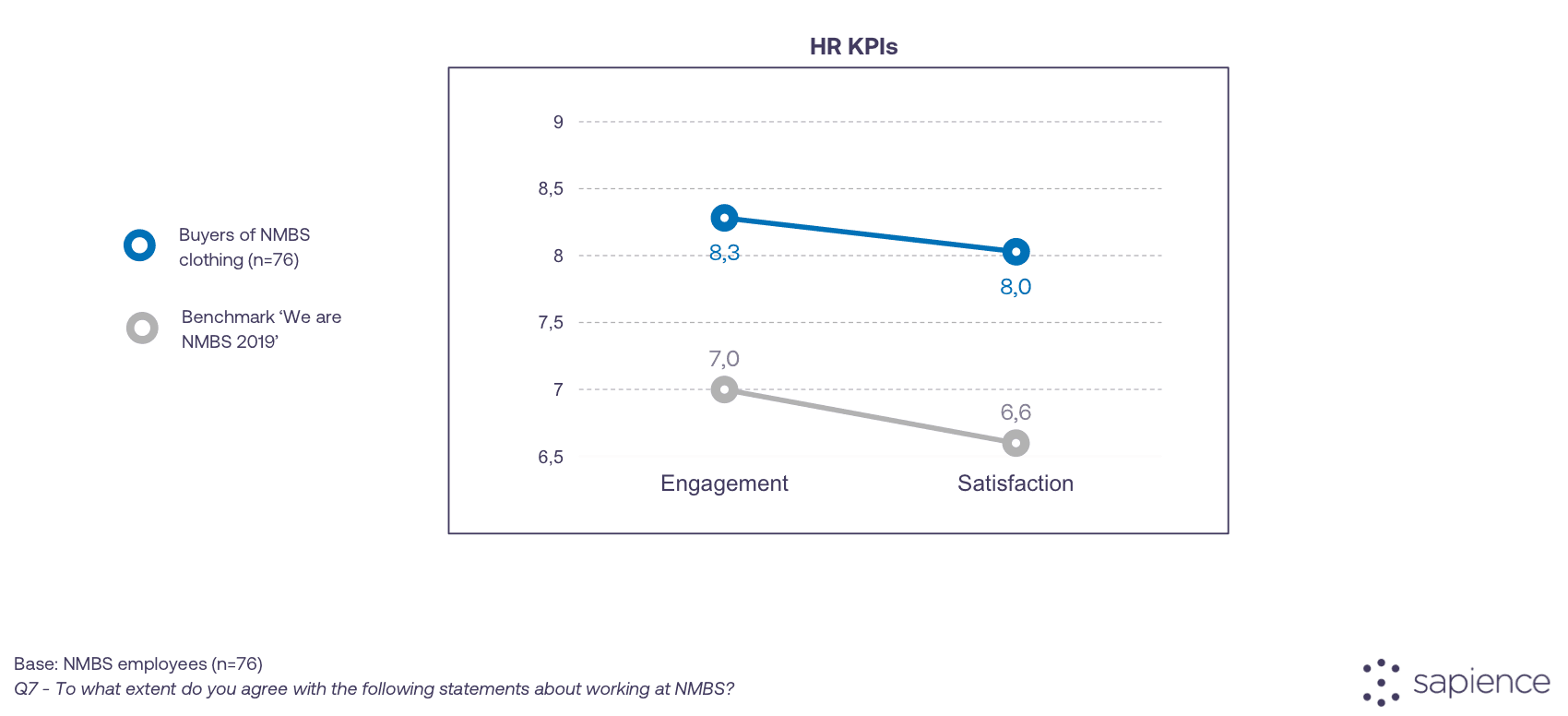
NMBS/SNCB, the Belgian national railway, ran a branded clothing programme. Research agency Sapience, with the Vrije Universiteit Brussel, surveyed 258 participants and compared them against NMBS's own pre-existing employee engagement survey rather than an industry average.
| Measure | Company benchmark | Received the clothing | Change |
|---|---|---|---|
| Engagement | 7.0 | 8.3 | +19% |
| Satisfaction | 6.6 | 8.0 | +21% |
| Ambassadorship | 6.6 | 8.3 | +26% |
| Energy | 6.6 | 7.9 | +20% |
| Loyalty | 6.9 | 8.0 | +16% |
Every engagement sub-factor moved in the right direction. The largest was ambassadorship, whether an employee speaks positively about their employer externally.
Two caveats you should hold onto. It is a correlational study, not a randomised experiment, and we say so at length in the full write-up including its limitations. And the effect depended heavily on execution: employees whose items carried a visible logo scored 8.6 on engagement against 8.1 for those with non-visible items. An unworn or unbranded item produced nothing.
If you act on this one, the execution detail is the whole thing. Start from items ranked by how often people actually wear them rather than by unit price.
2. Fix onboarding, specifically the first week
Onboarding quality is one of the few engagement levers with a well-established evidence base across the HR literature, and it has the advantage of a natural measurement point: 90-day retention.
The practical version is unglamorous. A manager who is genuinely free on day one, a working laptop, a first task that matters, and something physical that arrives before the person does. If you want the operational detail, we have a guide to running a welcome kit programme and one on measuring its return.
Tier 2: levers you can measure yourself this quarter
3. Ask two questions you can actually trend
Add two questions about whatever you are changing to your existing survey, keeping the surrounding wording untouched, and split the results by who was exposed. That is the entire method behind tier 1. It costs two survey lines.
4. Give managers fewer people
Span of control is measurable, correlates with engagement in most organisations' own data, and is usually the single largest structural driver nobody adjusts. Pull your engagement scores by team size before your next reorg.
5. Make recognition specific and public
Generic recognition reads as policy; specific recognition reads as attention. Measurable through recognition frequency and the engagement sub-scores. Physical recognition outlasts an email at milestones worth marking, and a considered gift is the usual vehicle.
6. Close the loop on the last survey
The fastest way to destroy engagement measurement is to run a survey and act on nothing. Response rates fall, the honest people stop answering, and your data quietly becomes worthless. Publish what you heard and what you are doing, even when the answer is "not this year."
7. Shorten the distance between work and outcome
People disengage when they cannot see what their work did. Measurable through the "my work is meaningful" style items most instruments already contain.
8. Give distributed teams something physical
Remote and hybrid teams lose the incidental signals that carry belonging in an office. The mechanism is unproven at the level of tier 1, but it is measurable by splitting engagement scores by location type. If you are testing it, items that ship anywhere are the constraint that matters.
Tier 3: real, but resistant to measurement
9. Hire and remove managers on behaviour, not output
Almost certainly the largest lever on this list, and the hardest to attribute cleanly because the counterfactual is unobservable.
10. Tell people the truth about the business
Transparency builds engagement in ways that show up everywhere and isolate nowhere.
11. Let people change roles internally
Internal mobility keeps people who would otherwise leave. Visible in retention data over years, not quarters.
What to do first
If you have no baseline, start there. Everything above is unfalsifiable without one, and you probably already own the instrument.
If you do have a baseline, pick the lever whose effect you could see inside one survey cycle. Perception measures such as ambassadorship and satisfaction move fast. Retention moves slowly, which is why programmes get cancelled before their effect is visible.
And be suspicious of any engagement advice, including this article, that does not tell you what was measured and against what.
Frequently asked questions
What is the fastest way to improve employee engagement?
Fix the thing your last survey told you about and tell people you fixed it. Closing the loop moves engagement faster than any new initiative, because it changes whether people believe the exercise is real.
Does company merchandise improve employee engagement?
In a 2023 benchmarked study of 258 people, employees who received branded company clothing scored 8.3 on engagement against a 7.0 company benchmark, a 19% increase, with satisfaction at 8.0 against 6.6. The effect was concentrated among those whose items carried a visible logo. The study is correlational rather than causal.
How do you measure employee engagement properly?
Against your own prior measurement, with identical question wording between cycles, split by exposure to whatever changed. Comparing against an industry average tells you far less than comparing against yourself last year.
What is the difference between engagement and satisfaction?
Satisfaction is how someone feels about the job. Engagement is how much discretionary effort they put in. A comfortable but disengaged employee scores high on one and low on the other, which is why measuring only satisfaction is misleading.
How long before engagement initiatives show results?
Perception measures can move within one survey cycle, typically three to six months. Retention and performance effects lag 12 months or more, which is the main reason working programmes get cut early.
Further reading
The full research study · Employer branding examples with measured outcomes · Swag items ranked by real wear rate · The welcome kit guide · Sustainable corporate gifts
Talk to Sunday about measuring the physical side of engagement