



Most articles about employee recognition ideas cover frequency, specificity and public versus private. Those matter, and we will get to them.
But they skip the half where recognition usually fails: the physical part. Someone chooses an item, it gets handed over, and a meaningful share of it is never used again. That failure is invisible, because nobody audits what happened to last year's gifts.
We have measured data on that half, so this list is built around it.
The two rules that decide whether recognition lands
Be specific. "Great work this quarter" reads as policy. "The way you handled the migration rollback on Thursday" reads as attention. The second costs nothing extra and is the entire difference.
Be timely. Recognition delivered at the annual review has been decoupled from the thing it recognises. A same-week note outperforms a formal ceremony six months later.
Everything below assumes those two. Without them, no item helps.
Recognition ideas that cost nothing
- Name the specific behaviour in a public channel. The highest return-per-effort action available.
- Recognise upward and sideways, not just downward. Peer recognition carries different weight because it has no power dynamic.
- Tell someone's manager, not just them. Recognition that travels is worth more than recognition that stops.
- Recognise the unglamorous work. The person who maintains the thing nobody notices until it breaks.
- Ask people how they want to be recognised. Public praise is uncomfortable for a meaningful minority. Record it at onboarding.
When you do give something physical
Here is the part with data behind it.
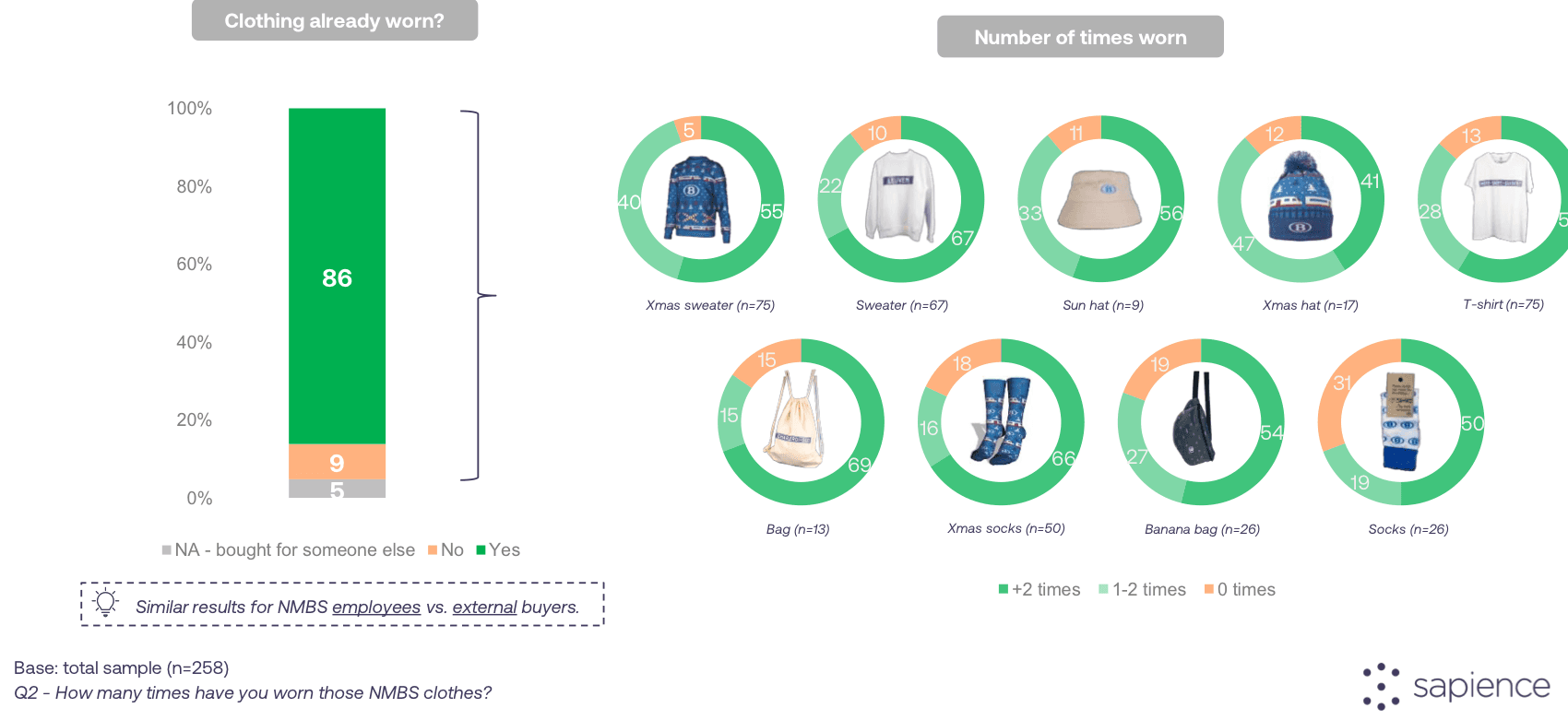
In a 2023 study run by Sapience with the Vrije Universiteit Brussel, 258 people were surveyed about branded items they had received. The usage split by item was wide.
| Item | Used 2+ times | Used 1-2 times | Never used |
|---|---|---|---|
| Bag | 69% | 15% | 15% |
| Sweater | 67% | 22% | 10% |
| Seasonal socks | 66% | 16% | 18% |
| T-shirt | 59% | 28% | 13% |
| Seasonal sweater | 55% | 40% | 5% |
| Plain socks | 50% | 19% | 31% |
Nearly a third of plain socks were never used at all. That is not a recognition gift, it is a transaction that cost money and produced nothing.
Three things follow.
6. Choose by usage rate, not unit price. A €40 item used weekly beats a €12 item used never, and the second is not cheaper, it is wasted. Start from items ranked by measured usage.
7. Make it visible if you want a second effect. In the same study, people whose items carried a visible logo scored 8.6 on engagement against 8.1 for non-visible items. Recognition that is also seen by others does two jobs.
8. Let people choose. The collection in the study was sold rather than given, and still produced the full measured effect. Choice appears to signal value in a way that default distribution does not. A swag store where people select their own item is the practical version.
Recognition for specific moments
- Work anniversaries, tiered so year five differs meaningfully from year one.
- Project completion, marked at the end rather than folded into a review cycle.
- Life events, which are the ones people remember longest, and which have nothing to do with performance.
- Seasonal moments, where the seasonal item is worth noting: the seasonal sweater in the data above had the lowest never-used rate of the entire collection at 5%. Almost everyone uses it. Nobody uses it in June. Both facts are true. Holiday gifting works precisely because the occasion carries it.
What recognition actually changes
Worth being precise, because recognition is often oversold.
In the study, the brand attributes that moved were the warmth ones. Sympathetic and friendly rose 12.5%. Trustworthiness and openness rose significantly. Meanwhile "efficient and well-organised" did not improve at all, and sat marginally lower.
That pattern is coherent. Recognition changes how people feel about the organisation, not whether they think it is well run. If your problem is that people find the company cold, recognition targets it directly. If your problem is that processes are broken, recognition will not fix that and may read as insulting.
How to know whether it worked
Your engagement survey almost certainly already contains a recognition item. Trend it, without changing the wording, and split it by who received what. That is the whole method, and it is covered in our survey questions guide.
The failure mode to avoid is the programme that launches loudly and stops quietly. A recognition scheme that ran for two quarters and then vanished is worse than never starting, because it tells people exactly how long the company's attention lasts.
Frequently asked questions
What are good employee recognition ideas?
Specific public acknowledgement costs nothing and works. Where a physical item is warranted, choose by whether people actually keep it: in measured data, bags and sweaters were used repeatedly by around two thirds of recipients while plain socks were never used by 31%.
How often should you recognise employees?
Often enough that it is not an event, specific enough that it is not policy. Measure recognition frequency in your existing engagement survey rather than guessing.
Do recognition gifts actually work?
Only if kept and used. An unused item produces no effect. Selecting by measured usage rate rather than unit price is the difference between a working programme and a cupboard of leftovers.
Should employee recognition be public or private?
Public works better for most people because it carries social proof, but not for everyone. Ask during onboarding and record the preference.
What is the difference between recognition and rewards?
Rewards are transactional and expected in advance. Recognition is discretionary and unexpected, which is why specificity matters more than monetary value.
Further reading
The full study, methodology and limitations · 11 engagement levers ranked by evidence · Engagement survey questions · Corporate gift ideas · Sustainable corporate gifts · Employee appreciation gifts explained