

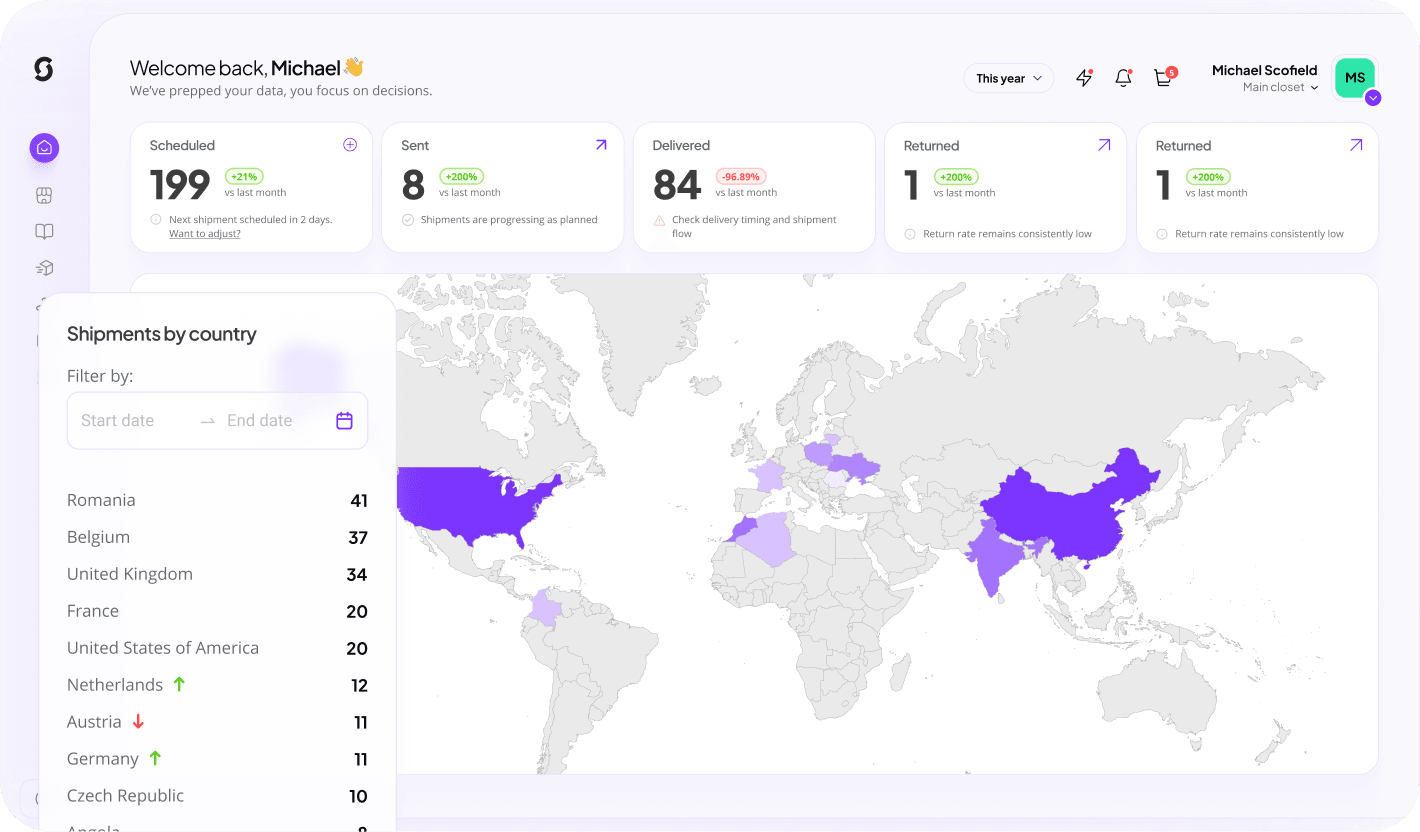




No code and no big project. Connect once, ask questions, then let the agent prepare quotes you approve. Here is the order that builds trust without risking a wrong order.
Part of our guide to agentic commerce for branded merch.

To use AI agents for your merch program, connect your merch platform to an AI assistant through MCP, then build trust in stages. Start with read-only questions about stock and shipments, move to budget suggestions and quotes a person approves, and only then set up recurring routines. With Sunday MCP, no code is needed.
Most guides on how to use AI agents assume you have a developer and a sandbox. A merch program needs neither. It needs a connection, a sensible order of steps and a clear rule about who approves what.
Here is the whole path in one table. Each step adds a little more responsibility for the agent, and the right-hand column never empties.
| Step | What you ask | What the agent does | What stays with you |
|---|---|---|---|
| 1. Connect | Nothing yet | Gets access to your Sunday account through OAuth | Requesting access, signing in |
| 2. Questions | Stock, shipments, top countries | Reads your Sunday data and answers | Checking the answers |
| 3. Suggestions | Budgets, kits, product ideas | Searches the catalog, prices options, builds wish lists | Choosing a direction |
| 4. Quotes | "Make a quote for this" | Generates the quote and sends the link | Approving the quote |
| 5. Shipments | Kits for new starters, client gifts | Plans the shipments | Confirming each shipment |
| 6. Routines | Monthly or quarterly checks | Runs the same prompt on a cadence | Approving whatever it prepares |
What do you need before you start?
- A Sunday account. No account yet? Create one here.
- An AI assistant that supports MCP. Claude, ChatGPT, Gemini or any other MCP client.
- Sunday MCP access, requested through the form on the Sunday MCP page. It is included on every Sunday plan.
- A named approver. Decide who approves quotes and confirms shipments before the agent prepares the first one.
Sunday is rolling out access to partners and agencies that handle merch requests for clients, and to power users with large merch programs. Sunday used the MCP internally first, to find out which tasks took teams the most time.
Step 1: request access and connect
Request access on the Sunday MCP page. Once Sunday grants it, you receive a connector URL. In your assistant, add Sunday as a custom connector using that URL, then sign in with your Sunday account. The sign-in uses OAuth, so the agent works with your own Sunday login.
That is the whole setup. No developer, no API keys to manage. The longer walkthrough is in how to connect Sunday to Claude, ChatGPT or Gemini, and if MCP is a new term, start with what an MCP server is.
Step 2: start with read-only questions
The first week should be questions only. Nothing gets ordered, you see how the agent reads your data, and you often find out things about your own program you did not know.
Illustrative example · You, in Gemini: How many black hoodies do we have left in stock, by size? And how many items did we ship last quarter, by country?
Sunday MCP: Here is your current hoodie stock by size from your Sunday inventory, followed by last quarter's shipped items grouped by country, most popular first. Want me to flag the sizes that are running low?
Good first questions are the ones you would otherwise send to a colleague or pull from an export.
- What do we have in stock right now, per product and size?
- How many items did we ship this quarter?
- Which countries order the most?
- What did we order for last year's kickoff?
- Which items are close to running out?
Step 3: let it suggest products and budgets
Next, give the agent a budget and an audience. Niels Vandecasteele at Sunday names assembling budgets as the most boring task in merch: "you have 20k to spend and a target audience." With one prompt, the agent searches the whole catalog, uses what is popular and what performs well, and comes back with a budget split.
Ask it to turn the result into a wish list you can share with colleagues, or to suggest a pre-made kit if you need something ready. This is also where the creative value shows up. You stop browsing the full catalog and start reacting to ideas that fit your audience. More on that in AI merch design, and a dozen scenarios in agentic AI examples in merch and gifting.
Step 4: move to quotes and approvals
This is where the agent starts saving real work, and where your controls matter most. Ask for a quote. The agent calculates prices, generates the quote and shows or sends it. A person approves it through a link.
Reorders are the best place to start, because there is a clear precedent.
You, in Claude: Create a quote to reorder the pants we ordered for the warehouse team in spring, same sizes as last time.
Sunday MCP: I found the spring order and prepared a quote with the same product, decoration and size split. Here is the link to review and approve it.
Niels expects this to be where agents take over first. "New products is a creative project. Reordering is an administrative transaction."
Start with one question
Connect Sunday to Claude, ChatGPT or Gemini and ask what is in stock. Quotes and routines come later, on your terms.
Request Sunday MCP accessIncluded on every Sunday plan · Works with Claude, ChatGPT and Gemini · You approve every order
Step 5: plan shipments and gifts
Once quotes feel routine, let the agent plan shipments. Welcome kits for next month's starters. A gift for a client who just signed. Merch from your stock to an office that is running low. The agent prepares the shipment, and a person confirms it before anything leaves the warehouse.
For HR, the flow is laid out in AI agents for HR and new hire welcome kits. For sales, in AI agents for sales. The delivery side runs through Sunday's distribution to 200+ countries.

A hoodie packed in a custom-printed box by Sunday. Shipments like this can be planned by an agent, and a person confirms each one before it goes out.
Step 6: make it a routine
The last step turns one-off prompts into habits. Some useful ones:
- A monthly stock check that flags low sizes and drafts reorder quotes.
- A quarterly event forecast. Say you hand out 1,000 to 1,500 items per event: load the calendar and ask for quotes covering the next three or six months.
- A leftover-stock review that asks which customers or employees should get what is left.
- A budget refresh before each kickoff or campaign, built from what performed well last time.
Depending on your assistant, you can save a prompt and rerun it, or run it on a schedule. Check what yours supports. The automation side is covered in AI workflow automation for swag programs. Whatever the routine prepares still goes through the same approvals.
Do you need to build an AI agent?
If you searched how to build AI agents, here is the short answer for a merch program: you probably do not need to. The assistant you already use is the agent. MCP gives it the tools. Your work is the instructions, the order of steps and the approval rules.
Building a custom agent on top of an API makes sense when you need logic no assistant offers. For most marketing, HR and ops teams, it adds a project where a connection would do. The trade-off is unpacked in MCP vs API.
The bigger point is the one Niels makes about where this goes: "It's like adding physical products to any software layer." Once Sunday sits inside your assistant, your CRM, HR tool and calendar can all lead to merch through the same chat.
Which mistakes should you avoid?
- Skipping the questions stage. It is how you learn to trust the output.
- Vague briefs. "Some merch for the team" gets generic suggestions. Describe the people and the budget.
- No named approver. Quotes sit unapproved and the agent gets blamed.
- Expecting automatic orders. Sunday MCP does not place orders. Design your process around approvals.
- Starting with the hardest creative project. Start with reorders and budgets, then work up to new collections.
For the controls finance will ask about, read the agentic commerce FAQ for procurement and finance. For the strategy behind all of this, see our guide to agentic commerce for branded merch.