





AI agents are starting to do the buying for companies. For branded merch the honest answer is a split: let agents run the admin, keep people on the creative work and on the final yes.
For the product itself, read Sunday MCP: manage your merch from Claude, ChatGPT or Gemini.

Agentic commerce is buying and selling where an AI agent does the shopping work for a person or a company: it searches, compares, checks stock, calculates prices and prepares the order. In B2B agentic commerce for branded merch, the agent handles budgets, quotes and reorders, and a person approves every order before anything is produced or shipped.
The argument of this article in one line: reordering merch is an administrative transaction that agents will take over fast, while new merch is a creative project where people stay in charge.
What is agentic commerce?
Most ecommerce assumes a person clicking through pages. Agentic commerce assumes software doing the clicking. You describe the goal, and an AI agent does the steps: it searches the catalog, compares options, checks what is in stock, calculates the price and prepares the order. You approve it or you send it back.
The consumer version gets the headlines. An AI shopping agent finds running shoes in your size or rebooks a flight. The business version is quieter, and in practice it may matter more, because companies buy the same things again and again and nobody enjoys the admin around it.
What makes this possible now is an open standard called the Model Context Protocol, or MCP. It lets an AI assistant like Claude, ChatGPT or Gemini connect to a business system and actually use it, instead of only talking about it. If the term is new to you, start with what an MCP server is, in plain English.
| Term | What it means |
|---|---|
| Agentic commerce | An AI agent does the shopping work: search, compare, price, prepare the order |
| AI shopping agent | The consumer version, buying finished products for one person |
| B2B agentic commerce | The company version, working inside budgets, approvals and existing stock |
| MCP | The open standard that connects an AI assistant to a business system so it can act in it |
Why is B2B merch different from consumer agentic shopping?
A consumer agent buys a finished product that someone else designed, made and stocked. Branded merch does not exist until you make it. That one fact changes what an agent can safely do.
Look at what sits around a single hoodie order in a company:
- Designs. Your logo, its placement, the colours and the decoration technique. All of it has to be produced to order.
- Approvals. Someone signs off on the mockup, and often someone else signs off on the spend.
- Brand guidelines. A wrong shade on 500 hoodies is a real cost and a visible one.
- Budgets. Department budgets, campaign budgets, per-head budgets for new hires or clients.
- A warehouse. Stock you already own, split across sizes and colours, sitting somewhere and waiting to be used.
Merch is complex. You want to automate as much as possible, and you still need a person confirming that the brand is respected. That is the line this whole article draws.
It is also why gifting MCPs and merch MCPs are different products. Goody and Sendoso both launched MCP servers in June 2026. Goody sends curated gifts from third-party brands, and Sendoso covers gifting and direct mail. Both automate buying someone else's product. Branded merch means designing, producing, storing and shipping your own. The fair side-by-side is in Sunday MCP vs Goody and Sendoso.
Creative project or administrative transaction?
The most useful split we have found is this one, in Niels's words:
A creative project needs taste, context and a person who owns the result. An administrative transaction needs accuracy and speed, and the decision behind it has already been made. Agents are good at the second and useful as a sparring partner for the first.
| Task | Type | Who does it |
|---|---|---|
| Reorder an approved hoodie in the same design | Administrative | Agent prepares the quote, a person approves |
| Check stock by size and colour | Administrative | Agent |
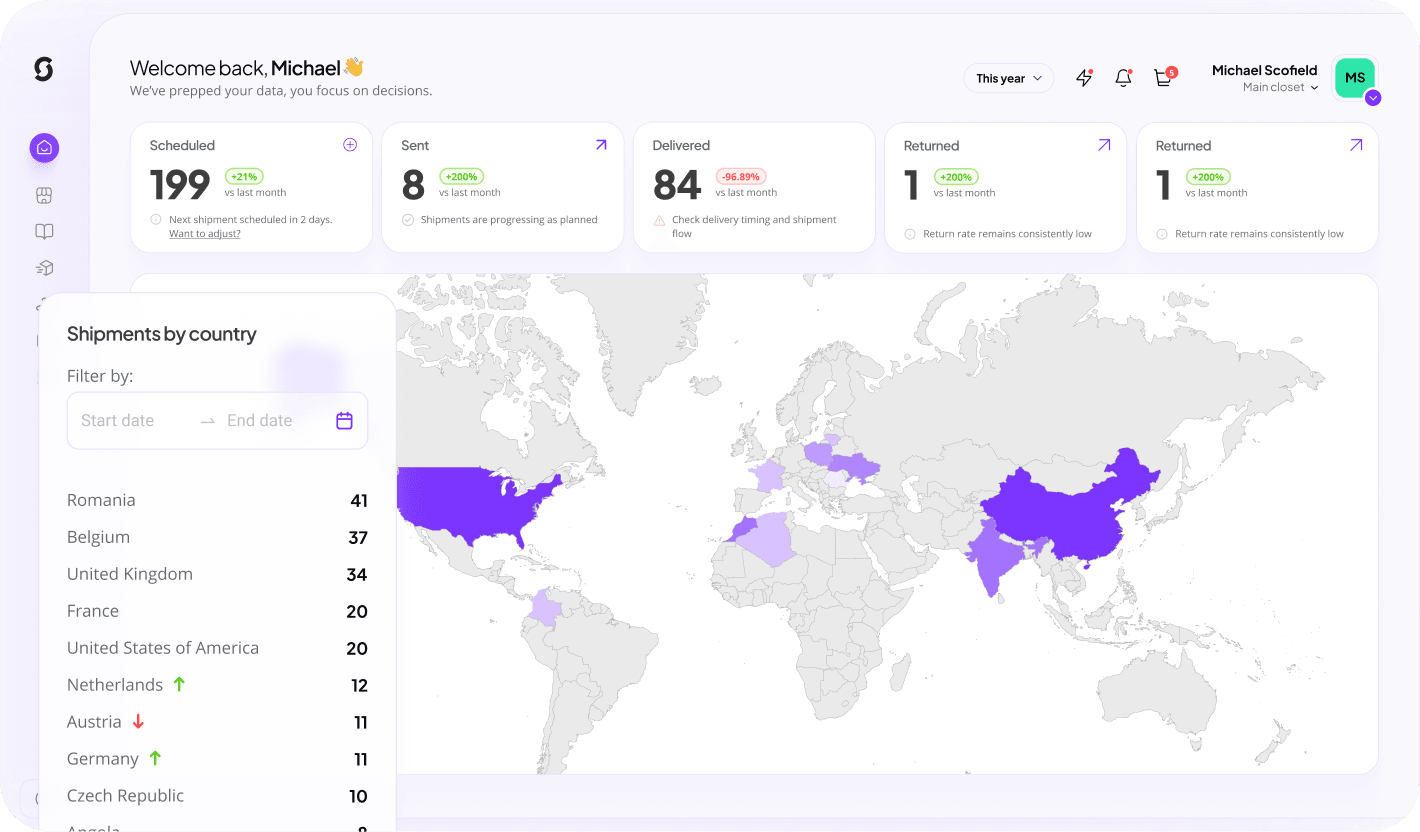
| Report what shipped, and to which countries | Administrative | Agent |
| Split a budget across an audience | Admin with creative input | Agent proposes, the team picks |
| Plan a shipment to a list of addresses | Administrative | Agent plans, a person confirms |
| Choose products for a new campaign | Creative | Agent suggests ideas, people decide |
| New design, new logo placement, new colourway | Creative | People sign off, every time |
Notice that the agent shows up in every row. What changes is how much of the decision it carries.

A gift set like this starts as a creative project. Someone picked the knit, the pattern and the box. An agent can suggest options, but that call stays with people.
How much merch will AI agents order?
Not most of it. Our bet at Sunday is significant though: around 20% of merch, maybe more, ordered by agents in about three years. Treat it as a bet, not a measurement. It is how we are planning the product.
That 20% will not be spread evenly. It will sit in reorders. The reason is simple. A reorder is a decision someone already made. The design is approved. The product has been worn and liked. There is a history of quantities and sizes. The only open questions are how many, which sizes and where to send them. An agent can answer those from your own data and hand you a quote to approve.
Companies that already run on AI will move first. For them, the reorder stops being a task on someone's list and becomes one prompt. New products move slower, because they are a creative project. Agents will help there too, mostly by suggesting ideas that fit an audience, which saves someone from scrolling a full catalog.

Once a hoodie like this has been designed, approved and worn, ordering it again is admin. That is where agents fit first.
Where do humans stay in the loop?
In Sunday MCP the rule is short. The agent cannot place an order. It can prepare almost everything else, and a person approves the result.
| The agent can | A person must |
|---|---|
| Suggest products and pre-made kits | Approve every quote, through a link |
| Calculate prices and build a budget split | Confirm every shipment |
| Request a quote, including a one-prompt reorder | Sign off designs against the brand guidelines |
| Select products and request designs | Own the spend decision |
| Plan shipments and answer stock or reporting questions |
There are no automatic orders today. Every order goes through a quote, every quote goes to a person, and the approval happens outside the chat on a link. That keeps the audit trail where finance expects it. Procurement and finance teams usually ask the same handful of questions about this, so we answered them in the agentic commerce FAQ for procurement and finance, and the controls themselves are covered in spend controls for AI agents.
Here is what a reorder looks like in practice.
You, in Claude · Illustrative example: How many black hoodies do we have left in stock, by size? Then create me a quote to reorder the pants from our last onboarding kit, same sizes as last time.
Sunday MCP: Here is current stock of the black hoodie by size. I have prepared a quote to reorder the pants using the size split from your previous order. Nothing is ordered yet. Open the quote link to review and approve it.
What does "physical products in any software layer" mean?
An AI assistant with MCP connections can work across several systems in one conversation. Your CRM, your calendar, your HR tool and your merch platform stop being separate tabs. That opens a kind of work no single system could do on its own.
Three scenarios show what that means. These are how-it-works examples, not customer results.
CRM data decides who, Sunday decides what
Say you have HubSpot connected to your assistant as well. You ask which customers would be best to send a gift to right now, the ones where it would have the most impact. Then you ask Sunday MCP what to gift them. It generates the packs in the Sunday app, and they go out after a person approves. The full workflow is in AI agents for sales.
Events turn into a forecast
Say you load in your event calendar and tell the assistant you hand out 1,000 to 1,500 items per event. You ask it to build a forecast for next quarter and to prepare quotes for the next three or six months. That turns a scramble before every event into a plan. We walk through it in AI workflow automation for swag programs.
Leftover stock finds a home
Say you have leftover stock in your Sunday platform and your assistant is connected to other systems that know your customers or employees. You ask which of them you should reward with it. Stock that would sit on a shelf becomes a thank-you. More scenarios like this are collected in 12 agentic AI examples in merch and gifting.
The same pattern works for people teams. A new start date in your HR system becomes a welcome kit suggestion, a stock check and a shipment plan, which is covered in AI agents for HR. If you want to see the physical side of that, our guide to new hire welcome kits shows what goes in the box.

The software can sit anywhere, the moment still happens at a real table. An agent can plan the shipment, a person confirms it before it leaves.
What should you automate first?
Start with the work nobody would miss. In our experience that list is short and very consistent.
1. Assembling budgets
This is the most boring merch task we know. You have 20k to spend and a target audience, and someone spends a week in spreadsheets and catalog tabs to turn that into a plan. With one prompt, the agent searches the whole catalog, looks at what is popular and what performs best, and comes back with a budget split. It can save the result as a wish list you share with colleagues before anyone asks for a quote.
You, in ChatGPT: We have €20,000 to spend on merch for our customer success team and their top accounts this year. Suggest a budget split and save it as a wish list I can share with my manager.
Sunday MCP: I have drafted a split within your €20,000, based on products that are popular and perform well for similar audiences. It is saved as a wish list you can share. When you are ready, I can turn any part of it into a quote for approval.
2. Reorders in one prompt
Same product, same design, new quantities. The agent creates the quote, you approve it on the link. This is where most of the agent-ordered volume will come from.
3. Data questions
Current stock. How many items shipped this quarter. Which countries you send to most. These questions used to mean an export and a pivot table. Now they are a sentence.
4. Ideas for new projects
Only after the first three are running. Here the agent works as a sparring partner: it suggests products and kits that fit an audience, so you do not browse the full catalog. Design approval stays with your team, as we explain in AI merch design: from idea to mockup to approved quote.
If you want the order of operations in more detail, from first connection to recurring tasks, read how to use AI agents for your merch program, step by step. For a set of ready-made prompts, see 30 prompts to run your merch program.
Put your merch inside your AI assistant
Sunday MCP connects your whole merch program to Claude, ChatGPT and Gemini. Agents prepare, you approve.
Request Sunday MCP accessIncluded on every Sunday plan · Works with Claude, ChatGPT and Gemini · You approve every order
How does Sunday MCP fit in?
Sunday MCP connects the whole Sunday merchandise platform to any AI assistant that supports MCP. That includes Claude, ChatGPT and Gemini, and any other MCP client your team uses. Whatever you do in the platform today, you can ask for in a chat.
Through it, a customer can:
- get product suggestions and pre-made kit suggestions
- calculate prices and request quotes
- select products and request designs
- plan shipments and send out merch, gifts included
- ask for reporting and data, such as current stock, items shipped and the most popular countries
- build budget suggestions and shareable wish lists
- reorder in one prompt, as a quote
Setup is short. You add Sunday as a custom connector using the URL you receive, then sign in with your own Sunday account. The step-by-step version is in how to connect Sunday to Claude, ChatGPT or Gemini.
We used it internally first, to find the parts of merch work that took our own teams the most time. It is now rolling out to partners and agencies, who handle merch requests for their clients and can find what they need much faster, and to power users with large merch programmes. Access is on request and included on every plan.
The time saving is real, but the platform already gave you most of that. What the MCP adds is the creative side. It comes up with ideas that fit your target audience, and nobody has to browse the full catalog to find them. The full product walkthrough lives in the Sunday MCP guide, and German readers can find it in MCP-Server für Merchandise.
The agent sits on top of a platform that already handles production, storage and shipping, across a catalog you can still browse yourself when you want to. No Sunday account yet? Create one for free and request MCP access once you are in.