



Remote employee engagement is the degree to which distributed employees feel energy, pride, loyalty and a willingness to speak well of the company. It is not the same as attendance on video calls or message volume in Slack. The tactics that move it are a documented communication rhythm, manager one-to-ones with a real agenda, recognition that is visible to the whole team, and at least one physical touchpoint a year. The tactic that separates a real programme from a good intention is measuring it with the same survey wording every time.
Almost every article on this subject recommends software. Virtual coffees, kudos channels, engagement platforms, pulse tools. All of that helps, and none of it addresses the specific thing a distributed team lacks: anything shared that is physical. This piece covers the standard levers honestly, then goes into the one intervention we have measured data on, including a clear statement of where that data does not transfer.
Why remote engagement breaks differently
Engagement in an office is partly passive. Belonging is transmitted by the building, the badge, the colleague wearing last year's team hoodie, the overheard conversation. Nobody has to decide to send those signals. Remove the building and every signal becomes deliberate, budgeted and scheduled, which means it can be forgotten.
Four failure modes show up repeatedly in distributed teams.
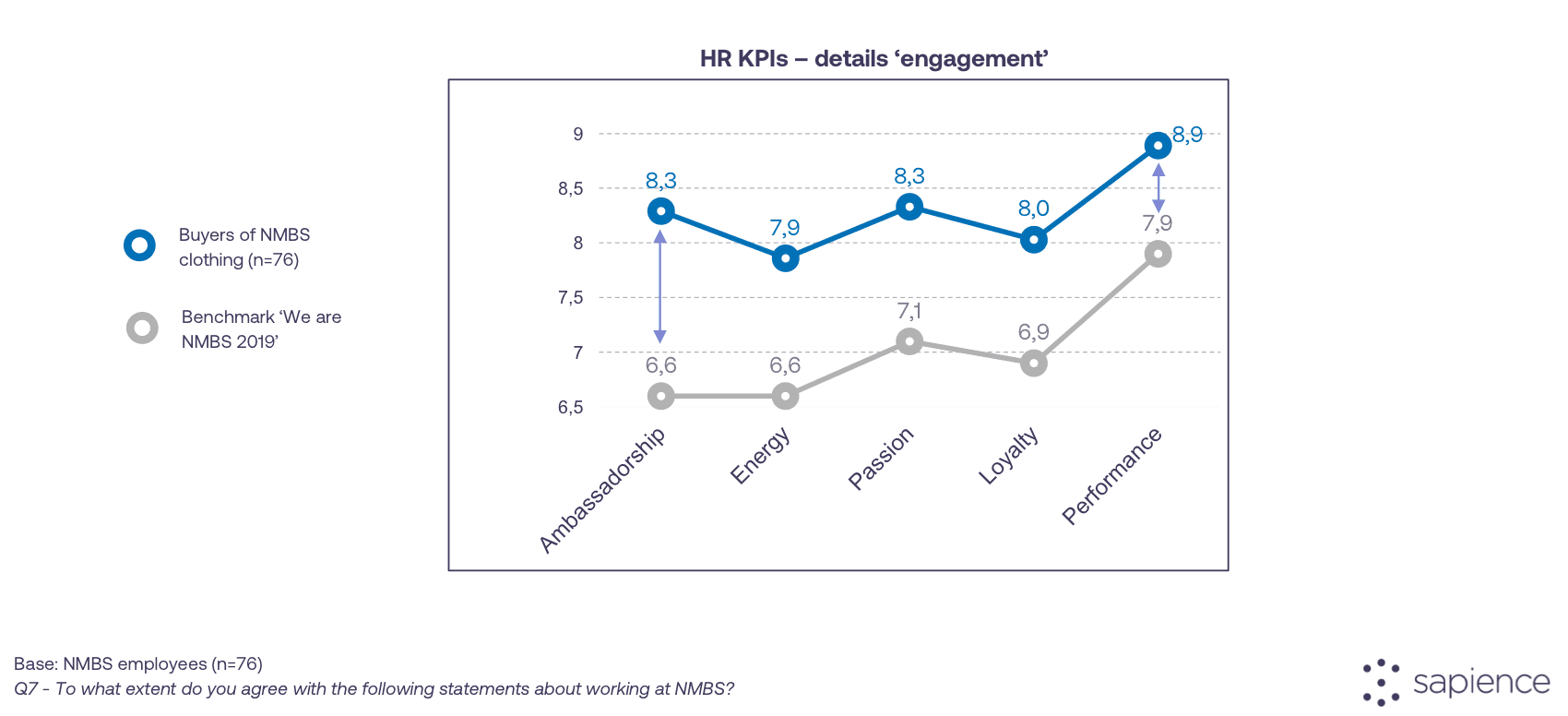
- Ambassadorship goes first. Engagement is usually broken into sub-factors: energy, passion, loyalty, performance and ambassadorship. The last one, whether someone would recommend the company to others, is the one that decays quietest in a remote setting, because nobody sees anybody else doing it.
- Recognition becomes private. A manager saying well done in a direct message is invisible to everyone else. In an office, praise leaks. Remotely it has to be routed on purpose.
- Onboarding sets the ceiling. A remote hire whose first week is a laptop and a calendar invite starts from a lower base, and rarely recovers it later.
- Activity gets mistaken for engagement. Message counts and meeting attendance are easy to measure and mean very little. A disengaged person can be extremely responsive.
What has actually been measured, and what has not
Most remote engagement advice has never been tested against a benchmark. Ours has been, once, and it is worth being precise about what that does and does not prove.
Sunday commissioned research agency Sapience and the Vrije Universiteit Brussel to study the branded merchandise programme at Belgian railway operator NMBS/SNCB, surveying 258 people. The results were compared against the organisation's own existing employee engagement survey, so the benchmark is the same population measured the same way.
| Metric | Organisation benchmark | Merchandise group | Change |
|---|---|---|---|
| Engagement | 7.0 | 8.3 | +19% |
| Satisfaction | 6.6 | 8.0 | +21% |
| Ambassadorship | 6.6 | 8.3 | +1.7 points |
Ambassadorship was the single largest effect in the study. That matters here for one specific reason: ambassadorship is the sub-factor a distributed team loses first, so the intervention with the biggest measured effect happens to hit the weakest point of a remote workforce.
Now the caveat, because it is important. NMBS/SNCB is a railway operator with a largely on-site workforce. This is not a study of remote workers. The numbers above should not be presented to your leadership team as evidence of what merchandise does for a distributed team, because that is not what was measured. What can reasonably transfer is the mechanism, and the mechanism is worth understanding before you decide whether it applies to you. The study is also correlational rather than causal, and covers one organisation in one country. The full study on company swag and employee engagement sets out the method, sample and limitations.
Nine things that move remote employee engagement
1. A documented communication rhythm
Write down what happens weekly, monthly and quarterly, and who owns each one. Remote teams do not suffer from too little communication so much as from unpredictable communication. A published rhythm removes the low-grade anxiety of not knowing when you will hear anything.
2. Manager one-to-ones with a fixed agenda
Thirty minutes, same slot, three standing questions: what is blocking you, what did you do that nobody saw, what do you want to be doing in a year. The third question is the one most managers skip and the one that predicts retention.
3. Asynchronous-first defaults
Decisions written down, meetings only when a document has failed. This is an engagement lever, not just a productivity one, because synchronous-by-default quietly penalises anyone in the wrong time zone and they notice.
4. Recognition routed publicly
Praise that only the recipient sees does about a third of the work. Route it to a channel, an all-hands, or a monthly note. Our employee recognition ideas post covers the formats, including the finding that people valued items they had chosen more than items simply handed to them.
5. An onboarding kit that arrives before day one
The highest-leverage single moment in a remote employee's tenure is the first morning. A box on the doorstep the day before is the cheapest way to make it feel deliberate. See welcome kit ideas that actually land, which now carries measured wear rates per item, and how to measure welcome kit ROI for the break-even maths.
6. One physical touchpoint a year
Something that arrives at the house and is not a laptop. This is the section with the data behind it, and it gets its own treatment below.
7. Optional social time that is genuinely optional
Voluntary events that everyone knows the CEO attends are not voluntary. Either make attendance genuinely free of consequence, or stop calling it optional. Forced fun is worse than no fun, because it adds obligation to isolation.
8. Career conversations on a schedule
Remote workers are promoted less often than their in-office colleagues in many organisations, and they know it. A scheduled, documented progression conversation is an engagement intervention disguised as an HR process.
9. Measure it, with the same wording every time
Change the question wording and you lose the comparison. This is the single most common mistake in engagement measurement, and it is unrecoverable: last year's number becomes useless. Our employee engagement survey questions post lists the exact wording used in the study, including the two extra questions that let you measure whether a merch programme is doing anything.
The physical-object argument, stated honestly
A distributed company has no shared physical space, so it has no shared physical object either, unless it sends one. Every other engagement lever available to a remote team is delivered through a screen.
Three findings from the study are relevant to whether that is worth doing.
- People actually use it. 86% of recipients had worn their item at least once. The never-worn rate varied from 5% on the best-performing item to 31% on the worst, so the item you pick matters more than the fact that you sent one.
- Visible branding outperformed discreet branding. Recipients with visibly branded items reported higher engagement (8.6 versus 8.1) and higher satisfaction (8.4 versus 7.7) than recipients whose items carried a hidden logo.
- There was a dose-response. People who wore the item scored higher than people who did not (8.3 versus 7.9 on engagement). A relationship that strengthens with exposure is harder to explain away as pure self-selection, which is what makes this more than a satisfaction survey.
Where this gets weaker for remote teams. The conversation effect measured in the study, 84% of wearers were spoken to about their item and 94% of those conversations were positive, largely happened around colleagues and the public. A remote employee wearing a company sweater at home has fewer colleague-facing wearing moments. The conversations still happen, but with neighbours, friends and people in the supermarket. That is arguably better for employer-brand reach and weaker for internal cohesion. If your goal is the second one, a physical object is a supporting act, not the lead.
If you do send something, three decisions follow from the data. Let people choose their own size rather than guessing, because an item that does not fit is an item that is never worn. Put the branding where it can be seen. And lead with the categories that scored highest on wear rate, which were bags and knitwear rather than caps or plain accessories.
For what to actually send, see gifts for remote employees, shipped anywhere, company swag ideas ranked by measured wear rate, and sustainable corporate gifts if waste is a concern, which for unworn merchandise it should be.
How to measure remote employee engagement
Engagement is measured with agreement statements, not with activity data. The study used six question blocks; the engagement block broke into five sub-factors, and running those separately is what makes the result actionable rather than a single number nobody can act on.
| Sub-factor | What it tells you | Why it matters remotely |
|---|---|---|
| Energy | Whether the work itself is draining | Catches burnout before attrition does |
| Passion | Whether people care about the outcome | Drops when work feels like ticket-processing |
| Loyalty | Intent to stay | The one that shows up in your turnover figure later |
| Performance | Self-assessed contribution | Usually the highest score, so a low one is a real signal |
| Ambassadorship | Whether they would recommend the company | The canary for distributed teams. Track it separately. |
Three rules that decide whether the exercise is worth anything at all. Reuse the exact wording every cycle. Run it at a fixed cadence rather than after something notable happens. And segment remote against on-site if you have both, because a blended average hides exactly the gap you are trying to find.
Five mistakes worth avoiding
- Counting activity as engagement. Slack messages, meeting attendance and hours online measure availability. A quietly disengaged person is often extremely responsive.
- Changing the survey wording. It destroys the benchmark permanently. Improve the questions once, then freeze them.
- Running the survey only when something is wrong. You get a crisis reading with nothing to compare it to.
- Guessing sizes. The fastest way to turn a gesture into landfill, and the never-worn rate is where that shows up.
- Hiding the logo. The measured gap sits between visible and discreet branding, not between branded and unbranded. A tasteful mark that can actually be seen is the point.
Remote employee engagement: questions answered
What is remote employee engagement?
It is the degree to which distributed employees feel energy, pride, loyalty and a willingness to recommend the company to others. It is measured with agreement statements in a survey, usually broken into sub-factors, and not with activity data such as message volume or meeting attendance.
How do you improve engagement in a remote team?
Publish a predictable communication rhythm, run manager one-to-ones with a fixed agenda including career questions, route recognition publicly rather than privately, get onboarding right before day one, keep optional social time genuinely optional, and measure with the same survey wording every cycle so you can see whether any of it worked.
Which part of engagement drops first when a team goes remote?
Ambassadorship, the willingness to recommend the company to others. It decays quietly because nobody sees anyone else doing it, and it rarely shows up in a single blended engagement score. Track it as its own line.
Does sending merchandise improve remote employee engagement?
There is measured evidence that a merchandise programme is associated with higher engagement and ambassadorship, but it comes from an organisation with a largely on-site workforce, not a remote one. The mechanism that is most likely to transfer is the physical touchpoint itself. The conversation effect is likely to be weaker among colleagues and stronger with friends and neighbours, which helps employer brand more than internal cohesion.
How often should you survey a remote team?
On a fixed cadence, typically quarterly for a short pulse and annually for the full instrument. Consistency matters more than frequency: the same questions at predictable intervals produce a trend, while ad-hoc surveys after notable events produce numbers with nothing to compare them against.
What is the difference between engagement and satisfaction?
Satisfaction is how content someone is with their situation. Engagement is how much discretionary energy and advocacy they give back. They move together but not identically, which is why the study reported them separately: engagement rose 19% and satisfaction 21% against the same benchmark.
Keep reading
- The full scientific study behind the numbers on this page
- How to improve employee engagement, the general version of this guide
- Employee engagement survey questions, including the exact wording used
- Employee advocacy programmes, if ambassadorship is your weak spot
- Employee swag and branded merchandise in the glossary