

Part of our complete company swag store guide.
Company swag boxes, or employee swag boxes, deliver a predefined bundle to a known recipient, so they suit onboarding, Christmas, customer gifts and event kits. Swag stores let people browse, choose, redeem and order on an ongoing basis. Between them sits the redeem campaign, a single page for one-off gifting with one to three choices.
The mistake is choosing the format by company size instead of by the decision the recipient is making. Somebody receiving a welcome gift is not shopping. Somebody spending a recognition balance is. Those are different experiences and they need different interfaces.
What's in this guide
Swag boxes vs swag stores vs redeem campaigns
Three formats cover almost every merchandise distribution problem. The difference between them is how much choice the recipient gets, and how often they are expected to come back.
| Format | What the recipient does | Best for |
|---|---|---|
| Swag box / welcome kit | Receives a predefined bundle. No selection, or size only | Onboarding, Christmas, customer gifts, event kits, milestone gifts |
| Redeem campaign | Submits address, size and maybe a small preference. One page, one moment | One-off gifting with one to three choices, seasonal sends, campaign rewards |
| Swag store | Browses, chooses, redeems, buys, returns later | Ongoing programmes with a rotating assortment and repeat visits |
Everything else is a variation on these. A welcome kit is a swag box. A swag box is a predefined gift. A store is ongoing choice.
When company swag boxes are the right format
Swag boxes win when the company already knows what it wants the person to receive and the moment is the point.
- Onboarding. A new hire on day one should receive something, not be handed a catalogue and a decision. The full playbook is in new hire welcome kits.
- Christmas and end-of-year. One curated gift, one send, one moment. See corporate Christmas gifts.
- Customer and prospect gifting. The recipient is outside your organisation and should not be asked to create an account to receive a gift.
- Event kits. Fixed contents, known headcount, one delivery address or many. Covered in event merchandise.
- Milestones. Anniversaries and recognition moments where the gift is chosen by the giver on purpose. See work anniversary gifts.
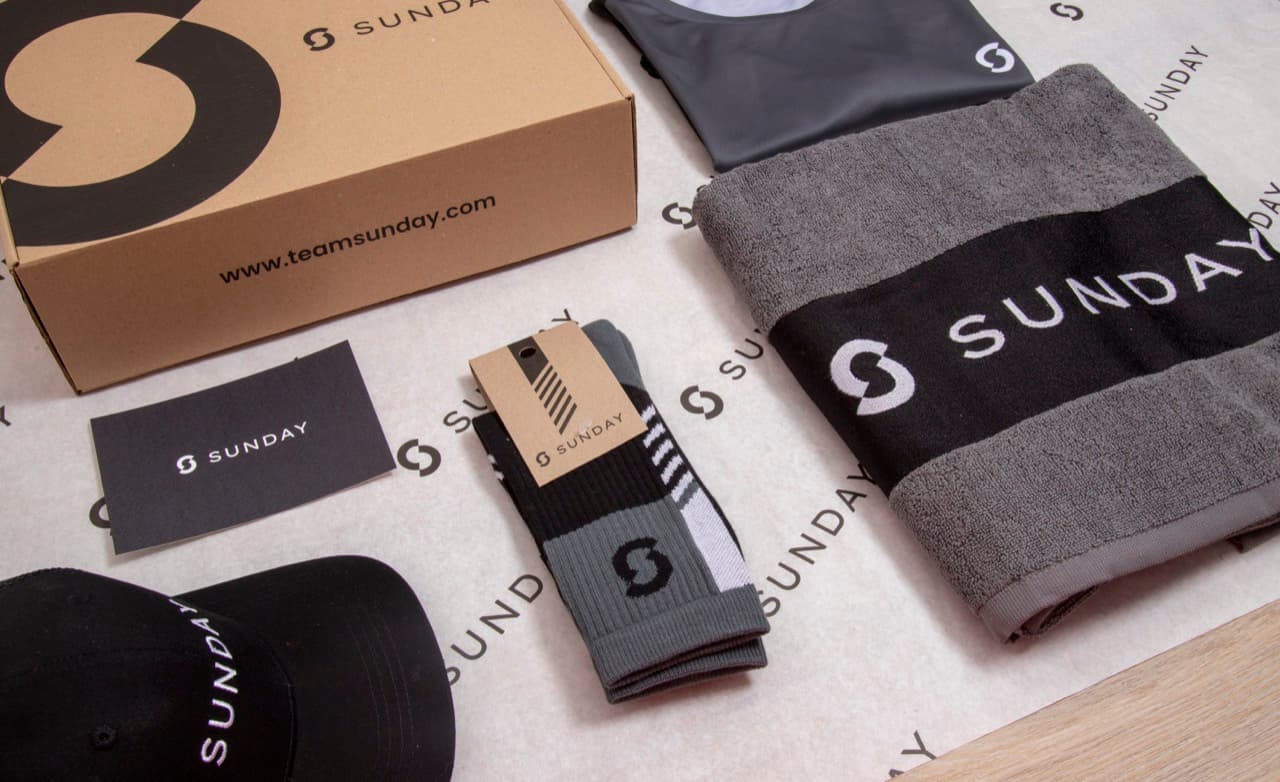
The presentation carries more weight here than in a store, because a box arrives as a single event. Packaging, the insert card and the sequence of opening it are the experience. A well-presented modest box beats a carelessly presented expensive one, which is why Sunday's standing advice on gifting is to brand less and package more.

A box works when the company has already made the decision. One considered product, presented properly, beats three products chosen at random.
What goes in a company swag box
Two to four useful, well-made items beat a box full of filler. Start from what people actually order and wear. Across Sunday's 4,000+ brands, sports socks are the most-ordered product, followed by T-shirts and hoodies. Those three are the backbone of most company swag boxes because everyone has a size and they get used.
Then weigh in what gets worn. In a 258-person study of the NMBS merchandise programme, branded bags were worn more than twice by 69% of recipients and sweaters by 67%, while 31% of plain socks were never worn. Design, not the product category, decides whether a basic earns a place in the box.
| Box | Typical contents | Why it works |
|---|---|---|
| Welcome kit | Hoodie, T-shirt, socks, a tote or backpack | Everything a new hire wears in week one, sized once |
| Christmas box | One standout sweater or blanket, socks, a card | One considered gift, presented well, beats many small ones |
| Customer or event box | Designed socks, a T-shirt, a bag | Light, easy to ship, no size friction for socks and bags |
Sizing is the only decision a box should ask of the recipient, which is where a redeem page helps. The minimum is 10 pieces per item, and 70% of Sunday orders go through automatic design templates with no designer and no proof cycle, so a small box run does not need an agency brief. For more product ideas, see 25 company swag ideas employees will actually use.
When a redeem page beats a store
This is the case most often missed, and it is the reason to be honest about where a store does not belong. If the user is not genuinely shopping, do not build a shop.
Use a redeem page when all of the following are true:
- There are one or two fixed gifts, or a choice between three at most
- The recipient mainly needs to supply an address, a size and perhaps one preference
- It is a single campaign: an onboarding kit, a Christmas gift, a customer send
- There is no ongoing assortment, and no reason for the person to come back
A redeem page finishes in under a minute. A store asks somebody to browse, compare and decide, which is a good experience when there is something to browse and a poor one when there are two items and a deadline. Forcing a store into that moment adds friction and produces exactly the low completion rate that gets blamed on the merchandise.
When you genuinely need a swag store
A store earns its place when merchandise stops being an event and becomes a programme. The trigger is complexity rather than headcount: different products for different audiences, varying budgets and approval rules, individual shipping across countries, continuous demand rather than one or two sends a year.
At that point the store is doing work a box cannot. Zalando House of Merch, for example, prices team orders by quantity directly on the product page, with tiers stepping down as volume rises and a minimum order quantity stated in plain language. A manager places a team order without requesting a quote, which is a workflow, not a gift.
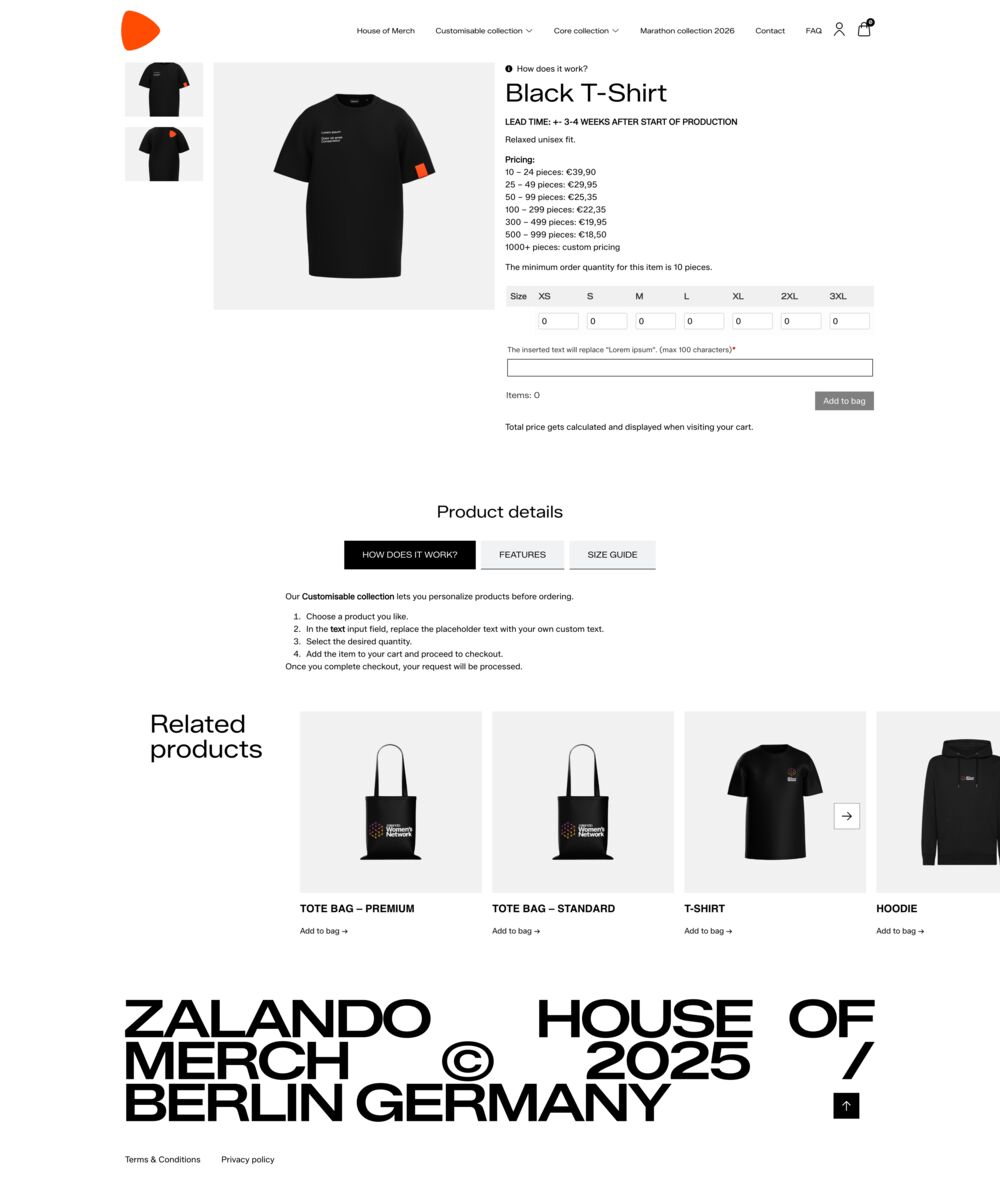
Zalando House of Merch: quantity-based pricing, a stated minimum order quantity and a text field for team customisation. A box cannot carry this decision.
The same is true when a balance is involved. Interstellar's store prices products in the company's own coin currency, so employees spend a balance rather than money. That only makes sense if there is a collection worth spending it on and a reason to return when the collection changes. The funding side of that is in swag store funding models, and the staff-only version is in the employee swag store guide.
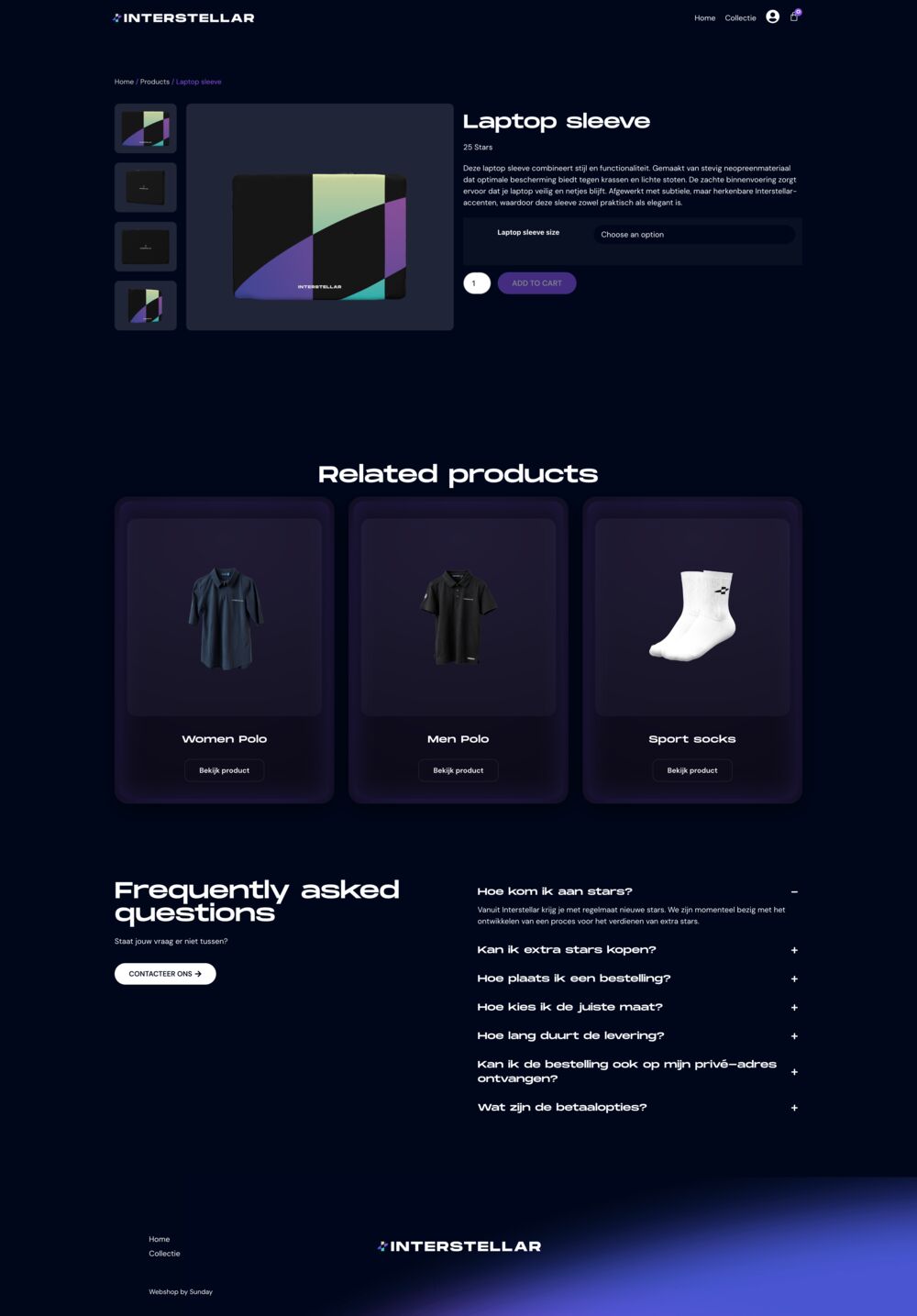
Interstellar prices each item in the company's own balance currency. Redemption in a store only works when the assortment gives people a reason to browse.
The formats reinforce each other
This is not a choice you make once. Mature programmes run two or three formats at the same time, each on the moment it fits.
- Standardised welcome kits plus an employee store. The kit handles day one, deterministically. The store handles everything after, with rotating collections and recognition credits.
- A store that sells boxes. Curated bundles are products too. Selling a gift set through the store gives managers a one-click way to send something complete.
- A redeem page fed from store stock. The same warehouse, the same products, a different front end for a one-off campaign.
- Campaigns that clear slow stock. Products that move slowly in the store perform well in event kits and customer sends. That loop is covered in swag inventory management.
What stays constant underneath is the operating layer: one assortment, one warehouse, one set of fulfilment and shipping rules. Only the interface changes. That distinction between the storefront people see and the operations behind it is covered in best swag platform.
Governed gifting, in practice
The Bitpanda Invite-only Store shows what happens when the two ideas meet. It looks like a store and behaves like a controlled gifting workflow. Recipients are C-level contacts who receive an invitation rather than open access. Orders go through an approval step before dispatch. Items are free, which removes any payment step and avoids the account friction that would stop a senior external contact halfway through.
It is not an employee shop. It is a gifting process with governance built into it, delivered through a store interface because the recipient does get a choice. That is the useful way to think about the whole question: match the interface to the decision the recipient is actually making, then add only the governance that decision requires.
If the recipient is choosing nothing, send a box. If the recipient is choosing between two or three things once, build a redeem page. If the recipient is choosing repeatedly from a collection that changes, build a store. The step-by-step build is in how to launch a swag store, and the wider gifting context sits in corporate gifts.
Whichever format you land on, the products are the same decision. Start with a reliable anchor like custom socks or custom hoodies, preview the artwork in the free sock mockup generator, and see how Sunday runs boxes, redeem pages and stores off one operation through the platform, the catalog and how it works.
Frequently asked questions
What is a company swag box?
A predefined bundle of branded merchandise sent to a known recipient for one moment: onboarding, Christmas, a customer gift, an event or a milestone. The company decides the contents; the recipient supplies at most a size and an address. Packaging and the unboxing sequence carry as much weight as the products.
What should you put in a company swag box?
Two to four useful, well-made items rather than many cheap ones. Across Sunday's 4,000+ brands the most-ordered products are sports socks, T-shirts and hoodies. In a 258-person NMBS study, bags and sweaters were worn more than twice by 69% and 67% of recipients, while 31% of plain socks were never worn.
Should I use a swag box or a swag store?
Ask whether the recipient will ever have a reason to come back. If not, send a box or use a redeem page. If people will choose repeatedly from a collection that changes, with balances or team orders, build a store. Choose by the recipient's decision, not by company size.
What is a redeem page?
A single page where a recipient claims a gift by entering an address, a size and perhaps one preference from up to three options. It finishes in under a minute, needs no account and suits one-off campaigns such as Christmas gifts, onboarding kits and customer sends where nobody needs to browse.
Can you run swag boxes and a swag store together?
Yes, and mature programmes do. A standard welcome kit covers day one, the store covers everything after, the store can sell curated boxes, and redeem pages can draw from the same stock. One assortment, one warehouse and one set of shipping rules sit underneath all three.
About this article
Box, redeem page or store
One assortment, one warehouse, three front ends. Create a free account and run the format each moment actually needs.
Build your swag store