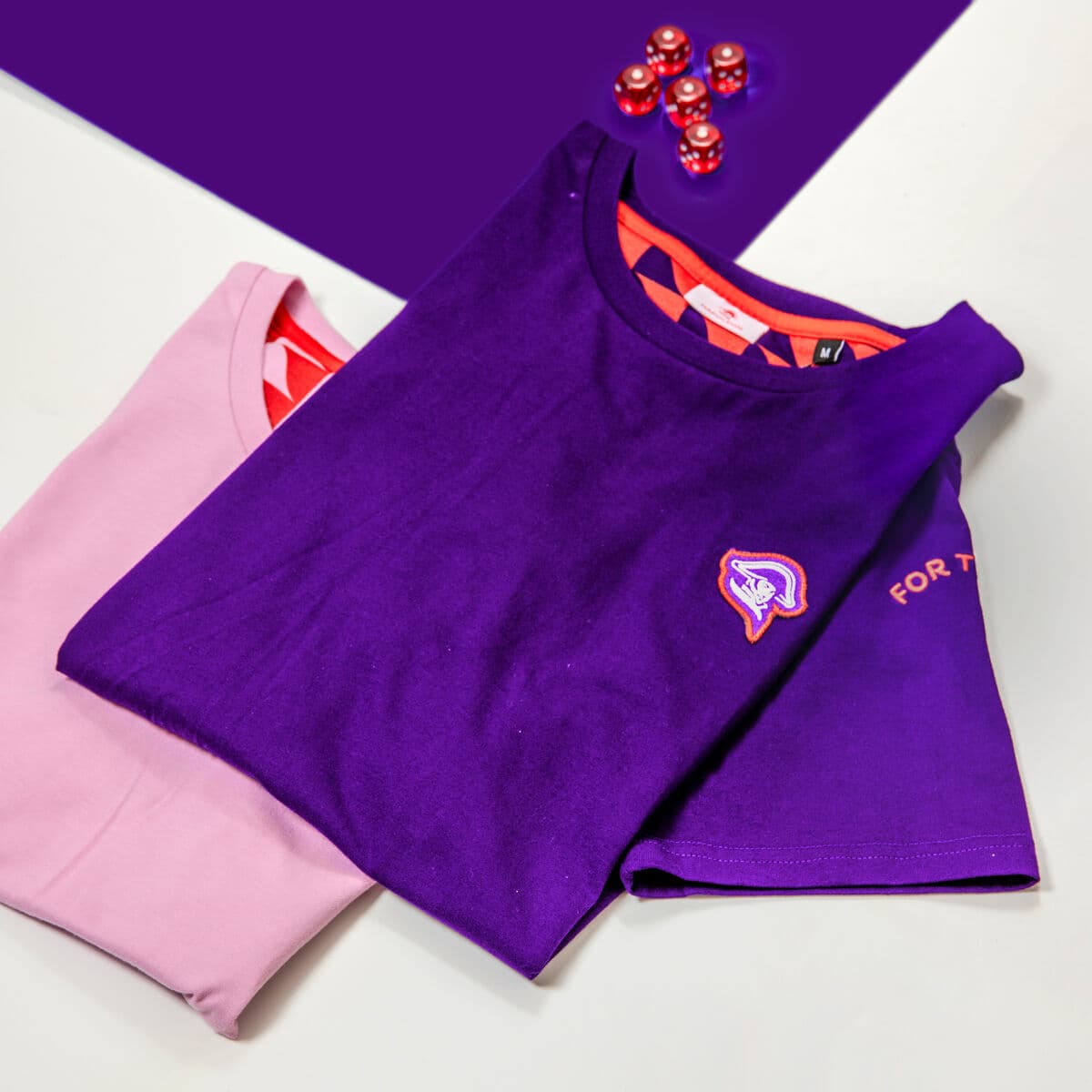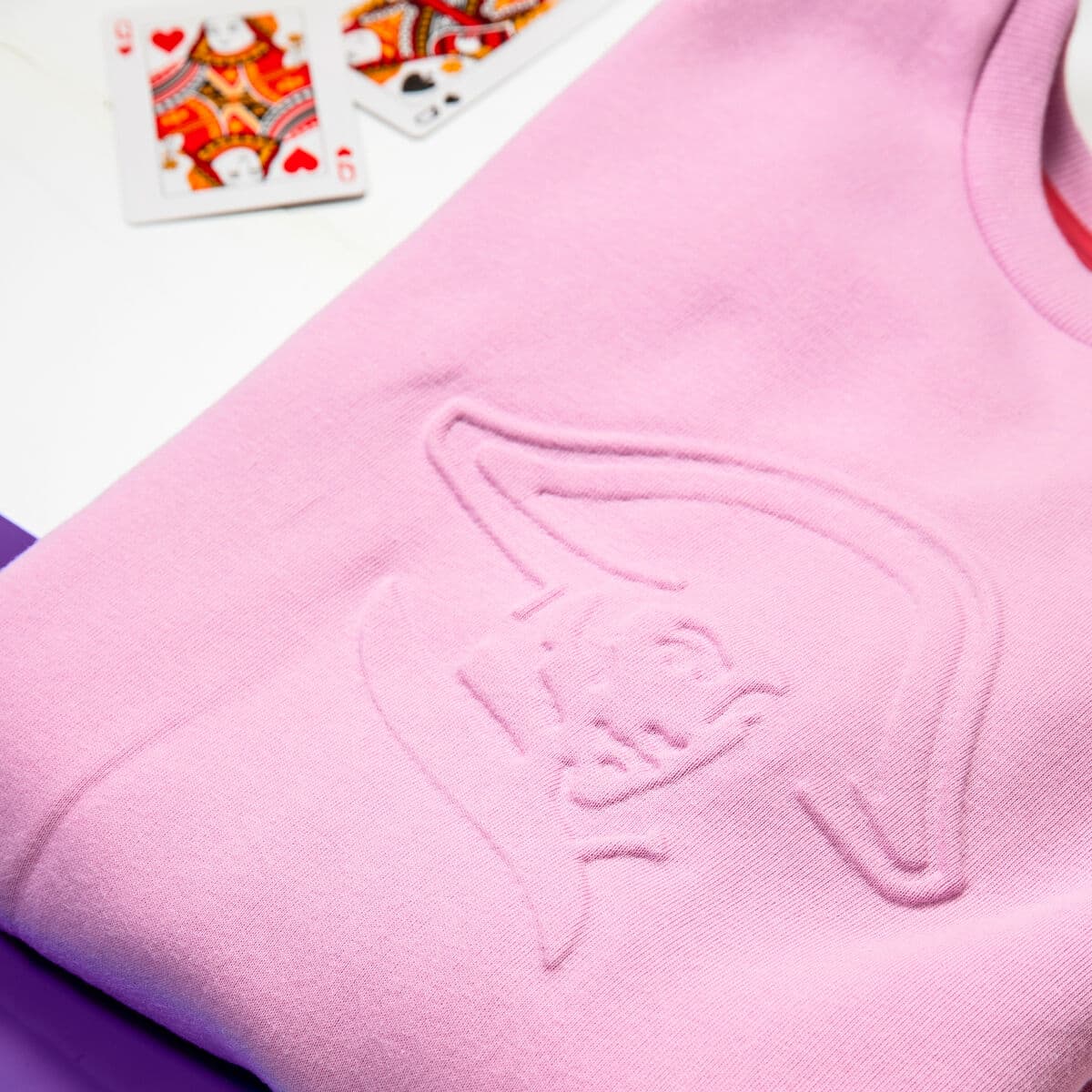

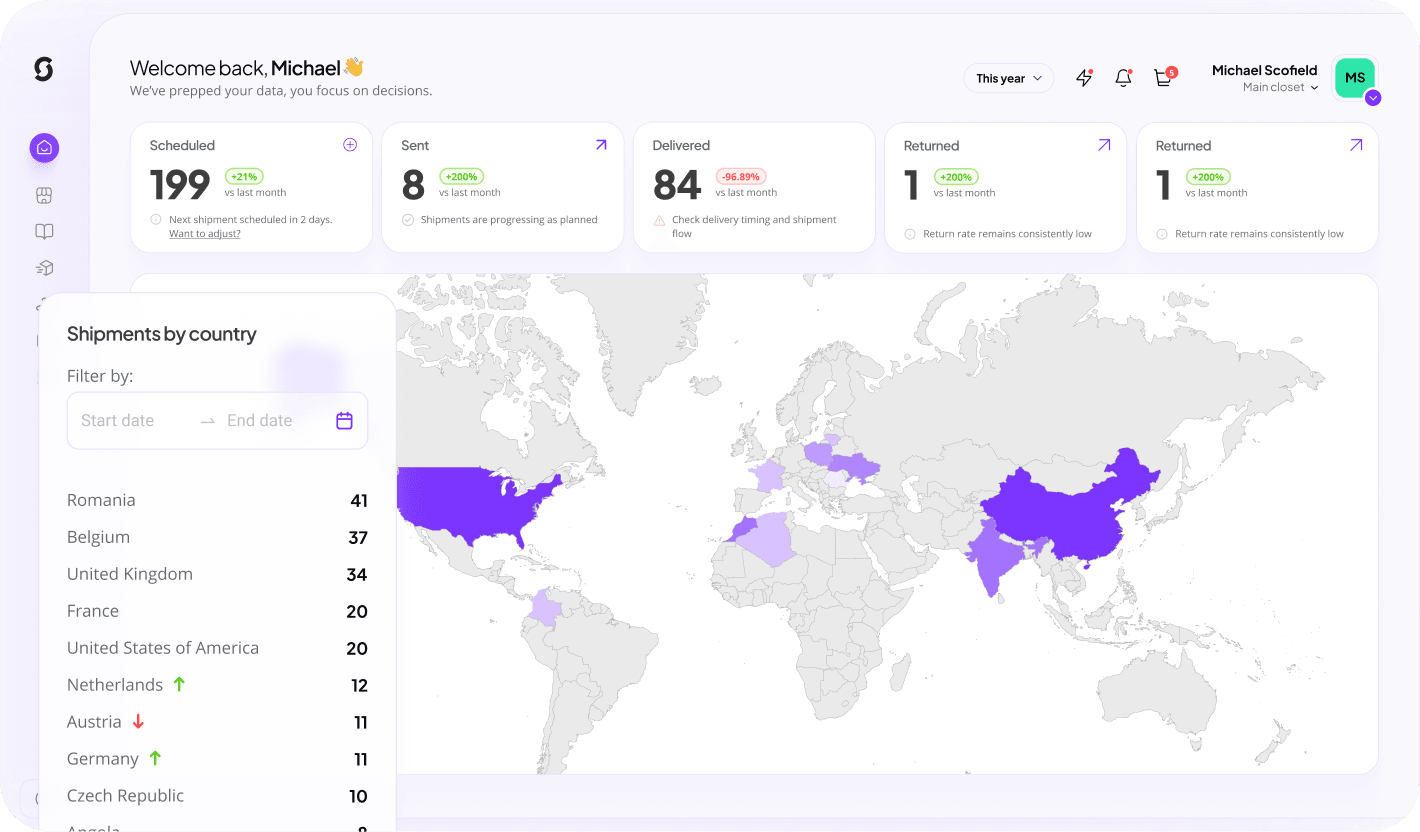



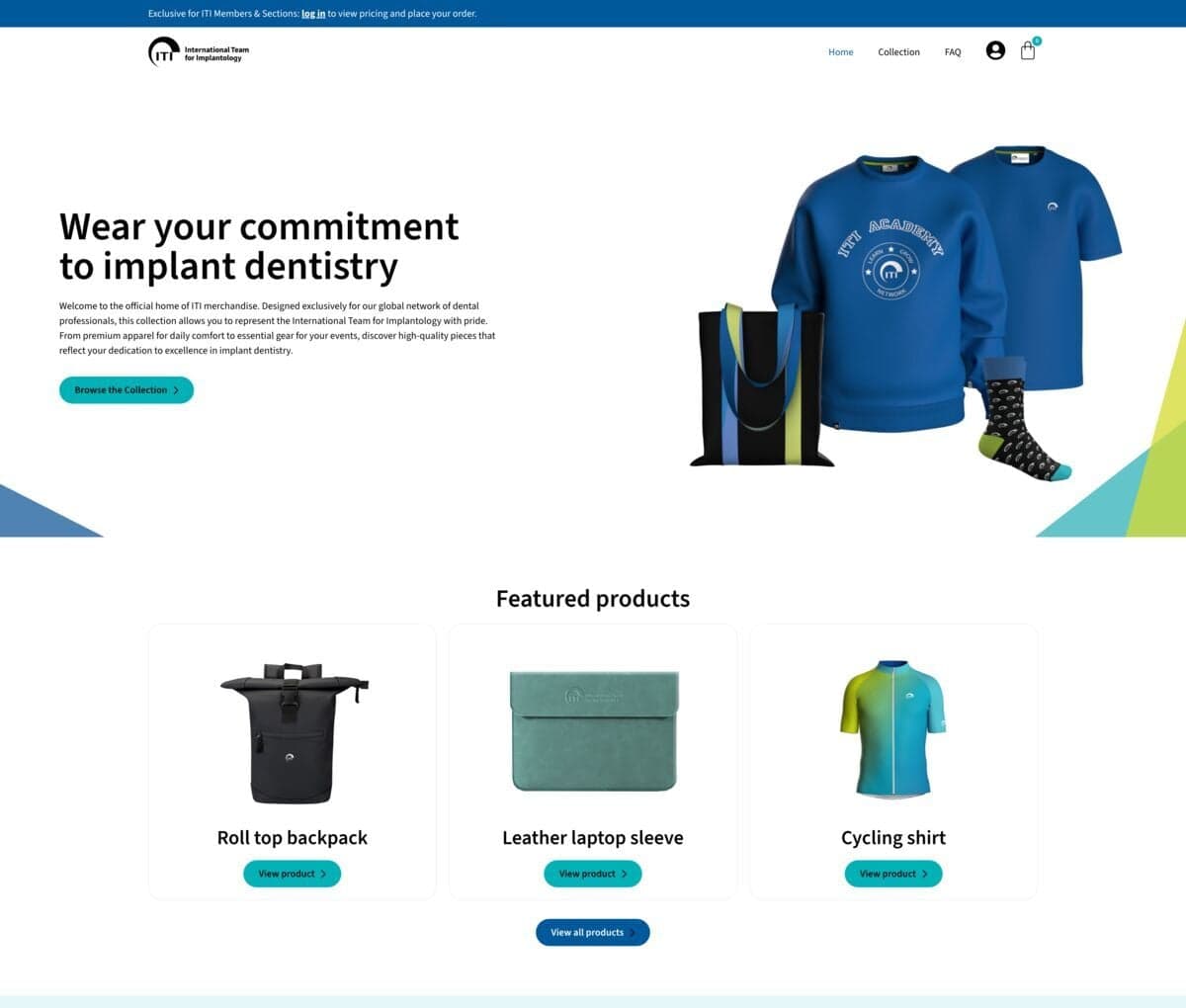
A company swag store, also called a company store or custom company store, is a branded online swag store where a defined audience of employees, partners, customers or managers browses, redeems or buys company merchandise. It is the front end of a merchandise programme. Behind it sit inventory, permissions, funding rules, fulfilment, shipping, customs, reporting and integrations, which is what makes it infrastructure rather than a webshop.
In one line: a swag store is the B2C front end for B2B merchandise. It should feel like shopping. It has to run like operations. Get that order right and everything below follows.
What's in this guide
- What a company swag store is
- Company store vs swag store
- Store vs swag management platform
- The 10 principles
- Who actually needs one
- The minimum viable store
- What sells best in a company swag store
- When not to use a store
- The audience experience
- Funding models
- Warehouse stock vs print on demand
- Inventory as a campaign asset
- Launching in three to four weeks
- Who owns the store
- Automation and integrations
- Global operations
- Measure the campaign, not the store
- The eight ways swag stores fail
- One partner or five vendors
- Frequently asked questions
What a company swag store is
A company swag store is a branded online store built for a specific audience. Employees log in and redeem an allowance. Partners order enablement kits. Customers buy from a public collection. Managers place department orders against a purchase order. The interface looks like retail because the people using it shop like consumers, and they judge it against every other store they use.
What sits behind that interface is the part buyers underestimate. Every order has to reach a warehouse, become a shipment, clear customs, generate tracking and land in a report. Every user has to see the right products at the right prices with the right payment method. That is why a corporate swag store is best understood as infrastructure for a merchandise programme, not a one-off web project that gets signed off and forgotten.
Company store vs swag store: are they the same thing?
Mostly, yes. "Company store", "custom company store", "corporate swag store" and "swag store" all describe the same thing: a branded storefront for company merchandise. "Company store" is the older retail term and is often used for stores that sell to the public or to employees at a discount. "Swag store" is the newer term and usually means a store where most items are company-funded or redeemed with credits.
The labels matter less than the audience. A store for employees, a store for customers and a store for managers ordering on a purchase order are three different products, even when they share one warehouse. The rest of this guide uses "company swag store" for all of them. For the staff-only version, see the employee swag store guide.
Store vs swag management platform
These two terms get used interchangeably and they should not be. They describe different products for different people, and collapsing them is the fastest way to buy the wrong thing.
| Company swag store | Swag management platform | |
|---|---|---|
| Who uses it | Employees, partners, customers, managers, fans | The internal merch team, plus marketing, HR and ops |
| What they do | Browse, redeem, buy, order | Manage inventory, users, campaigns, stock and workflows |
| Success looks like | An experience people come back to | Control, visibility and less administration |
| Design language | Retail. Photography, navigation, checkout | Operational. Tables, rules, dashboards, exports |
| Where to read more | This guide | Best swag platform |
The store is the audience experience. The platform is the operational control layer that makes the store possible. Most companies need both, but they buy them for different reasons and judge them by different measures. If you are still deciding which format your programme needs at all, start with company swag boxes vs swag stores, then come back here for the storefront.
The 10 principles
Everything in this guide comes back to ten principles. They are the spine of every store Sunday builds.
- Build for merchandise complexity, not company size. Headcount is a weak signal. Complexity is the real one.
- Give before you sell. An employee store must feel like a benefit, never a revenue stream.
- Curate. A small assortment with rotating collections beats an endless catalogue.
- Prefer small-batch warehouse stock over print on demand for established B2B programmes.
- Treat stock as a campaign asset. Slow movers are usually inventory waiting for a better campaign.
- Automate fulfilment, shipment creation and status updates. Nobody should copy orders by hand.
- Let the audience decide the rules. Governance, access and payment follow who is shopping.
- Prepare global operations before launch, not after the first customs problem.
- Keep it alive. Drops, scarcity and a reason to return.
- Measure the campaign outcome, not the store in isolation.
Who actually needs a company swag store
The tipping point is complexity, not headcount. A 200-person company running merch across four countries with three audiences and two budgets needs a store more than a 2,000-person company that ships one hoodie once a year.
As a rule of thumb, a store starts paying for itself around 500 active merchandise users. For distributed or remote-first organisations the number drops to roughly 250, because there is no office to absorb the logistics and every order becomes an individual shipment. Above ten to twenty thousand people, centralisation is the only credible alternative to chaos.
Headcount is the shortcut. These are the real signals that a programme has outgrown spreadsheets:
- Merchandise requests arrive by email, chat and shared spreadsheets.
- The same data gets re-entered by different people and nobody trusts the numbers.
- Different audiences need different products or different prices.
- Shipping is individual or multi-country rather than one pallet to one office.
- Budgets, approvals and access rights vary by role, department or region.
- Merchandise is continuous rather than a once or twice a year event.
Three or more of those and the question is no longer whether to build a store. It is which model to build.
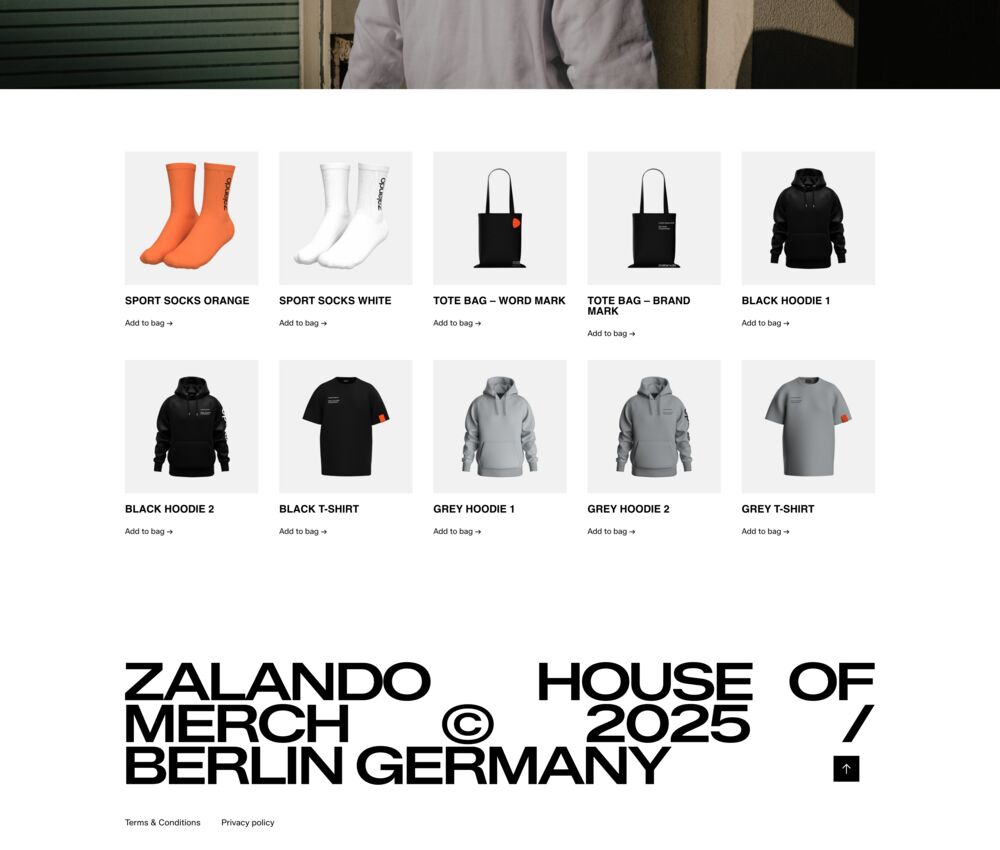
Zalando House of Merch runs a brand-approved, SSO-gated collection with purchase-order controls and volume-based dynamic pricing for team orders. Enterprise complexity, retail experience.
The minimum viable store
Technically you can launch with one product. Practically, a store needs enough range to feel like a store. The floors that work:
| Store type | Assortment | Why |
|---|---|---|
| Absolute minimum | 5 to 6 SKUs | Below this it reads as a landing page, not a shop |
| Broad ongoing programme | 15 to 20 SKUs | Enough for apparel, accessories and a gifting layer |
| Focused collection | 6, 9 or 12 SKUs | A clean grid, easy to shoot, easy to rotate |
Curation is the principle underneath the numbers. Less choice creates more usage. A 60-product catalogue does not double engagement, it doubles hesitation, and it quietly triples your stock risk. Pick fewer products, make them good, and change them on a schedule.
Alongside the assortment, a minimum viable store needs a clear audience and purpose, strong retail-quality product photography, simple access (SSO for enterprise), a funding model people understand, reliable stock and fulfilment, basic reporting, and one named owner with a plan for the next collection. Miss the last one and the store is already dying on launch day. The swag inventory management guide covers how to size the first order without over-committing.
What sells best in a company swag store
Wearable basics people use every week. Across Sunday's 4,000+ brands, sports socks are the most-ordered product, followed by T-shirts and hoodies. They anchor most stores because everyone has a size, they work for every audience, and they get worn.
Design decides whether they get used. In a 258-person study of the NMBS merchandise programme run with Sapience and the VUB, branded bags were worn more than twice by 69% of recipients and sweaters by 67%, while 31% of plain socks were never worn. The same study measured engagement up 19%, satisfaction up 21% and ambassadorship up 26% among employees who received merchandise.
Building the range is rarely the bottleneck. Sunday's catalog holds 490+ products and 2,700+ ready design templates, and 70% of Sunday orders go through automatic design templates with no designer and no proof cycle. The minimum is 10 pieces per item, which keeps small-batch stock realistic for a 6 to 12 SKU collection.
When not to use a store
A store is the wrong interface when the recipient is not genuinely shopping. If someone receives one fixed gift and only supplies an address and a size, a swag box or a redeem page is faster and converts better. The full decision, with the Bitpanda Invite-only Store as a governed gifting example, is in company swag boxes vs swag stores, and the gifting side is covered in the corporate gifts guide.
The audience experience
An employee swag store fails fastest when people feel their employer is making money from them. That single perception kills adoption before the assortment ever gets a fair hearing. The fix is a rule, not a discount: give before you sell. Everyone gets an item, a credit or a coin balance so the first experience is receiving value. Paid extras come afterwards, and they land differently once the store has already given something.
Fastned's employee store shows the mechanic in its simplest form. Employees sign in with SSO, coins are allocated automatically on first login, and the client can top up balances whenever there is a reason to. Nobody arrives at an empty basket and a price list.
Beyond that, people need six things from the experience, and all six are ordinary retail expectations:
- Fast, familiar navigation and retail-quality photography.
- Low-friction login and checkout, with no pointless account creation.
- Transparent balances, prices, shipping costs and order status.
- Relevant products rather than an oversized catalogue.
- Permissions that quietly tailor what each person sees.
- A reason to return, which usually means a new collection.
New hires and existing employees want different things. New hires need something deterministic: a welcome kit or a small essential selection, not an open-ended shopping trip on day one. Existing employees need the opposite: an ongoing store, rotating collections, and credits attached to anniversaries and recognition. Both are covered in depth in the employee swag store guide, and the onboarding side connects to new hire welcome kits.
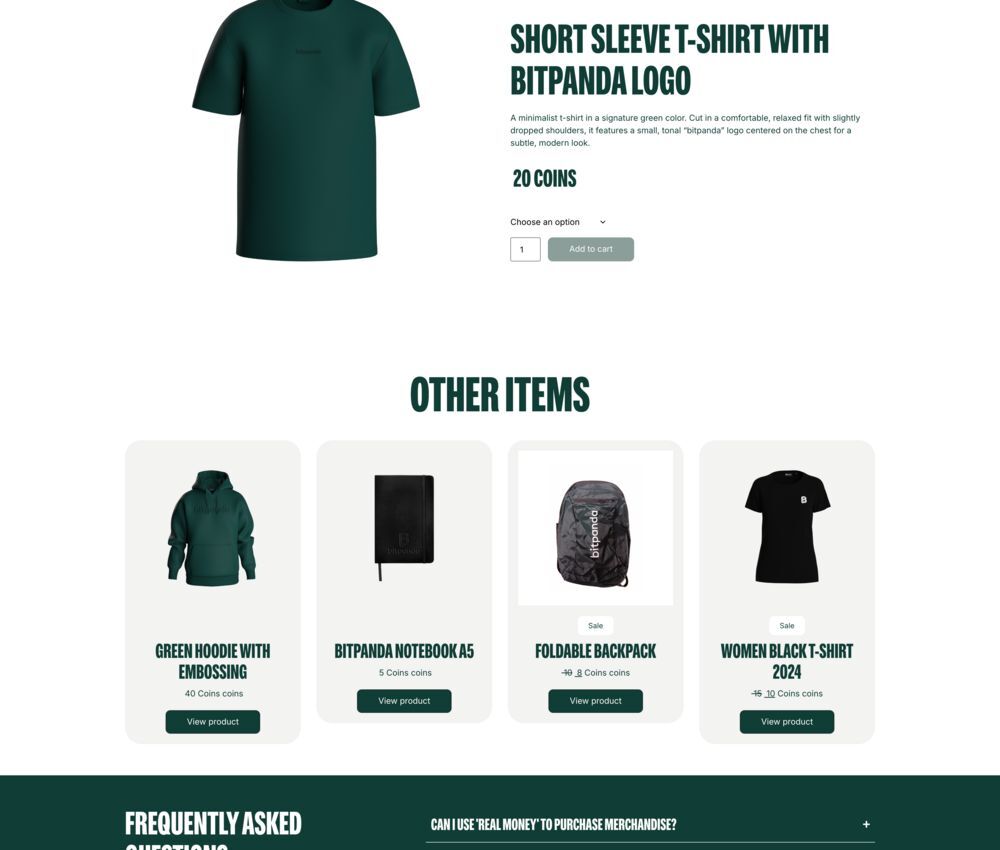
Bitpanda Boutique runs on SSO with credits allocated through the Workday API, and tags new products automatically so returning employees can see what changed.
Funding models
How the store is paid for shapes how it feels. There are six workable models, and most mature programmes combine two or three.
| Model | Best fit | Design caution |
|---|---|---|
| Company-funded | Essential gear, onboarding, uniforms | Set eligibility and limits before launch, not after |
| Coins or credits | Rewards and recognition | Explain what a coin is worth and seed balances at launch |
| Employee-paid | Optional extras after a funded baseline | Never launch a store as pure profit |
| Real payments | Internal or public e-commerce | Currency, tax and refund handling are day-one decisions |
| Invoice or purchase order | Managers, departments, enterprise | Validate role and references at checkout |
| Hybrid, role-based | Mixed audiences in one store | The right method should appear automatically, not be chosen |
Real implementations tend to be hybrids. ITI's store selects Stripe or invoice dynamically depending on the user's role, so the same storefront serves individual members and institutional buyers without either group seeing the other's checkout. BVNK runs genuine payments in multiple currencies. Thule combines SSO with a coin balance for managers ordering for their teams. The full decision guide is in swag store funding models.
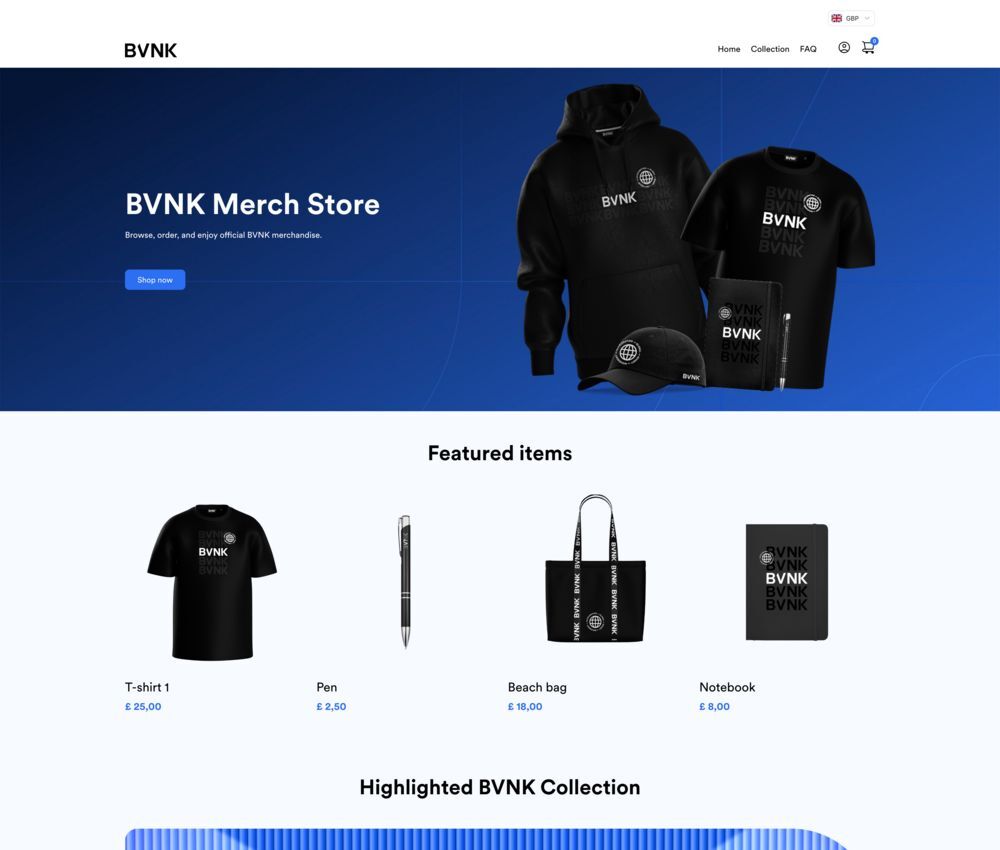
BVNK runs internal e-commerce with real payments across multiple currencies. Multi-currency is a capability to deploy, not a blocker to design around.
Warehouse stock vs print on demand
For an established B2B merchandise programme, small-batch warehouse stock almost always wins. Orders dispatch in roughly 24 hours. Products, finishing and photography are better, because you are producing a real collection rather than decorating a blank. Every recipient gets the same item, which matters when the item represents your brand.
Print on demand has real strengths, and pretending otherwise is not useful. It removes inventory risk and it suits three cases well: very small companies testing whether demand exists at all, artists and creator communities selling merch for profit, and genuine long-tail items you cannot forecast. What it costs you is lead time, typically five to six weeks to the recipient, plus a quality ceiling that tends to make merchandise feel promotional rather than premium.
The return on a company swag store is rarely merch margin. It is brand value, engagement and incentive impact. That reframes the stock question: start with a modest opening order, replenish what sells, and spend the saved risk budget on quality. The full comparison is in print on demand vs warehouse stock.
Inventory as a campaign asset
Good stores run a controlled loop. Curate small, open with modest stock, track demand, replenish winners, and give slow movers a new job instead of a discount. A jacket that under-performs with employees can become a customer activation gift, an event giveaway, a partner enablement item, a referral reward or part of a bundle. Dead stock is usually inventory waiting for a better campaign.
Quarterly collections plus an annual sell-off keep the loop clean. And a controlled stock-out is not automatically a failure. Handled deliberately, with core essentials still available, scarcity is proof of demand and gives the next drop a reason to exist. More on the operating rhythm in swag inventory management.
Launching in three to four weeks
A store build runs parallel to merchandise production and takes roughly three to four weeks. The target is simple: the store is ready when the goods hit the warehouse. Sunday designs the store in around 95% of implementations, with the client guided by customer success, an account manager and an e-commerce developer.
The seven steps:
- Onboard the programme and agree the audience, objective and scope.
- Decide the experience: funding, access, permissions, shipping.
- Design the homepage in Figma on Sunday's storefront framework.
- Collect feedback and get approval on the design.
- Build and configure the store, products, rules and integrations.
- Test the full journey: login, balance, visibility, checkout, warehouse order, tracking and the edge cases.
- Seed value, communicate internally, and release the first collection.
The decisions to sign off before build starts are audience and access, cybersecurity and SSO, product and page permissions, funding method, shipping charges and destinations, returns and refunds, content ownership, and reporting and integrations. Step by step detail is in how to launch a swag store.
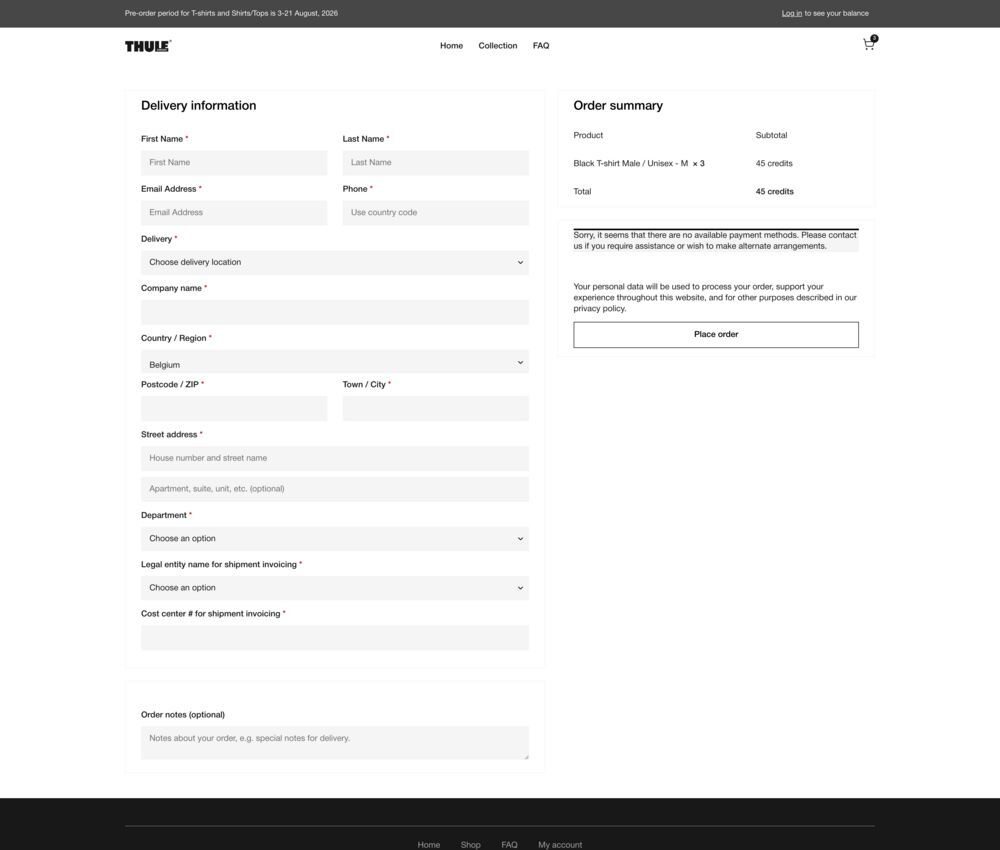
Test the whole journey before launch, checkout included. Thule's managers order through SSO with a coin balance, custom order emails and client-editable store content.
Who owns the store
There is no universal owner. Marketing, HR and office or workplace teams all lead successful programmes. What matters is that one person owns the objective and the audience experience, and that the supporting decisions sit with the people qualified to make them.
| Decision | Usually owned by |
|---|---|
| Objective and audience | Marketing, HR, workplace or partnerships |
| Brand and collection approval | Brand team |
| Budget controls | Finance and procurement, with the owner |
| Eligibility and credits | HR |
| Store operations and fulfilment | Sunday |
| Security, SSO and integrations | IT, with Sunday |
| Performance review | The owner, with Sunday customer success |
Procurement genuinely influences ordering rules, contracts and purchase-order handling, and that influence is useful. It should rarely own the audience experience, because procurement optimises for cost control and a store lives or dies on whether people want to use it.
Automation and integrations
Some things should never be manual once a store is live. Transferring orders from store to warehouse. Creating shipments and labels. Syncing stock and order status. Sending tracking and status communications. Applying role, price and visibility rules. Recording redemptions, balances and transactions. Every one of those done by hand is a queue waiting to break.
Some things should stay human. Collection curation. Campaign concept. Exceptional approvals. Deciding which moments deserve recognition. Automation follows scale and operating preference, and Sunday does not impose it for its own sake.
The integrations that matter are identity and SSO (used by Fastned, Thule, ITI, Zalando and Bitpanda Boutique), HRIS for credits and lifecycle events (Bitpanda Boutique runs credits through the Workday API), CRM for customer and sales campaigns, rewards and recognition platforms feeding a balance, procurement and finance systems for purchase orders and approvals, and warehouse and courier systems for fulfilment and status. Where a suitable API exists, the integration is usually straightforward. Detail in swag store integrations.
Access rules decide what each person sees. ITI hides products and entire pages by role, and runs a custom SSO experience, so one storefront serves several audiences.
Global operations
Nothing inherently breaks at global scale. Every global rule simply has to be prepared. The four that decide whether a store works internationally:
Customs and duties. The company covers and organises them. An employee should never be asked to pay to collect company swag. DDP shipping, or an equivalent arrangement, is the mechanism. This is the single rule most self-assembled stores get wrong, and recipients remember it.
Currency and tax. Deployable capabilities, not blockers. BVNK is the proof that multi-currency payments in an internal store are a configuration question.
Warehousing. One location is simpler and usually right. Multiple locations need routing, ownership and replenishment rules. A solid operating partner beats adding warehouses without a model behind them.
Returns. This is a policy decision before it is a technology decision. A €25 T-shirt can cost €50 to return internationally. Reasonable policies include keep-and-replace, local donation, a size exchange without a return, or a standard return for higher-value items. Technology should enforce the policy you chose. It should not choose the economics for you. Full detail in the global swag store guide.
Measure the campaign, not the store
Operational signals are worth tracking: orders, active users, repeat orders, coins used, stock turnover, fulfilment performance and dead stock. They tell you whether the machine is running. They do not tell you whether it was worth building.
Connect the numbers to the reason the store exists. For employees, that means engagement, retention, ambassadorship and culture, evidenced by adoption, redemptions, repeat use, MerchMetrics and direct feedback. For customers, loyalty, retention and expansion. For partners, enablement and partner-generated revenue. For managers and departments, efficiency: self-service rate, purchase-order accuracy, approval time and support volume.
Two illustrations of what good evidence looks like, and what it does not. ITI's store is built for an expected 35,000 to 40,000 users a year, which is a capacity and design target rather than a reported result. Interstellar's store, which runs a coin model without SSO today, is qualitatively praised internally for its look and feel, which is real feedback but not a metric. Zalando's merchandise operation reports monthly admin falling from around 40 hours to 40 minutes, roughly 15% lower cost and lead times down to five days. Different kinds of proof, and it is worth being precise about which is which. More in swag store metrics.
The eight ways swag stores fail
- A paid employee store that gives nothing first.
- Treating launch as completion. A static store is an abandoned store.
- Too many SKUs, so nobody chooses anything.
- Low-quality print on demand that makes the brand feel cheap.
- Manual fulfilment and manual tracking.
- No owner and no objective.
- Global policy left unprepared until the first customs bill.
- Measuring only commerce vanity metrics.
Every one of these is a decision, not an accident. Which is good news, because decisions can be made differently.
One partner or five vendors
You can assemble a merch agency, an e-commerce agency, a warehouse and a courier, or work with one partner that owns the whole journey from product idea to delivery. Specialists genuinely win for unusual public retail builds, mature in-house commerce teams and small print-on-demand tests; for an ongoing, multi-country programme the assembled model tends to cost more in coordination than it saves. The full comparison, with twelve questions to ask any supplier, is in best swag platform: one accountable partner or assembled vendors.
See how Sunday runs it on the platform, the catalog, how it works and distribution. For a wardrobe-style store, see the corporate clothing brand store.
Frequently asked questions
What is a company swag store?
A company swag store, or company store, is a branded online store where employees, partners or customers browse, redeem or buy company merchandise. It looks like retail and runs like operations: stock, permissions, funding rules, fulfilment, customs and reporting sit behind the storefront. Sunday runs stores like this for brands shipping to 200+ countries.
Is a company store the same as a swag store?
In practice, yes. Company store, custom company store and swag store all describe a branded storefront for company merchandise. Company store is the older term, often used for stores selling to the public or staff. Swag store usually means items are company-funded or redeemed with credits. The audience matters more than the label.
What items sell best in a swag store?
Wearable basics people use every week. Across Sunday's 4,000+ brands the most-ordered products are sports socks, then T-shirts and hoodies. Design still decides use: in a 258-person NMBS study, bags and sweaters were worn more than twice by 69% and 67% of recipients, while 31% of plain socks were never worn.
How long does it take to launch a company swag store?
Roughly three to four weeks. The store is built in parallel with merchandise production, so it is designed, configured and tested by the time goods reach the warehouse. Sunday designs the store in about 95% of implementations, and orders dispatch in around 24 hours once stock is in.
How many employees do you need before a swag store makes sense?
Complexity matters more than headcount. As a rule of thumb a store pays for itself around 500 active merchandise users, or about 250 for remote-first teams where every order ships individually. Multiple countries, audiences or budgets push you over the line sooner, even in a smaller company.
Who pays customs and duties on company swag?
The company, always. Recipients should never be asked to pay to collect company merchandise. Ship delivered duty paid (DDP) or an equivalent arrangement so duties become a planned programme cost. Sunday ships to 200+ countries and handles customs and duties, which also cuts refused parcels and support tickets.
About this article
Keep reading
- Global swag store: customs, duties, currencies and returns
- Employee swag store: give before you sell
- Best swag platform: one accountable partner or assembled vendors
- Company swag boxes vs swag stores: which format fits
- How to launch a swag store in 3 to 4 weeks
- Swag inventory management: the controlled loop
- Swag store integrations: SSO, HRIS, CRM, procurement and warehouse
- Swag store metrics: measure the campaign, not the store
- Swag store funding models: coins, credits, payments and PO
- Print on demand vs warehouse stock for a swag store
Your swag store, in your brand
Storefront, stock, funding rules, integrations, global DDP shipping and fulfilment, from one accountable partner. Create a free account and start building.
Build your swag store